
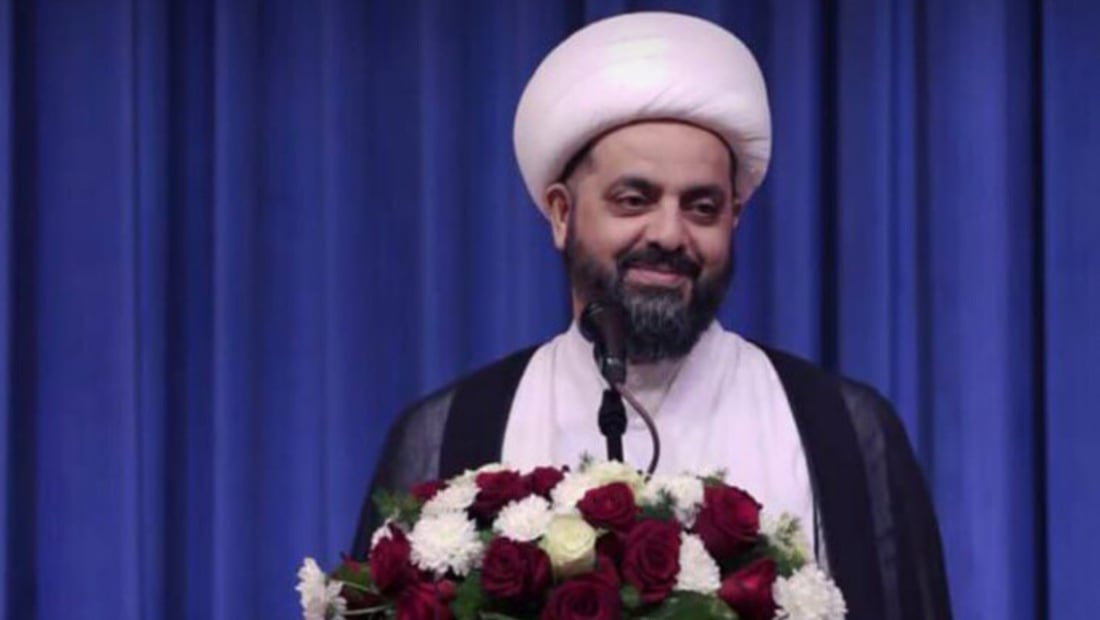
Asaib Ahl al-Haq leader Qais al-Khazali speaks at a ceremony celebrating his movement’s newly secured government positions in Baghdad on Oct. 18, 2026.
Weapons and economy are new government’s biggest tests, Khazali says
BAGHDAD — Bringing weapons outside state control under government authority and the country’s economic difficulties are the two biggest challenges facing Iraq’s new government, Asaib Ahl al-Haq leader Qais al-Khazali said Sunday, as his movement celebrated winning senior posts in Prime Minister Ali al-Zaidi’s cabinet.
Speaking at a ceremony honoring officials nominated by Sadiqoun, Asaib’s political wing, Khazali said the government faced hard economic conditions caused by regional developments as well as the weapons question, which had to be handled properly, putting national interests ahead of partisan and personal ones, as Iraq strengthens state institutions, including the Popular Mobilization Forces. He named Laith al-Khazali, his brother, appointed deputy prime minister for services on Thursday, and Mohammed al-Mousawi, the new labor and social affairs minister, as the movement’s key representatives in government. The United States designated Asaib a Foreign Terrorist Organization in 2020 and both Khazali brothers Specially Designated Global Terrorists.
Khazali rejected suggestions that Asaib had abandoned its principles by joining the government, calling such criticism a misunderstanding of how the movement had evolved. Its methods had changed with Iraq’s political circumstances but its goals had not, he said: it was a military resistance during the foreign occupation and later shifted to political resistance aimed at building an independent state and confronting corruption and instability.
On June 2, Asaib formed a central committee to oversee separating its armed formations from the PMF and placing their weapons under state control, documenting personnel, weapons, vehicles, equipment and other resources. Zaidi welcomed the decision as a step toward strengthening state authority and the rule of law. The government has not announced that Asaib’s handover is complete.
Zaidi has set June 30, 2027, as the deadline for bringing Iraqi armed factions’ weapons under state control and disarming non-Iraqi armed groups in the country. The timetable, which began on Oct. 1 after the U.S.-led coalition’s mission ended, sets a 90-day halt to attacks followed by a six-month handover, though the handover period has caused disagreements in the Coordination Framework, with some factions seeking two years. Sabah al-Numan, spokesperson for the commander-in-chief, said on Oct. 13 that most factions had responded positively.