
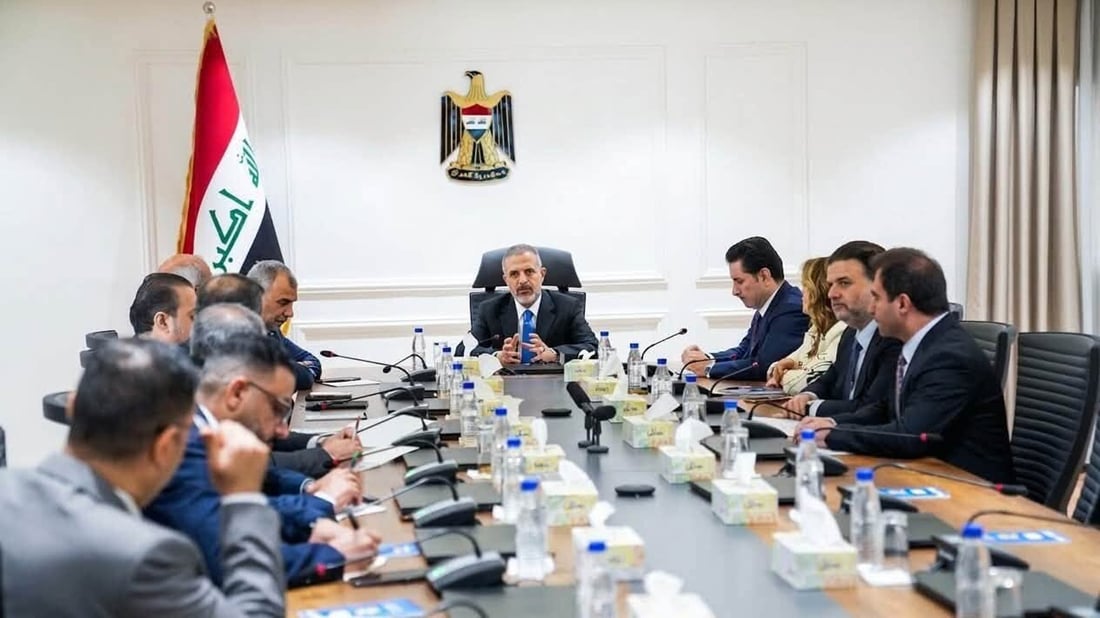
KDP bloc and federal ministers agree 2027 budget needs political consensus
BAGHDAD — The Kurdistan Democratic Party’s lawmakers and a federal ministerial committee have agreed that the draft 2027 budget needs political consensus to secure the rights of all Iraqis, the party’s parliamentary bloc said Saturday.
The talks covered the budget bill, the Kurdistan Region’s oil and guarantees for the Region’s salaries and financial dues, the bloc said in a statement to 964media. The statement gave no details of what, if anything, was agreed on the bill’s provisions, the Region’s share or oil deliveries.
Deputy Prime Minister Mohammed Ali Tamim, who heads the Ministerial Council for Economy, led the government side. Shakhawan Abdullah, who heads the KDP bloc and sits on the party’s central committee, led the lawmakers.
Prime Minister Ali al-Zaidi set up the committee after meeting the bloc, according to the statement. Chaired by Tamim, it includes the oil, finance and construction ministers and the Federal Board of Supreme Audit, and its task is to go through the budget bill’s provisions and the Region’s oil with the KDP lawmakers.
The ministers are Oil Minister Basim al-Abadi, Finance Minister Falih al-Sari and Construction and Housing Minister Rebaz Hamlan, the KDP’s nominee in the cabinet.
Zaidi told the bloc’s lawmakers on Tuesday that his government would guarantee salaries for Kurdistan Region employees on a par with state employees in other ministries and governorates, his office said.
On Thursday, Tamim chaired a special meeting of the Ministerial Council for Economy on the draft budget, attended by the finance, oil and construction and housing ministers, the head of the audit board and an adviser to the prime minister, the council said in a statement to 964media. The meeting hosted a delegation of KDP lawmakers to discuss the Kurdistan Region’s budget, the council said.
Erbil and Baghdad are at odds over the draft. The Kurdistan Regional Government wants the Region’s share of the budget based on 14.14% of Iraq’s population, the figure it takes from the 2024 census, and rejected a federal figure of 12.68% in September, according to KRG cabinet statements. On Oct. 28, the KRG cabinet asked the federal cabinet not to let the bill go to a vote in its current form.
Oil is the other dispute. Economist Nabil al-Marsoumi, citing the draft, has said it counts on the Region delivering 400,000 barrels of oil a day to the State Oil Marketing Organization, or Somo, the federal oil marketer. In a later post, he said the Region’s fields produce about 255,000 barrels a day, of which 80,000 go to local consumption and about 175,000 are exported through the pipeline to Turkey’s Ceyhan port.
Federal funds for the Region’s October salaries reached Erbil on Wednesday. The KRG’s Finance and Economy Ministry said 834.92 billion dinars (about $550 million at the official rate) had been deposited after Baghdad withheld 120 billion dinars as the federal treasury’s share of the Region’s October non-oil revenue. It said payments would begin Sunday.
The draft budget is due in parliament on Nov. 15, a month after its legal deadline, according to the chair of parliament’s Finance Committee, Uday Awad, who gave the date on Oct. 26.
Kurdistan Region salaries are paid from the federal budget in exchange for the KRG handing over oil and non-oil revenue. Iraq has had no budget this year. Spending has been governed by the one-twelfth rule, which caps monthly spending at one-twelfth of the previous year’s actual current spending, since the three-year law covering 2023 to 2025 expired.