
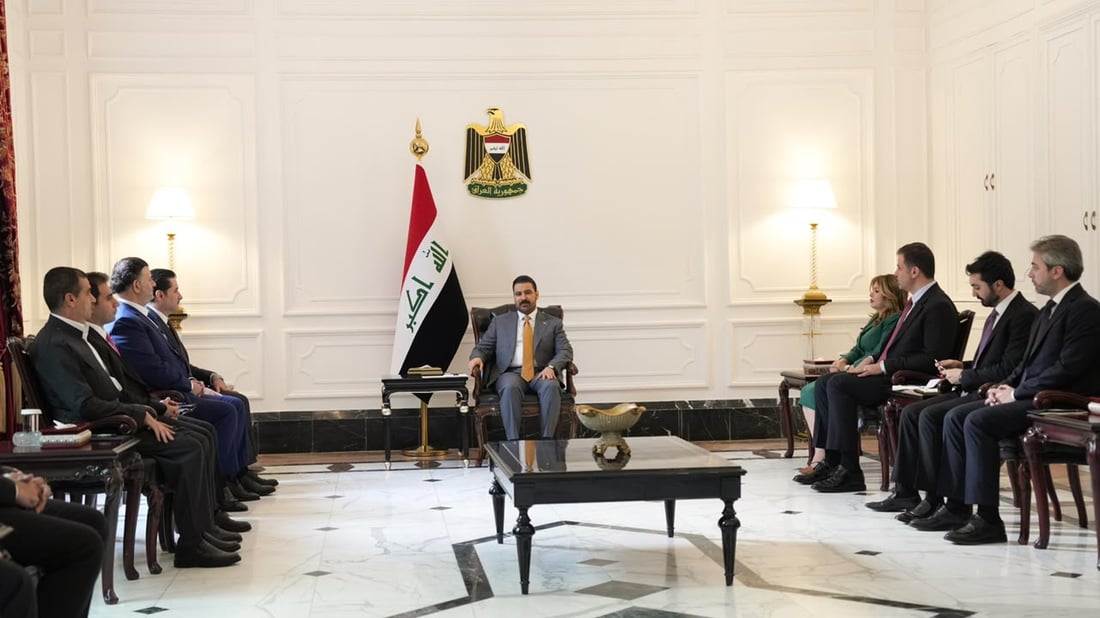
(Photo: the Prime Minister's Media Office)
Zaidi assures KDP lawmakers Kurdistan Region salaries are guaranteed
BAGHDAD — Prime Minister Ali al-Zaidi told the Kurdistan Democratic Party’s lawmakers on Tuesday that his government would guarantee salaries for Kurdistan Region employees on a par with state employees in other ministries and governorates, his office said.
Zaidi received the head and members of the KDP’s parliamentary bloc to discuss services, relations between the federal government and the Kurdistan Regional Government and the provisions of the draft 2027 federal budget, according to a statement from his media office.
The pledge comes as Erbil presses Baghdad to change the draft. The KRG cabinet on Wednesday, Oct. 28, asked the federal cabinet not to let the bill go to debate and a vote in its current form, and told its negotiating team to set out the provisions and tables it considers unconstitutional or inaccurate.
The KRG wants the Region’s share of the budget based on 14.14% of Iraq’s population, the figure it takes from the 2024 census, and rejected a federal figure of 12.68% in September, according to KRG cabinet statements. It has also asked that the salaries of the Region’s employees, Peshmerga, retirees and welfare recipients match those in the rest of Iraq.
The draft has been delayed and is due in parliament on Nov. 15, a month after its legal deadline, the chair of parliament’s Finance Committee, Uday Awad, said on Oct. 26.
Zaidi said his government had overcome many challenges in recent months despite complex economic and international conditions. He said it would keep fighting corruption, pursuing those involved and cutting off its sources, and would tackle the economy’s problems by developing non-oil revenue, with a plan to raise oil production.
He urged lawmakers to carry out their legislative and oversight role and help pass key laws, and said the government was working to give the Iraqi economy a clear identity based on a development vision.
Shakhawan Abdullah, who heads the KDP bloc, said the bloc supported the government’s efforts and reform policies and that the Region was committed to the constitution and the law to ensure social justice, according to the statement. He praised Zaidi’s stance on guaranteeing the Region’s rights on a par with other governorates.
Kurdistan Region salaries are paid from the federal budget in exchange for the KRG handing over oil and non-oil revenue. A 2025 arrangement required the KRG to deliver 230,000 barrels of oil a day to the State Oil Marketing Organization, or Somo, and 120 billion dinars (about $79 million at the official rate) a month in non-oil revenue. Federal and Kurdish lawmakers have clashed this year over salary transfers and whether Erbil meets those terms.
Exports through the Region’s pipeline to Turkey’s Ceyhan port resumed on Sept. 27, 2025, after a halt of about two and a half years, with sales handled by Somo. Oil flowed through the pipeline again in March after a standoff between Baghdad and Erbil, as the U.S.-Israeli war with Iran disrupted exports from the south.
Salary payments to the Region have been delayed repeatedly over the years, and this year funds for April salaries arrived in tranches in mid-May. Federal authorities have at times held back transfers, saying the KRG had not met its obligations, while Kurdish officials say salaries are a constitutional right that must not be tied to political or financial disputes.