
Most factions have responded positively to 2027 weapons deadline, Numan says
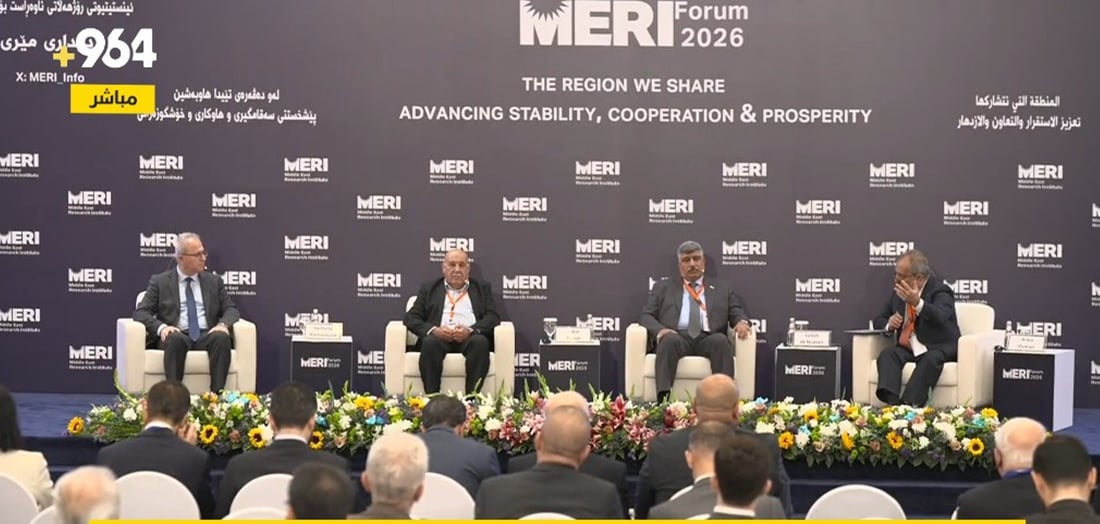
ERBIL — Iraq has set June 30, 2027, as the deadline for bringing armed factions’ weapons under state control, and most factions have responded positively, Sabah al-Numan, spokesperson for the commander-in-chief of the armed forces, said Tuesday at the Middle East Research Institute Forum.
Numan spoke on a panel titled “After the Coalition: Iraq, Kurdistan Region and the New Regional Balance,” alongside Jabar Yawar, former secretary-general of the Kurdistan Region’s Ministry of Peshmerga Affairs, and Sarhang Hamasaeed, a U.S.-based peacebuilding expert. It was moderated by Hiwa Osman, general director of 964media. “We have entered a new phase in Iraq, the post-coalition phase,” Osman said.
Prime Minister Ali al-Zaidi’s government has made restricting weapons to state institutions central to its program, Numan said, with decisions on war and military operations to rest “exclusively with constitutional institutions” and the commander-in-chief. The plan aims to bring armed groups into the state’s security framework while recognizing their role in the war against the Islamic State group. The end of the coalition’s mission on Sept. 30 had removed the factions’ main justification for keeping their weapons, he said, and several had since announced they were ready to suspend military activity and follow the commander-in-chief’s orders, with a noticeable change in their public statements. Kataib Hezbollah said on Sept. 30 that it was not bound by any timetable, and on Monday it praised the Houthi strike on Riyadh’s airport.
Pressed by Osman on how the government would prevent attacks on neighboring countries and the Kurdistan Region, and threats against Iraqi leaders, Numan said security forces had reorganized their areas of responsibility, redeployed personnel and formed new units, including a desert force covering Karbala, Najaf and Muthanna along the Saudi border. Iraq’s borders are now fully secured, he said. Drones that struck Saudi Arabia’s East-West pipeline on Sept. 11 were launched from Maysan, Iraqi authorities have said.
In polls on Qarar, 964media’s polling app, 44% of 666 respondents disagreed or strongly disagreed that Iraq had regained its sovereignty with the American withdrawal. About 60% agreed that disarming the factions was unrealistic, and about 20% disagreed.
Numan rejected the suggestion that Iraqi pilots need American authorization codes to fire weapons from F-16s. The Iraqi Air Force has carried out every airstrike against Islamic State targets since the start of 2026, he said, with coalition aircraft and surveillance previously helping to identify targets, and U.S. Central Command acknowledged Iraq’s surveillance, reconnaissance, targeting and strike capabilities in mid-2026. Iraqi personnel had also built up maintenance skills, he said, though cooperation with foreign partners would continue. “The coalition mission has ended, but our relationship with some coalition countries has not ended,” he said, adding that Iraq would reactivate and expand its bilateral agreements covering intelligence, counterterrorism, training and military support, now on terms of its own choosing. No country could fight terrorism that crosses borders on its own, he said.
Yawar said the coalition’s departure was not a conventional withdrawal. About 2,500 coalition personnel had been in Iraq in recent years, many as advisers or support staff, he said, compared with what he put at about 100,000 U.S.-led troops, with tanks, aircraft and helicopters, before the 2011 withdrawal. The coalition had a defined mission against the Islamic State group, and Iraq and the United States agreed in 2024 to end it in stages, he said; bilateral agreements could now carry defense cooperation forward.
The Peshmerga’s unification under the ministry follows two decades of effort dating back to a 2006 agreement between the late President Jalal Talabani and then-Kurdistan Region President Masoud Barzani, leaders of the Patriotic Union of Kurdistan and the Kurdistan Democratic Party, said Yawar, who worked on the process for years. Ceremonies on Sept. 21 marked the final stage of merging Peshmerga forces into two commands, with divisions and brigades under the ministry. The timing followed a September 2022 memorandum of understanding with coalition advisers from the United States, Germany, Britain and the Netherlands, which aimed to complete unification and reform by the end of September 2026.
Administrative unification was not the same as a common command and doctrine, Yawar said. The harder tasks were unified command and control across formations and replacing party loyalties with a national military doctrine, challenges he said applied to Iraq’s wider security forces as well. Asked whether the unified Peshmerga could respond to a threat without deferring to the parties, he pointed to 2014, when serving Peshmerga, retirees and volunteers mobilized against the Islamic State offensive despite having no unified command. The constitution makes the Kurdistan Region’s Peshmerga, police and Asayish responsible for security in the region, he said, and Baghdad should fund their salaries, equipment, weapons and training alongside federal forces and move from coordination to a more integrated relationship. The Peshmerga Ministry has asked Baghdad to pay its forces on a par with the federal army since coalition funding ended.
Effective security institutions required trust, political agreement and a shared national vision, Numan said, acknowledging that political disputes after 2003 had held back military capabilities and contributed to instability. Cooperation between federal and Kurdistan Region security institutions was now at a high level, he said, and Kurdistan Region representatives had attended a meeting at the commander-in-chief’s office before the coalition left to plan for border management and the post-coalition period.
Hamasaeed, speaking in a personal capacity, said a message from Shiite cleric Muqtada al-Sadr after the coalition’s departure suggesting a new chapter with the United States would likely be received positively in Washington, though he had no direct knowledge of the U.S. response. Opinion in Washington on Sadr had long been divided, he said: some still associated him with American deaths during the Mahdi Army’s clashes with U.S. forces in 2003 and 2004, while others saw his move into electoral politics, including the Sadrist movement’s 2021 election win before it withdrew from parliament the following year, as a turn away from armed confrontation. The message was aimed not only at Washington but at Iraq’s political forces, armed factions and public, he said, and could also be read against regional tensions involving Iran.
U.S. concerns went beyond weapons, according to Hamasaeed. Past sanctions had been tied to attacks on U.S. and coalition forces, Iraqi institutions and neighboring countries, and bringing armed groups into state institutions would not resolve those concerns if they continued to act for outside powers or outside effective state control. American pressure could continue in that case, he said, particularly if the conflict involving Iran intensified.
Zaidi’s timetable sets a 90-day halt to attacks from Sept. 30, followed by a gradual six-month handover. Sadr dissolved his Promised Day Brigade on Sept. 30 and called for all weapons to be placed under the state, after moving his larger Saraya al-Salam under the commander-in-chief in May. The coalition’s anti-ISIS task force is now headquartered in Jordan.