
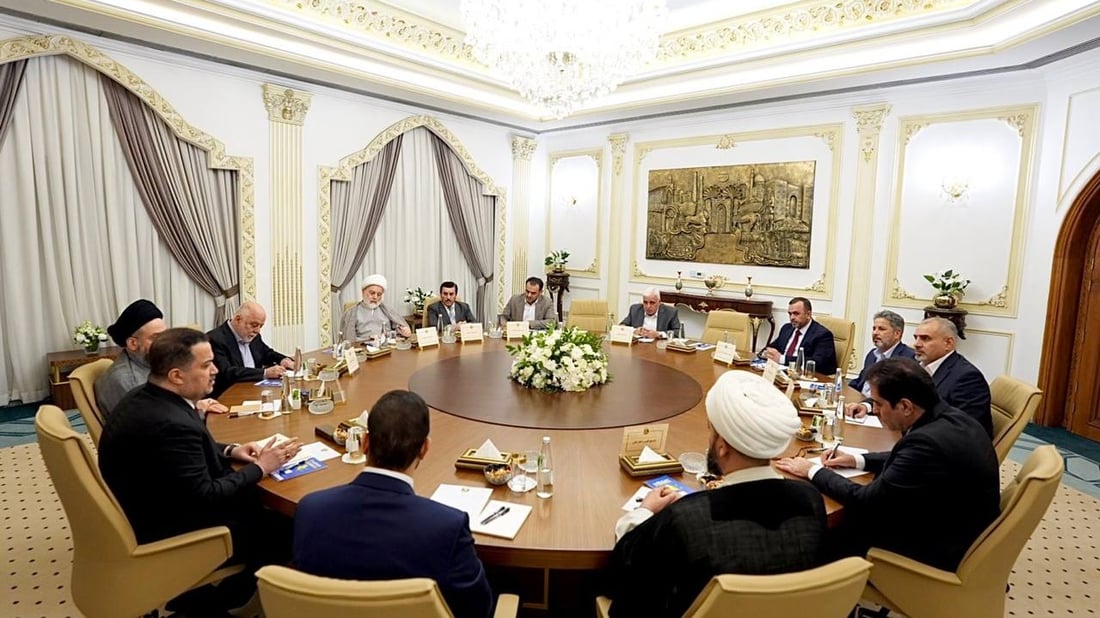
Leaders of Iraq’s Shiite Coordination Framework attend a meeting in Baghdad.
Internal divisions
Iraq’s ruling alliance puts off meetings over budget and weapons rows
BAGHDAD — The Coordination Framework, Iraq’s ruling alliance of Shiite parties, has put off its leadership meetings since Oct. 19 over disputes about the Kurdistan Region’s budget share, factions’ weapons and Iran border crossings, a source in the alliance told 964media Thursday.
According to the source, recent events have made the delay longer. The main ones are Prime Minister Ali al-Zaidi’s unannounced visit to Iran, Kataib Hezbollah’s escalating attacks on his government and leaked intelligence reports alleging oil smuggling from Jurf al-Sakhar, an area of northern Babil officially renamed Jurf al-Nasr in 2014.
The alliance needs time to discuss these issues, and its meetings are on hold until they are settled, the source said.
The Framework’s last meeting on record, its 300th, was held Oct. 19 at the office of former Prime Minister Mohammed Shia al-Sudani. There, it reaffirmed a June 30, 2027, weapons deadline for bringing weapons outside state control under government authority, and authorized Zaidi’s government to take whatever measures were needed to meet it.
Khalid Walid al-Marsoumi, a Framework figure from Sudani’s Reconstruction and Development Coalition, gave a different account in a report published Thursday by the newspaper Al-Mada. He denied that contact between the alliance’s leaders had stopped and said bilateral and expanded meetings were being held away from the media.
The moment called for practical steps more than media statements, Khalid Walid told the paper. The talks covered weapons, border crossings and airports, he said.
A Kurdistan Regional Government delegation visited Baghdad days ago to discuss the Region’s share of the budget but reached no result, and disputes over the Region’s financial dues remain, the source said.
Zaidi met Kurdistan Region Prime Minister Masrour Barzani in Baghdad on Monday for talks on the 2027 federal budget, oil and non-oil revenue, salaries and the oil and gas law. The KRG wants the Region’s share based on 14.14% of Iraq’s population, the figure it takes from the 2024 census, and has rejected a federal figure of 12.68%. No agreement on the share was announced.
Framework leaders also need to discuss Zaidi’s recent visit to Iran, the source said. Iraq’s ambassador in Tehran, Yasser al-Hajjaj, said Monday that Zaidi had made a private, unannounced visit to ease regional tensions. He did not say when Zaidi traveled or whom he met.
Zaidi’s timetable for the factions sets a 90-day halt to attacks from Sept. 30, followed by a six-month handover of their weapons to the state. Kataib Hezbollah, an Iran-aligned armed faction that the United States designated a terrorist organization in 2009, and Harakat al-Nujaba have refused to give up their weapons. Other factions have begun returning weapons kept in one another’s depots ahead of a handover, sources told 964media.
The source said Framework leaders also had to settle the government’s stance on Kataib Hezbollah’s escalation. In a Nov. 3 statement, the group’s security official, Abu Mujahid al-Assaf, said Iraq’s ruling alliances had approved the country’s part in a blockade of Iran. The statement also asked Framework leaders about what it called contracts to sell oil to the UAE’s state oil company, Adnoc, at a discount of $47 a barrel. Assaf gave no evidence for either claim.
The Kataib Hezbollah-linked Huqooq bloc took the Adnoc question to parliament on Thursday. Its lawmaker Hussein al-Darraji sent eight questions to Oil Minister Basim al-Abadi about any contracts, agreements or memorandums of understanding with Adnoc, signed or under negotiation, according to documents he published.
Darraji asked for the legal basis of any such deals and who had negotiated and approved them. He also asked whether they went through the usual procedures of the State Oil Marketing Organization, or Somo, or through direct contracts and exemptions. His other questions covered whether Adnoc had received price discounts, whether the deals had been audited, and the volumes, value and payments involved.
On Wednesday, fellow Huqooq lawmaker Miqdad al-Khafaji sent a parliamentary question to the prime minister. He asked for the constitutional and legal basis for exporting Iraqi crude through Syria’s Banias port and Jordan’s Aqaba, and for guarantees that the oil would not reach Israel.
The leaked report alleges that oil is drawn from a pipeline in Jurf al-Sakhar, widely regarded as a Kataib Hezbollah stronghold, and carried away by tanker truck. On Wednesday, Parliament Speaker Haibat al-Halbousi ordered a committee of lawmakers to investigate the report, along with intelligence on oil smuggled from the Kirkuk fields and the Kurdistan Region through Iran to Afghanistan. Zaidi, as commander-in-chief of the armed forces, ordered his own investigative committee the same day.
Babil Governor Ali Turki has rejected the allegations. He said the site named in the report is a fuel station that has been in official use for about four years. 964media could not verify the report or its images.
Border crossings with Iran are another source of friction. Iraq reopened the al-Sheib crossing in Maysan governorate on Tuesday, nearly three weeks after closing it, and said its Mandali crossing in Diyala governorate would close temporarily from Friday for maintenance. Foreign Minister Fuad Hussein said in an interview with Al Jazeera on Saturday that the United States had formally asked Iraq to close all but two of its crossings with Iran.
The Framework had been due to meet Monday at the office of Humam Hammoudi, head of the Islamic Supreme Council of Iraq, to discuss the budget, the Kurdistan Region delegation’s visit, security and attacks on oil fields, a source told 964media that day. The meeting was put off, possibly to Wednesday, the source said then. No meeting has been announced since.
The Framework has not set a date for its next leadership meeting.