
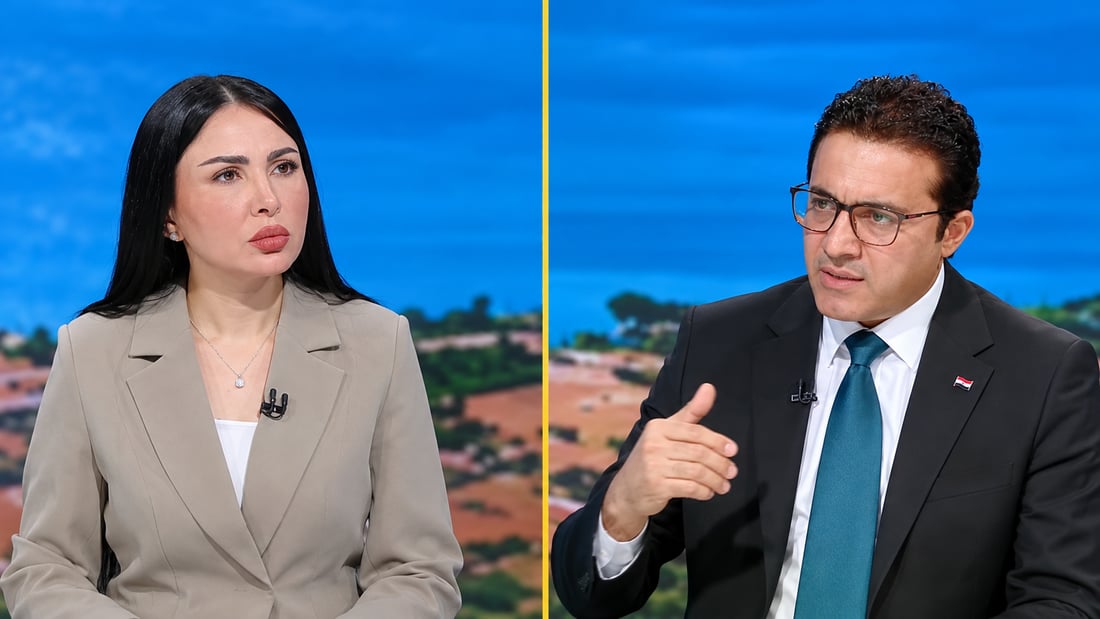
Iraqi government spokesperson Haider al-Aboudi (right) speaks during an interview with presenter Riam al-Faisal on Al-Rabiaa TV, Nov. 9, 2026. (Photo: Al-Rabiaa TV)
Media Monitor
Iraq warns factions outside armed forces after 35-rocket truck seized
BAGHDAD — Armed groups outside Iraq’s armed forces will face the law, government spokesperson Haider al-Aboudi said in a televised interview, pointing to the seizure of a truck carrying 35 rockets that he said had foiled an attack.
Security forces seized the shipment in an intelligence operation by the Intelligence Service and the army, Aboudi told presenter Riam al-Faisal on Al-Rabiaa TV. “Had the Intelligence Service, the intelligence agencies and the security forces not been ready, operations of this kind would not have been foiled,” he said.
“We ask: are the armed groups part of the armed forces or outside them? If they are part of the armed forces, it is natural that they take orders from the commander-in-chief, and if they are outside these formations, they will face what the law provides,” Aboudi said.
He did not say who was moving the rockets or what their target was. The newspaper Al-Mada reported Sunday that authorities had arrested three members of the Popular Mobilization Forces carrying 35 rockets in Latifiya, south of Baghdad. The PMF is the state-sanctioned umbrella of mostly Shiite armed groups formed in 2014 to fight the Islamic State group.
Latifiya lies near Jurf al-Sakhar, an area of northern Babil officially renamed Jurf al-Nasr in 2014, which the newspaper said is controlled by armed factions. Aboudi did not say whether the truck he described was the one in the paper’s report.
His remarks came as Kataib Hezbollah, an Iran-aligned armed faction that the United States designated a terrorist organization in 2009, steps up its accusations against Prime Minister Ali al-Zaidi and his government.
“The Iraqi government does not respond to statements. The government is holding a direct dialogue with the parties concerned, and they know who they are,” Aboudi said.
The government’s responsibility lay on the ground, not on social media, and it was fully responsible for keeping Iraq out of any conflict in the region, he said. He also said Baghdad had been chosen to carry Washington’s message to Tehran because it had regained the trust of the international community.
Aboudi said money recovered through Dawn Strike, the anti-corruption drive that began with raids in Baghdad’s Green Zone on June 28, had reached 2 trillion dinars (about $1.3 billion at the official rate), and that investigations pointed to 16 trillion more (about $11 billion). He gave no breakdown of either figure. “Dawn Strike will not stop, and all the money that is recovered will go to the Generations Fund,” he said, referring to a sovereign wealth fund meant to save part of Iraq’s oil revenue.
The dispute with Kataib Hezbollah escalated on Tuesday, Nov. 3, when the group’s security official, Abu Mujahid al-Assaf, said Iraq’s ruling alliances had approved the country’s part in a blockade of Iran. He gave no evidence for the claim. He also accused Zaidi and his office of tampering with the bill governing the PMF before it was sent to parliament.
On Saturday, Assaf urged the Federal Commission of Integrity, Iraq’s anti-corruption body, to investigate what he called Zaidi’s “financial empire,” which he put at 21 trillion dinars (about $14 billion at the official rate). He gave no evidence for the figure.
On Sunday, Saud al-Saadi, a lawmaker from the Kataib Hezbollah-linked Huqooq bloc, sent formal parliamentary questions to Zaidi and the head of the integrity commission, according to documents from his office. He asked whether reports that Zaidi’s wealth had reached 21 trillion dinars were true, what stakes Zaidi held in companies, projects and banks before and after taking office, and what had been done to prevent conflicts of interest in state contracts.
Also on Sunday, a Rusafa Investigation Court warrant for the arrest of Hussein al-Hamidawi, the son of Kataib Hezbollah’s secretary-general, became public. The warrant, dated July 5, accuses him under the Anti-Terrorism Law of heading an armed group that uses violence and threats to undermine Iraq’s security. No arrest has been announced.
Saadi said earlier this month that a committee of the Coordination Framework, the ruling alliance of Shiite parties, had agreed with the factions on regulating their weapons, but that Zaidi had not signed the deal for fear of U.S. pressure. The government has not published any agreement with the factions.
Zaidi has set a timetable for the factions’ weapons that runs to June 30, 2027: a 90-day suspension of attacks from Sept. 30, followed by a six-month handover to the state. Kataib Hezbollah said on Sept. 30 that it was not bound by any timetable, and Harakat al-Nujaba has also refused to hand over its weapons.
In August, the governing coalition said armed activity outside state authority after Sept. 30 could be treated under the Anti-Terrorism Law.