
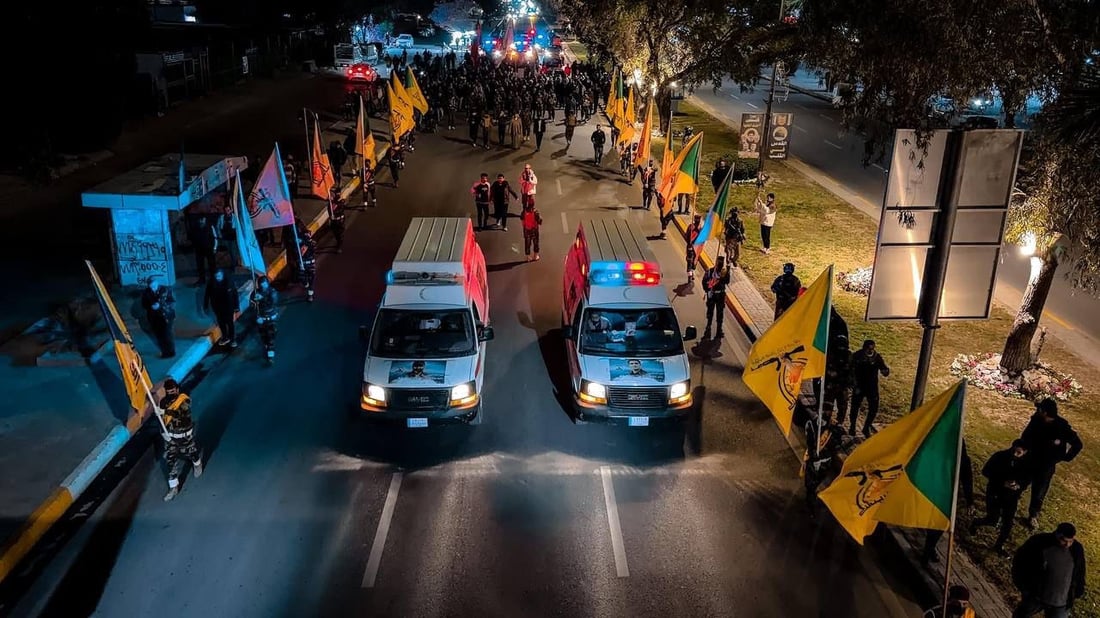
FILES: Supporters of Kataib Hezbollah carry flags and march during a funeral procession in Baghdad for two fighters killed in airstrikes on Jurf al-Sakher, Feb. 28, 2026.
Baghdad court seeks arrest of Kataib Hezbollah leader’s son under terrorism law
BAGHDAD — A Baghdad court has ordered the arrest of Hussein al-Hamidawi, the son of Kataib Hezbollah’s secretary-general, accusing him under the Anti-Terrorism Law of heading an armed group, according to a court documents.
The arrest and search warrant, issued by the Rusafa Investigation Court, accuses him of leading a group that uses violence and threats to undermine Iraq’s security and stability, spread fear among people, endanger their lives and seize private property. It names him in full as Hussein Ahmed Mohsen Faraj al-Hamidawi and orders police to bring him before the investigative judge for terrorism cases.
The document is dated July 5 but circulated Sunday. That was a day after Kataib Hezbollah’s security official called for an anti-corruption investigation into Prime Minister Ali al-Zaidi’s wealth. No arrest had been announced by Sunday.
The warrant cites Article 4, paragraph 1, of Anti-Terrorism Law No. 13 of 2005, read with paragraphs 1 and 3 of Article 2. Those paragraphs class two kinds of act as terrorism: violence or threats meant to spread fear among people, and organizing, heading or joining an armed terrorist gang. Article 4 sets the death penalty for them.
His father, Ahmed al-Hamidawi, known as Abu Hussein, leads Kataib Hezbollah, an Iran-aligned armed faction that the United States designated a terrorist organization in 2009. Washington placed the faction’s leader under terrorism sanctions in February 2020, and in April it offered up to $10 million for information on him.
The faction’s security official, Abu Mujahid al-Assaf, on Saturday urged the Federal Commission of Integrity, Iraq’s anti-corruption body, to open an urgent investigation into what he called Zaidi’s “financial empire.” He put its value at 21 trillion dinars (about $14 billion at the official rate). He asked where the money came from and whether it was tied to ration-card contracts, food supplies for the army and deals with foreign companies. He gave no evidence for the figure.
On Tuesday, Assaf said Iraq’s ruling alliances had approved the country’s part in a blockade of Iran, and he compared anyone who takes part to an early enemy of the Prophet Mohammed. He also accused Zaidi and his office of tampering with the bill governing the Popular Mobilization Forces before it was sent to parliament. Kataib Hezbollah had not joined the government, would not join it and had sought no post in it, he said.
Saud al-Saadi, head of the Kataib Hezbollah-linked Huqooq bloc in parliament, said earlier this month that a Coordination Framework committee had agreed with the armed factions on regulating their weapons. He said Zaidi had not signed the deal because he feared U.S. pressure. The Framework is the ruling alliance of Shiite parties.
“Who says there are understandings between the government and the factions? In fact, a committee from the Coordination Framework reached understandings with the factions and agreed on a number of issues and provisions,” Saadi said in an interview on Al-Rabiaa TV.
Mansour al-Buaiji, a lawmaker from former Prime Minister Mohammed Shia al-Sudani’s Reconstruction and Development Coalition, said last month that every armed faction had joined the government and agreed to hand its weapons to the state on a set timetable. He said even Kataib Hezbollah might take part. Kataib Hezbollah said on Sept. 30 that it was not bound by any timetable for handing over weapons.
In August, Iraq’s governing coalition said armed activity outside state authority after Sept. 30 would be treated under the Anti-Terrorism Law. Under the government’s plan, armed factions are to hand their weapons to the state by June 30, 2027.