
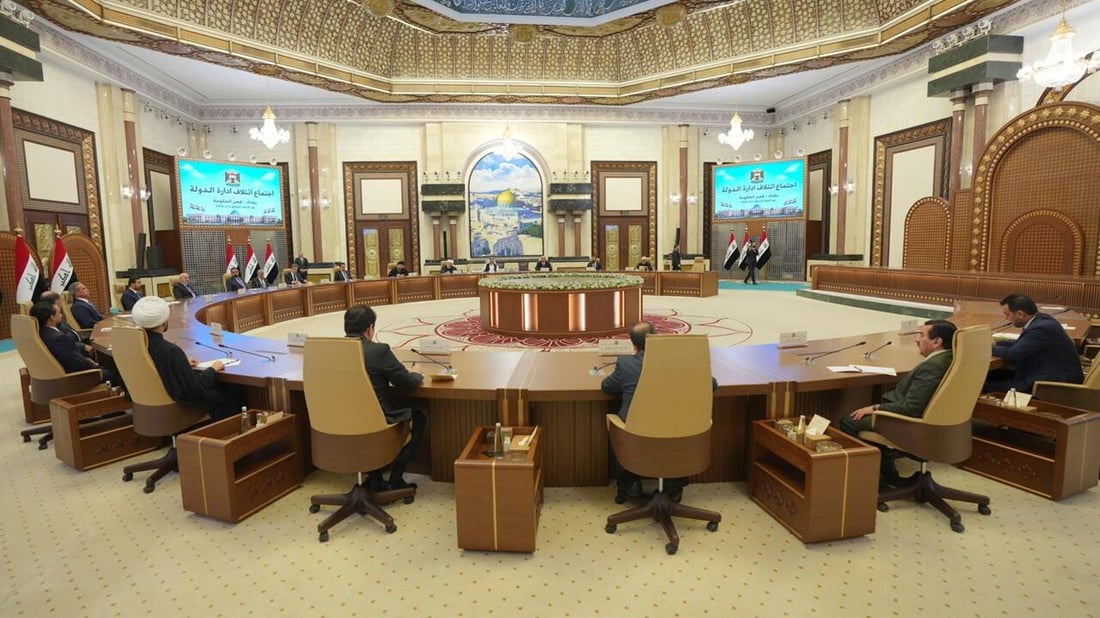
(Photo: the Prime Minister's Media Office)
Armed groups face terrorism law after September 30, governing coalition says
BAGHDAD — Iraq’s governing coalition said Wednesday that armed activity outside state authority after Sept. 30 will be treated under the Anti-Terrorism Law, turning the government’s disarmament deadline into a criminal threshold for the first time.
The State Administration Coalition announced the decision after a meeting attended by Prime Minister Ali al-Zaidi, President Nizar Amedi, Parliament Speaker Haibat al-Halbousi, Supreme Judicial Council President Faiq Zaidan, Kurdistan Region President Nechirvan Barzani and party leaders. Participants reaffirmed support for keeping all weapons under state authority, in line with the government program approved by parliament, according to a statement from the prime minister’s media office.
The coalition said Iraqi territory must not be used to launch attacks on neighboring countries or in ways that draw Iraq into conflicts against its interests. Anyone doing so commits “the crime of threatening the country’s security” and should be considered outside the law, it said, citing constitutional provisions that prohibit weapons outside state authority and the formation of armed groups outside the official forces.
The coalition is Iraq’s governing alliance, formed after the 2021 elections, and includes Shia Coordination Framework parties, Sunni blocs and Kurdish parties.
Its warning comes 55 days before the deadline and two days after Kataib Hezbollah said it would keep and expand its weapons rather than hand them over. Secretary-General Abu Hussein al-Hamidawi said the group must “hold firmly to the weapons of the resistance and not relinquish them, but rather to develop them and expand their arsenal.” Kataib Hezbollah, Harakat al-Nujaba and Kataib Sayyid al-Shuhada have refused to take part in the plan while U.S. forces remain in Iraq. Asaib Ahl al-Haq, Saraya al-Salam and the Imam Ali Battalions have moved to comply, though the command arrangements for them have not been made public.
The reference to attacks on neighboring countries follows U.S. and Saudi airstrikes on Popular Mobilization Forces sites in late July, which the force said killed at least 20 of its members and wounded 32. U.S. Central Command said the strikes answered more than 30 drone attacks on Saudi Arabia over the previous 72 hours.