
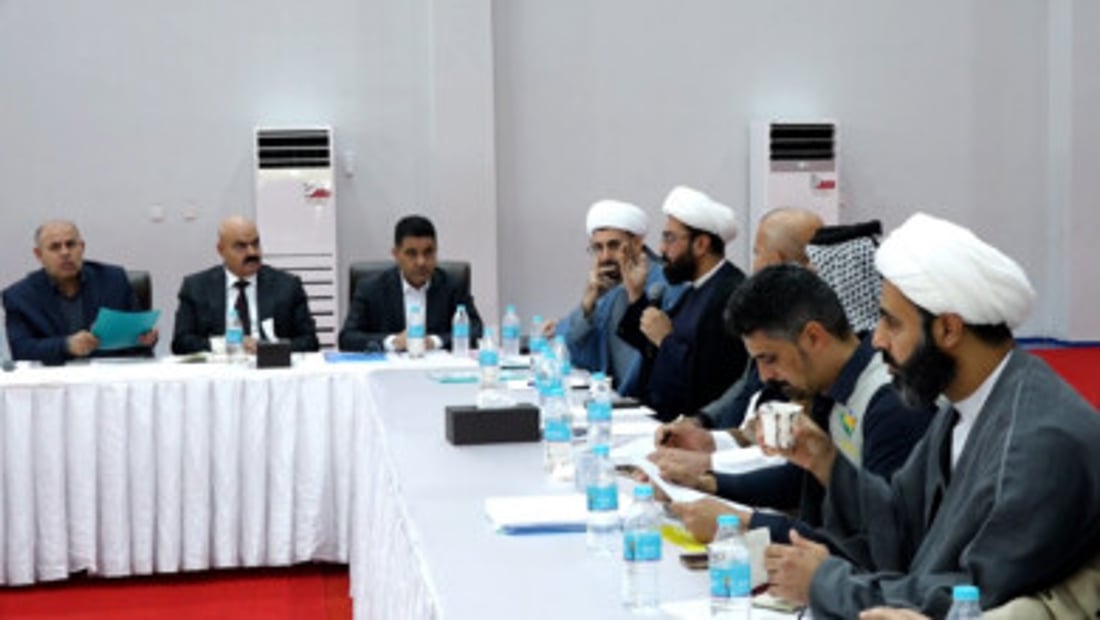
Government officials attend a meeting in Basra on Monday to discuss local demands. (Photo: 964media)
Basra protesters’ demands ‘all acceptable,’ government official says
BASRA — A federal delegation heard protesters’ demands in Basra’s northern Sadiq district on Monday and is drafting a proposal for the cabinet to add nine more areas there to a state public works program, the program’s head said.
The delegation included representatives of the ministries that run public services and of the Planning Ministry. It met representatives of the district’s protest movement, whose demands include stalled projects, jobs and better roads and services.
Abdul Razzaq al-Maliki heads the team in charge of the government’s service effort program, which sends ministries’ machinery and crews to carry out quick public works. He told 964media the visit was made on the orders of Prime Minister Ali al-Zaidi.
“Implementing the prime minister’s directives to meet representatives of the popular movement in the areas of northern Basra, we met today, together with the government delegation that includes all the service ministries and representatives of the Ministry of Planning, to listen to the protesters’ demands and present a draft to be put before the Council of Ministers,” Maliki said.
He said the program already works in three areas of Sadiq: Northern Housh, Southern Housh and Samari. “Today, we were presented with requests to include nine new areas in the team’s work,” he said.
Maliki said the team had already drawn up technical specifications and cost estimates for the work and approved them. “They will be included in the draft to be put before the prime minister, so they can be included in the team’s next plan,” he said.
Zaidi formed a government team on Saturday to visit Basra, review its services and ongoing projects and send the cabinet a detailed report, his media office said.
Ahmed al-Fatlawi, the general coordinator for governorate affairs, told 964media the demands would now be studied in detail. He works for the Supreme Commission for Coordination Among Governorates, a body chaired by the prime minister that brings federal ministers together with the governorates.
“Conveying these demands will lead to their being discussed and examined in detail, and to setting out the requirements needed to issue decisions that respond to them,” Fatlawi said.
“My assessment is that a significant part of these demands can be met through administrative decisions issued at the level of the ministers concerned or at the local level,” he said.
He said other demands would need funding to pay the companies carrying out projects, fixes for administrative and technical problems on some projects or allocations in the budget. “The demands are all acceptable, and they fall to the local government and the federal government as their responsibility,” Fatlawi said.
Protest leaders in Sadiq agreed with a government delegation on Saturday to shelve plans to enter the area’s oil fields and keep to peaceful sit-ins. In return, service crews were to go back to work in the district and paving was to begin on its roads. The two sides also agreed to arrange a meeting at parliament between protest representatives, members of parliament’s Finance Committee and officials from the ministries concerned.
The deal came after the protesters’ three-day deadline ran out Friday. On Tuesday, protesters from tribes and communities in Basra’s northern Qurna and Sadiq districts shut Station 8 at the West Qurna 1 oil field, demanding services and jobs. They threatened to shut all the oil fields in the area if the federal and local governments did not act.
Basra lawmakers on Wednesday called for a sovereign fund under parliament’s oversight to rebuild the governorate and backed the protests, including the open-ended sit-in near West Qurna 1. They also called for a government delegation led by Zaidi to meet residents.
The protesters’ demands include work on a bridge linking Sadiq with Ezz al-Din Salim district, jobs for unemployed young people and the rebuilding of the Qurna-Basra road. West Qurna 1, one of Iraq’s largest oil fields, has been operated by China’s PetroChina since ExxonMobil left in early 2024.