
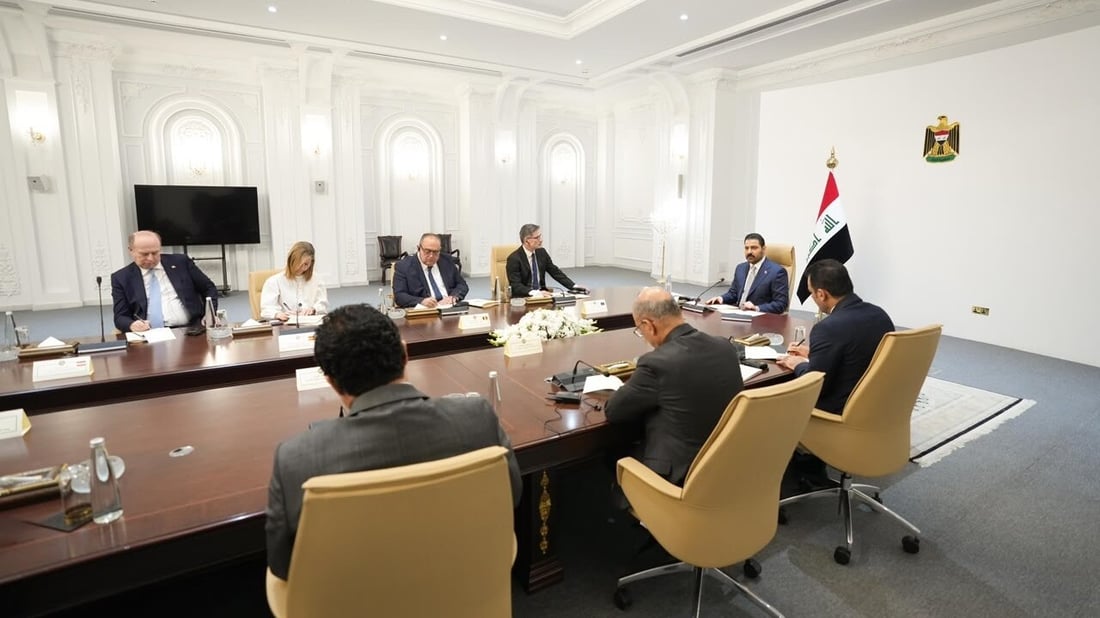
Zaidi tells EU envoys Baghdad will enforce control of borders and oil
BAGHDAD — Prime Minister Ali al-Zaidi told European Union ambassadors on Thursday that his government would enforce federal authority over Iraq’s borders and oil, citing a top court ruling that backed his orders on the Kurdistan Region’s crossings.
The Federal Supreme Court’s interpretation of the constitution, issued Wednesday at his request, confirmed that federal security forces and the army are responsible for securing Iraq’s international borders and upheld Baghdad’s constitutional powers over oil, Zaidi said, according to his media office.
Kurds are an integral part of the Iraqi people, Zaidi said, and the federal government is committed to protecting their rights and meeting their needs on the same basis as citizens in Iraq’s other governorates.
His government would keep up its measures against corruption and oil smuggling across Iraq, he said. It would not back down from its anti-corruption campaign and would not allow weapons outside the constitution and the law.
The ambassadors backed the government’s efforts against corruption and smuggling and said cooperation and partnerships with Iraq should expand, the prime minister’s office said.
Zaidi told them his government had begun taking firm measures against the problems facing the state, to strengthen political and security stability and draw foreign investment. Its aim was a state built on citizenship, the rule of law, strong institutions, balanced foreign relations and equal rights and duties, he said.
The court’s ruling, final and binding, backed Zaidi’s control of the Region’s borders and crossings. Securing Iraq’s international borders, including those in areas the Kurdistan Region administers, is an exclusive federal power, the court said. Federal authorities may also supervise the agencies at every border crossing, including the Region’s, though customs must be run in coordination with the regions and governorates under the constitution.
The seven-point ruling also confirmed federal oversight of oil and gas fields and of contracts for production, marketing and exports, while oil and gas are managed jointly with the producing regions and governorates. It limited the Region’s powers to the territory the Kurdistan Regional Government ran on March 19, 2003, the eve of the U.S.-led invasion. Two of the court’s members dissented.
On Tuesday, Zaidi ordered the federal government to take over every border crossing in the Region after an inquiry into suspected oil smuggling at the state-owned North Oil Company. He removed Lt. Gen. Omar al-Waeli, head of the Border Ports Authority, and dismissed the commander of the Kirkuk Operations Command and the Kirkuk police chief. He also suspended the North Oil Company’s director general and his deputies and sent the inquiry’s findings to the judiciary.
The orders told the Border Forces Command to close unofficial crossings on Iraq’s international borders, including those in the Region, and two Defense Ministry brigades to close unofficial roads between the Region and Diyala, Salah al-Din, Kirkuk and Nineveh governorates. They also barred the KRG from issuing oil export permits without the federal Oil Ministry’s approval.
The KRG cabinet, meeting under Kurdistan Region Prime Minister Masrour Barzani on Wednesday, rejected the orders as a violation of the constitution and called them a sign that Baghdad wanted to return Iraq to centralized rule. It said the Region would keep cooperating against corruption and smuggling and that disputes must be settled through dialogue under the constitution.
Kurdish leader Masoud Barzani, who heads the Kurdistan Democratic Party, said on Tuesday that the Region would not submit to unconstitutional decisions but would help stop smuggling through legal means. Kurdistan Region President Nechirvan Barzani rejected any attempt to deal with the Region through the language of military force.
Large crowds rallied at Erbil Citadel on Thursday morning against the orders, as Zaidi was meeting the ambassadors.
At Thursday’s meeting, Zaidi also discussed relations with EU member states, economic and investment cooperation, regional developments and the situation inside Iraq. He said his government was working to build a new economic identity for Iraq resting on stability, investment, reconstruction and stronger state institutions.
He had met EU Ambassador Klemens Semtner on Oct. 22 to discuss a planned Iraq-EU investment agreement, banking cooperation and trade, his office said at the time. Zaidi invited European companies to invest in Iraq and pointed to the Development Road project, the planned road and rail corridor from Basra to Turkey, as a link between East and West.
Speaking at an EU partnership event in Baghdad on Oct. 27, Semtner said the bloc was ready to support the government in bringing weapons under state control, reforming the economy and fighting corruption. He had conveyed the bloc’s support to Zaidi in May, when Zaidi was still forming his government.
The Federal Supreme Court has set Dec. 14 to hear a separate lawsuit asking it to declare Masrour Barzani’s cabinet what the suit calls a caretaker government.