
'Unconstitutional'
Kurdish leaders close ranks against PM Zaidi’s border and oil orders
ERBIL — Kurdish leader Masoud Barzani said on Tuesday that the Kurdistan Region would not submit to unconstitutional decisions. The Region’s leaders and its two main parties closed ranks against Prime Minister Ali al-Zaidi’s orders on its border crossings and oil.
That evening the Coordination Framework, the ruling alliance of Shiite parties, said it supported the orders as a step to protect public money. It also urged Baghdad and Erbil to settle their disputes through dialogue.
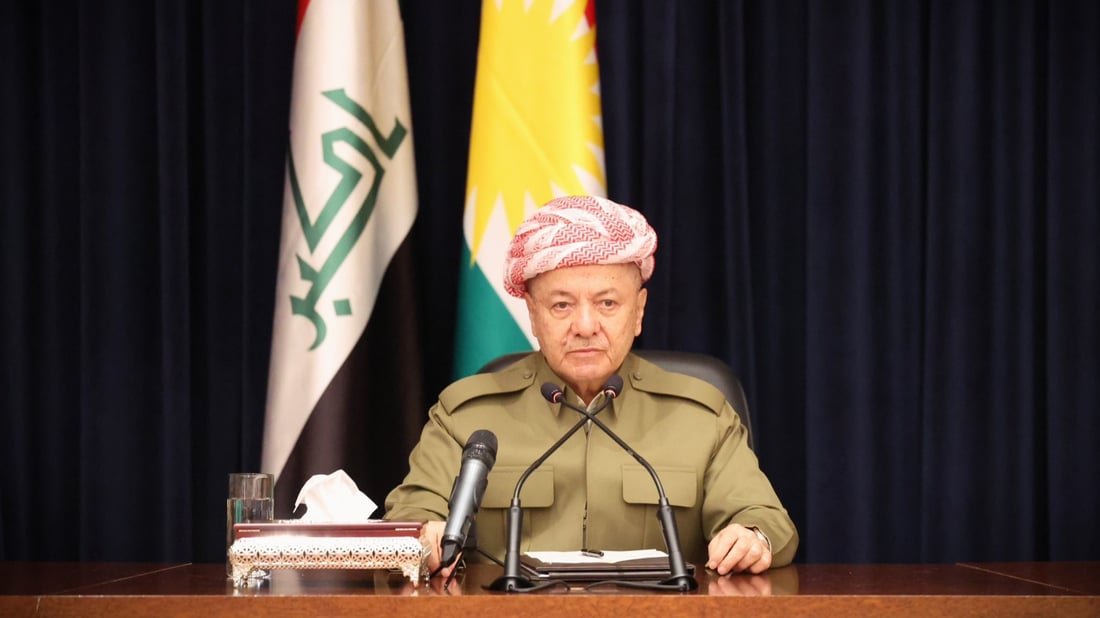
“The Kurdistan Region will not submit to unconstitutional decisions or to the imposition of the will of any person or party,” said Barzani, who heads the Kurdistan Democratic Party. The words came in a signed message released by his office, the Barzani Headquarters.
Barzani said he had backed Zaidi from the start in solving problems and fighting corruption. “Just as we helped the Iraqi prime minister root out corruption, we will also help stop illegal activity and smuggling, but through legal and constitutional means,” he said.
He said a misleading and unjust campaign was under way against the Region, with false accusations published against it every day. “We believe problems cannot be solved through false campaigns, baseless accusations and unilateral decisions,” he said.
Barzani’s message did not list the orders he objected to. It came hours after Sabah al-Numan, spokesperson for the commander-in-chief of the armed forces, announced that Zaidi had ordered the federal government to take over every border crossing in the Region. The orders followed an inquiry into oil smuggling at the North Oil Company, the Kirkuk-based state company that runs oil fields across northern Iraq.
They came days after Iraqi forces began replacing the brigades of Kataib Hezbollah in Jurf al-Sakhar, the northern Babil area where the government’s campaign against oil smuggling began this month. The Iran-aligned armed faction has held the area since 2014 and denies smuggling oil.
Under the orders, the Kurdistan Regional Government may not approve exports of crude or petroleum products without the federal Oil Ministry. The ministry is to take over the management of federal oil fields in Diyala, Kirkuk, Salah al-Din and Nineveh governorates that are under the KRG’s security control. The Energy Police, the Interior Ministry force that guards oil and power sites, is to watch those fields with cameras, and two Defense Ministry brigades are to close unofficial roads and tracks between the Region and the four governorates.
Kurdistan Region President Nechirvan Barzani said the announcement had come while talks between the Region and the federal government on unresolved issues were still going on. “We firmly reject any attempt to deal with the Kurdistan Region through the language of military force,” the presidency’s statement said.
“A strong and stable Kurdistan Region makes for a stronger and more stable Iraq,” Nechirvan Barzani said. He called for unity among the Region’s political forces and urged Iraq’s parties to act with wisdom and a sense of national responsibility.
Kurdistan Region Prime Minister Masrour Barzani told reporters in Erbil that the orders were “in no way acceptable.” He said they contradicted messages a federal delegation had brought to Erbil about solving problems on the basis of the constitution. His government would keep talking with Baghdad, he said, and the door was open to an agreement on every issue if it rested on the constitution.
Masrour Barzani said a three-way meeting on the Khor Mor gas field days earlier had made good progress on how the Region’s constitutional rights to its natural resources would be applied. But he said Baghdad had often made promises it did not keep.
He urged the Region’s parties to put their differences aside, saying protecting the Region was bigger than any personal or party gain. Kurds were ready to “all become Peshmerga,” the Region’s armed forces, to protect it, he said.
The KDP and the Patriotic Union of Kurdistan, which said on Nov. 5 that it was quitting the KRG, said in a joint statement that any violation of the Region’s rights was a red line. They called the measures of recent days unexpected and surprising for the Region’s citizens.
PUK President Bafel Talabani said in a separate statement that the constitution and serious dialogue were the only way to settle disputes. His party’s commitment to peace and dialogue came from strength and responsibility, not hesitation, he said. Corruption must be confronted and those responsible firmly held to account, wherever they were and whoever was behind them, he added.
The Framework’s statement cited Article 27 of the constitution, which says public assets are sacrosanct and that protecting them is the duty of every citizen. It said investigations should be completed through the judiciary and oversight bodies so that no one escaped accountability, and that natural resources and border crossings should be managed under the constitution and the law. “The money and resources of Iraqis are a red line that must not be squandered,” it said.
In Baghdad, Parliament Speaker Haibat al-Halbousi received a KDP delegation led by senior party official Hoshyar Zebari. Halbousi told them the outstanding issues between the federal government and the Region had to be settled on the basis of the constitution and the law, with everyone bound by them without exception, his media office said.
Zaidi also filled two of the posts left empty by Tuesday’s dismissals. He named Lt. Gen. Mohammed al-Zubaidi to lead the Kirkuk Operations Command, replacing Maj. Gen. Muad Baday Faraj. Maj. Gen. Hassan Kadhim Obaid, until now the police chief of Muthanna governorate, was assigned to head the Border Ports Authority in place of Lt. Gen. Omar al-Waeli, a security source told 964media.
The orders came two weeks after Zaidi and Masrour Barzani met in Baghdad on Nov. 9 to discuss the Region’s share of the 2027 federal budget, the management of oil fields and the long-stalled oil and gas law. Baghdad has given no timetable for the handover of the crossings and has not said how it would be carried out with Erbil.