
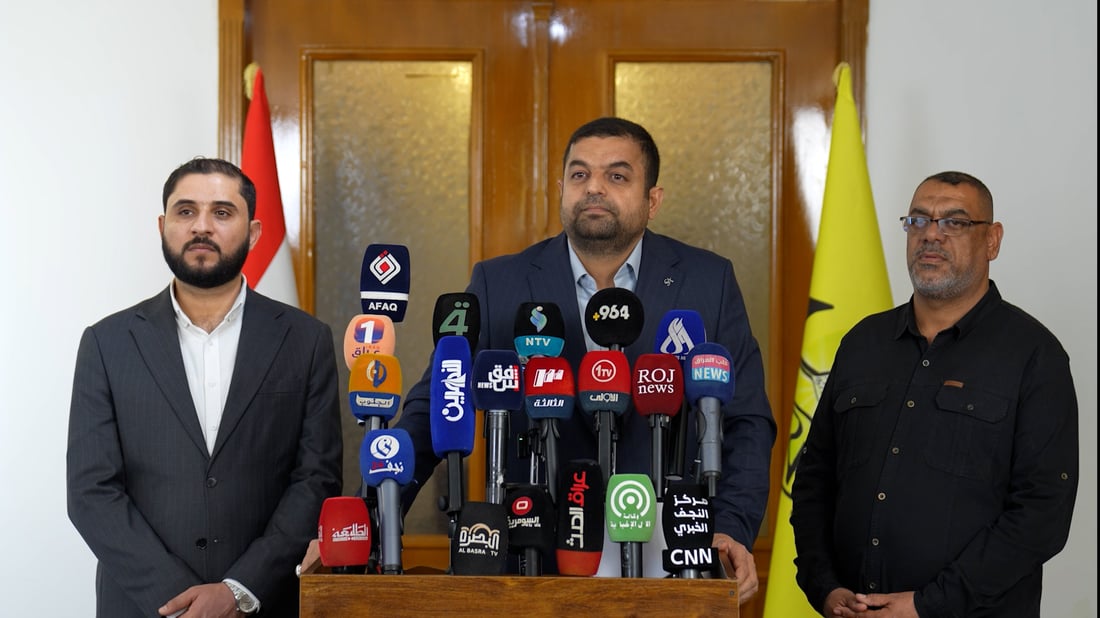
Nujaba to sue Najaf MP over claim pipeline tap was on its land
NAJAF — Harakat al-Nujaba said Tuesday it would sue lawmaker Abdul Hadi al-Hasnawi, who had said that the pipeline tap in a Najaf oil smuggling case was on the armed faction’s land and not on his arrested brother’s farm.
Nujaba is an Iran-aligned faction that the United States designated a Foreign Terrorist Organization in September 2025. At a news conference in Najaf attended by 964media, it said it would ask government bodies for a technical and legal investigation to establish who owns the land the MP named, along with its boundaries, area and title deeds. It said it backed the government’s pursuit of the corrupt but rejected “the use of corruption cases in campaigns of political and media targeting.”
Earlier Tuesday the MP, of the Reconstruction and Development Coalition, showed a map of the site in a video monitored by 964media. He denied that his brother Hussein Ali al-Hasnawi, the emir of the Bani Hassan tribes, had any link to the smuggling in the Haydariya subdistrict. He said the tap was on Nujaba’s land and the farm plots leased next to it, and he called for aerial images that would show when the breach was made and how long it had been used.
“The site of the breach lies outside the boundaries of my brother’s farmland, 1,600 meters away from it, according to official maps and aerial photographs,” he said.
Security forces arrested the emir on Saturday, a security source told the state-run Iraqi News Agency. The MP said he had handed his brother over himself once the family learned of a warrant for him. He said another brother had left for medical treatment three days before the incident and “did not flee, as is being claimed.” He did not name that brother.
The land is about 25 kilometers from the family’s home, the MP said. “My brother received the land 15 days ago and intended to use it purely for farming. He worked during the day and brought in sprinklers in front of people’s eyes,” he said.
He said army and Popular Mobilization Forces troops are posted along the road between the breach and his brother’s land. On the other side are Defense Ministry depots with watchtowers, soldiers and vehicles, which he said aerial photographs show.
He asked the Supreme Judicial Council to send a technical and investigative committee to inspect the site, drawn from intelligence, the National Security Service and the Oil Ministry. He said experts should establish “the age of the hole in the oil pipeline and the age of the plastic pipe” and compare them with the 15 days since his brother took over the land.
He also asked the head of the council to let his brother’s lawyers attend the questioning and see the case papers, which he said was a right guaranteed by the constitution. He urged the Bani Hassan and other Arab tribes not to overstep or respond to anyone and said the courts were fair. “Don’t be a thief, and you won’t fear the sultan,” he said, quoting a saying.
A spokesperson for the tribe gave a different distance. Qasim al-Hasnawi told Iraq AlHadath TV, a Baghdad channel, that a letter from the Najaf Agriculture Directorate puts the emir’s farm 3 kilometers from the punctured pipeline. “I am ready to provide you with the letter,” he said. 964media has not seen the letter.
The spokesperson said three pipelines run through the area, all of them 3 kilometers from the emir’s farm. Two are in use, and the third has been abandoned since 2006 and has 300 holes in it. He said he reached that conclusion from his own research and is not an oil expert.
He asked how smuggling tankers could have gone unseen. He said the interior minister had told a security meeting with the prime minister that every barrel of oil is tracked from the moment it leaves the ground, and Najaf Governor Yousif Kanawi had said the whole governorate is photographed from the air every week.
“This whole case is a 911 call,” he said, referring to the emergency line. He said a loss from a pipeline would show up within a week or a month in the flow measured at its delivery point, and he asked where the refinery’s or the ministry’s report of a shortfall was. “We place our absolute trust in the judiciary, and the judiciary has not had its say yet,” he said.
The court on Saturday ordered the arrest of Mohammed Ali al-Hasnawi, a Najaf Provincial Council member who chairs its energy committee, and of his brother. The order came after an investigating judge inspected the site and found oil had been smuggled through the pipeline, according to a Supreme Judicial Council statement. The judiciary said the pipeline runs through a plot belonging to the two men, who had dug a trench all the way around it to keep people out. It did not name them.
The MP denied on Saturday that his name was linked to the case. On Sunday, tribal leaders meeting at his guesthouse in Haydariya said the emir had been held over digging to protect his land from encroachers, not over the pipeline. On Monday, the Defense Ministry’s intelligence and security directorate in Najaf said it had seized an excavator used to dig a trench near an oil pipeline and arrested its driver.
The Najaf case is one of a string of oil smuggling cases the government has opened since its crackdown began in Jurf al-Sakhar. The cases have since reached the Basra border, Nasiriyah and the northern oil fields of Kirkuk.