
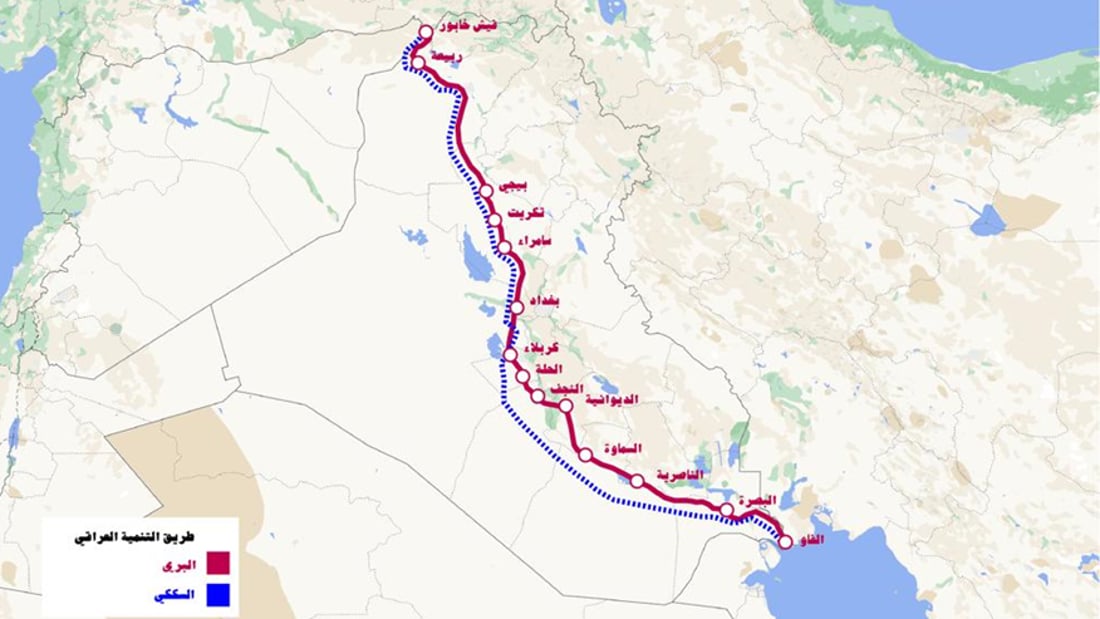
Map showing the proposed route of Iraq’s Development Road project, with planned railway and highway connections linking Grand Faw Port in Basra to the Turkish border and onward to Europe.
Europe asks ever more often when Development Road will be done, Turkey says
BAGHDAD — Engineering designs for the Development Road, Iraq’s planned rail and highway corridor from the Gulf to Turkey, have reached advanced stages, Transport Minister Wahab al-Hasani said Wednesday.
Hasani spoke at the Iraq International Transport, Airports and Logistics Exhibition and Conference in Baghdad. His Turkish counterpart, Abdulkadir Uraloglu, told the same conference that European officials were asking more and more often when the project would be finished.
“Our European counterparts ask more often with each passing day, ‘When will you finish the Development Road?'” Uraloglu said.
Uraloglu also said the two countries planned to begin with railway construction paid for in oil. In October, an Iraqi railway official said Baghdad was negotiating an oil-backed fund with Turkey under which Turkish companies would be paid in oil for construction work, and that upgrades to Iraq’s existing rail lines would be financed separately through a World Bank loan.
The corridor would run about 1,200 kilometers from Grand Faw Port in Basra governorate to the Turkish border, where it would connect with networks serving European markets. It is estimated to cost $17 billion.
Hasani said the government wanted to turn Iraq’s location into an economic asset by investing in ports, railways, highways and aviation, and by joining them into a single transport network.
“Iraq is regaining its economic role as a vital bridge between East and West,” Hasani said.
He called Grand Faw Port Iraq’s main sea gateway to world markets and pointed to the immersed tunnel under the Khor al-Zubair channel, which he inaugurated on Nov. 12. The tunnel links the Faw Peninsula with Umm Qasr, shortening the road journey between them, and connects the new port to Iraq’s road network and the planned corridor.
He also listed plans to modernize airports and add international destinations for Iraqi Airways, and invited foreign companies and investors at the conference to form partnerships on infrastructure, technology transfer and long-term jobs.
Uraloglu said the corridor, running from Faw Port on the Gulf through Turkey to Europe, would offer what he called “a historic opportunity” as an integrated system of railways, highways and logistics centers. He said Ankara was building north-south routes to complement its east-west links, with the Development Road at the center of that strategy.
Roads and railways alone would not make the corridor succeed, Uraloglu said. Border crossings also had to be simplified, customs clearance sped up and transport systems digitized. He said Turkish engineering and construction companies could help build Iraq’s transport infrastructure.
Patrick Philippe, director of certifications and standards at the International Road Transport Union, a Geneva-based industry body, told the conference that Iraq had taken important steps to ease trade and transport. He pointed to infrastructure upgrades and the development of about 3,000 kilometers of roads.
Moving goods between Turkey and Kuwait through Iraq could take four days instead of 45, Philippe said. He did not explain the comparison.
Road transport also needs trained, officially registered drivers, customs offices and inspection facilities, Philippe said. He said those could cut errors, accidents and costs.
In July, the Transport Ministry said it had completed preliminary designs for the corridor and moved on to detailed engineering of bridges, stations and other facilities. Prime Minister Ali al-Zaidi then ordered officials to draw up a mechanism to finance the project.
The ministry has set 2031 as the target for the first phase, 2038 for the second and 2050 for full capacity. It estimates that the corridor could create more than 100,000 direct jobs and about 1.6 million indirect ones. Iraq, Turkey, Qatar and the United Arab Emirates have signed a memorandum of understanding supporting the project. Oman has asked to join, and China has sought a role in the corridor, according to the ministry.
The route’s northern end is still unsettled. In September, Iraqi and Turkish officials advanced talks on the Fishkhabur-Ovakoy crossing as the corridor’s northern gateway. It would give federal Iraq a direct link with Turkey and could divert trade from the Ibrahim Khalil-Habur crossing, which the Kurdistan Regional Government runs.
The two governments signed agreements on transport links, including the Ovakoy-Fishkhabur route, during Zaidi’s July 28 visit to Ankara. Zaidi discussed the corridor with Turkish Foreign Minister Hakan Fidan in Baghdad on Oct. 17. On Nov. 17, government spokesperson Haider al-Aboudi listed the Development Road among the draft 2027 budget’s financing tools but gave no figures.