
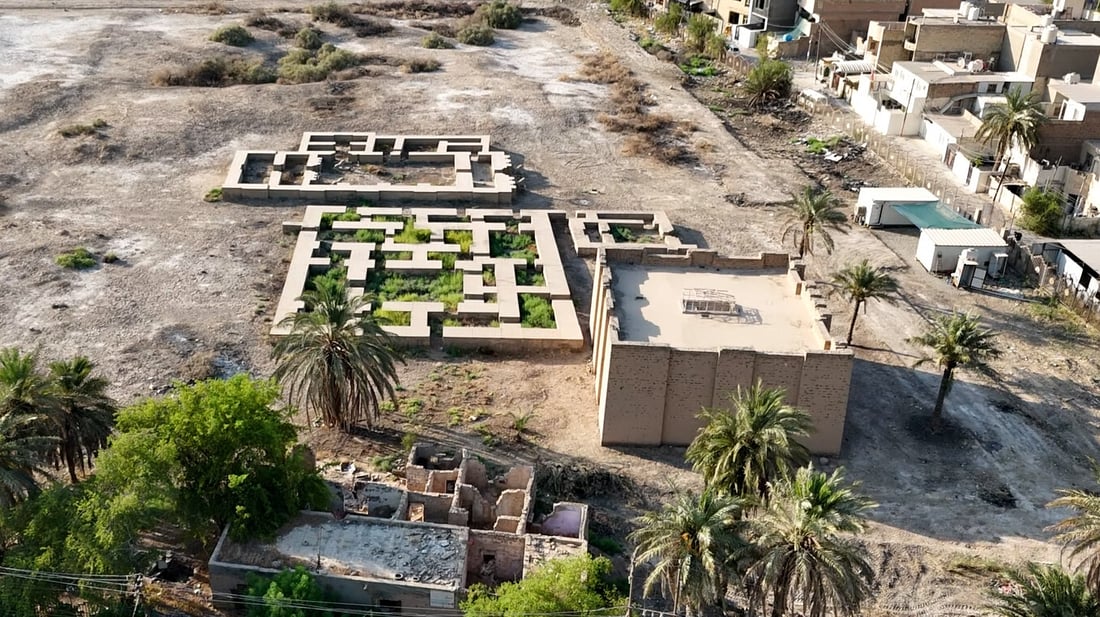
An aerial view of Tell Harmal, the ancient Babylonian city of Shaduppum, in Baghdad’s New Baghdad district. The archaeological site is undergoing renewed study by an Italian excavation team. Photo by 964media.
Residents urge better upkeep as archaeologists resume work at Tell Harmal
BAGHDAD — Residents and heritage advocates are calling for better maintenance of Tell Harmal, one of Baghdad’s most prominent archaeological sites, as Italian archaeologists resume fieldwork at the nearly 4,000-year-old Babylonian city of Shaduppum.
Located in Baghdad’s New Baghdad district, Tell Harmal is the site of the ancient city of Shaduppum. Excavations uncovered cuneiform tablets on mathematics, geometry and administration, including discoveries researchers later identified as predating geometric principles commonly associated with the Greek mathematician Pythagoras.
Mahmoud Mahdi, whose family has lived beside the site since 1954, told 964media he worked alongside renowned Iraqi archaeologist Taha Baqir during excavations in his youth.
“The site has been part of the lives and culture of local residents for decades,” Mahdi said.
He recalled that archaeological and tourist delegations from around the world regularly visited Tell Harmal during the 1970s and 1980s. Mahdi said one of the site’s most celebrated discoveries was a collection of clay tablets containing mathematical concepts that, researchers told him, predated Pythagoras’ theorem by centuries.
Mahdi said residents protected the site during the regime change of 2003 and prevented looting, but it is now affected by accumulated waste and debris. He called on the Baghdad Municipality and relevant authorities to clean and preserve the site.
Heritage advocate Manar al-Amir described Tell Harmal as one of Baghdad’s most important archaeological mounds, saying excavations between 1945 and 1949 uncovered cuneiform tablets documenting mathematics, geometry and administration.
She said the site “suffers from clear neglect” despite its historical importance and that she was surprised by its condition during a recent visit. Amir said the site has been closed for years and is in a residential neighborhood near al-Rasheed Camp.
Ahmed al-Mukhtar, media director at the State Board of Antiquities and Heritage, disputed claims that the site has been seriously neglected.
“What is being circulated about major neglect at Tell Harmal is inaccurate,” he told 964media, explaining that the site’s location in the middle of a residential area means waste is often dumped near its perimeter fence.
Mukhtar said the board conducts regular inspections in coordination with the Baghdad Municipality and local authorities and urged residents to report violations instead of only posting photographs on social media.
He said Tell Harmal is included in the board’s maintenance and restoration program and that an Italian archaeological team is currently working at the site. Although security conditions interrupted work at times, the team has resumed studies and soil sampling.
Mukhtar added that the board faces limited funding and that plans to appoint 5,000 archaeological guards remain suspended, leaving the protection of heritage sites dependent on cooperation with security agencies, UNESCO and international donors.