
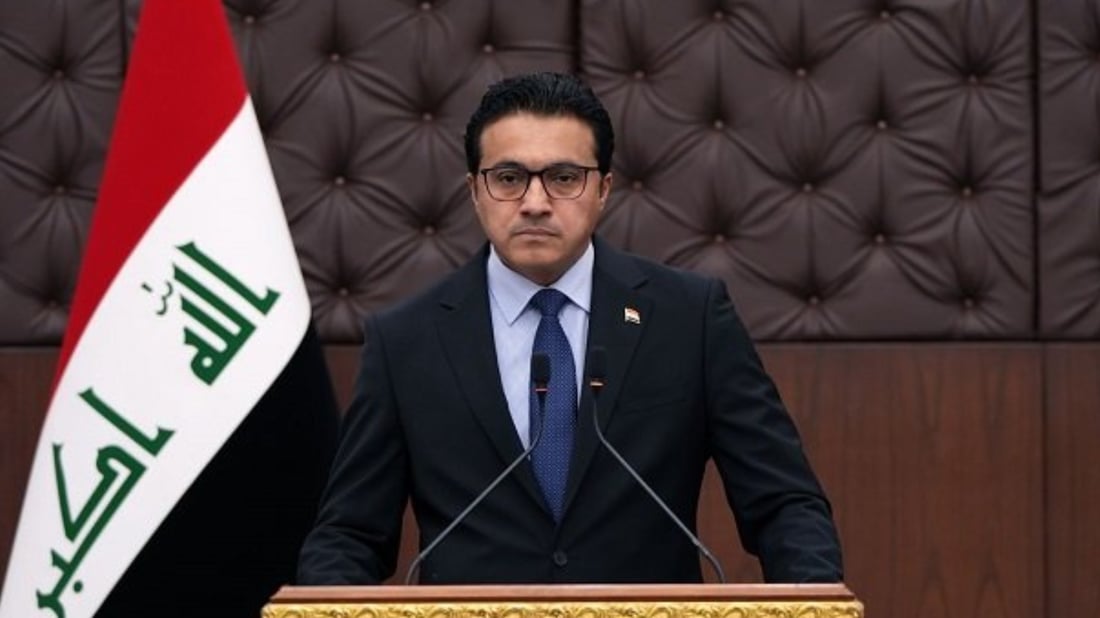
Zaidi to visit Damascus for talks with Sharaa, spokesperson says
BAGHDAD — Prime Minister Ali al-Zaidi is expected to visit Damascus in the coming days for talks with Syrian President Ahmed al-Sharaa and a visit to the Sayyida Zaynab shrine, government spokesperson Haider al-Aboudi said Thursday.
Zaidi discussed the trip with Syrian Foreign Minister Asaad al-Shaibani, who was in Baghdad for the Oct. 17-18 meeting of Organization of Islamic Cooperation foreign ministers, Aboudi said in a televised interview. “The prime minister will also visit Sayyida Zaynab shrine, and the Syrian foreign minister welcomed the visit,” he said. The shrine, south of Damascus, is a major Shiite pilgrimage site.
Zaidi is also planning visits to Lebanon and Jordan, Aboudi said, without giving dates. Zaidi sent Sharaa a message on security and economic cooperation in June, and the two countries agreed that month to revive an oil pipeline. Iraq currently exports some crude by tanker truck through Syria.
Aboudi said the al-Sheib border crossing with Iran had been closed temporarily so its infrastructure and logistics could be upgraded. “The al-Sheib crossing is the weakest logistically compared with other crossings, so al-Zaidi directed that it be modernized,” he said.
He rejected Iranian statements that Tehran had not been told of the closure. “The Iranian side’s denial is inaccurate. I contacted the official responsible for border crossings, who confirmed that the Iranian side had been notified through the approved channels. All crossings with Iran are currently open except al-Sheib,” Aboudi said.
An official source said Tuesday that al-Sheib would close at 6 a.m. Wednesday to goods and travelers until further notice under Zaidi’s directives, and that other crossings with Iran would be closed gradually. The government said Wednesday that the crossing’s “technical and logistical” facilities were not ready for continued operations, while government adviser Abdul Amir Taiban said the closure was needed to stop drugs and counterfeit currency from entering Iraq.
Aboudi also denied reports that a recent explosion at a weapons storage site had targeted the Popular Mobilization Forces. “There was no targeting of the Popular Mobilization Forces. What happened was an explosion of old weapons and ammunition,” he said. The facility did not hold weapons surrendered by armed factions, he said, adding that ballistic missiles and other weapons handed over by those groups were stored separately under appropriate conditions.
Five PMF members were lightly injured when a stockpile of damaged ammunition exploded at a PMF headquarters in eastern Baghdad on Saturday evening, and preliminary findings by Interior Ministry forensic teams pointed to an internal malfunction with no sign of an external attack, the PMF said Sunday.
Aboudi also defended the government’s warning against efforts to undermine bringing weapons under state control, saying the policy followed an agreement between political blocs and armed factions. “The state is the authority that decides on war and peace and is the official holder of weapons,” he said.
He drew a line between criticism and threats to security. “We do not target journalists or restrict freedom of opinion, which is constitutionally guaranteed. But anyone who threatens Iraq’s internal security or attempts to affect its stability will face government action, regardless of their affiliation,” Aboudi said.
Zaidi on Monday ordered state institutions to file criminal complaints against anyone using the media to incite violence, back weapons outside state control or obstruct state decisions on restricting weapons to official institutions, citing Articles 2 and 4 of the Anti-Terrorism Law.
Zaidi’s timetable sets a 90-day halt to attacks from Sept. 30, followed by a six-month handover of weapons ending June 30, 2027. The Islamic Resistance in Iraq said on Sept. 30 that its four factions were not bound by any government or political deadline and would keep their weapons until they verified that U.S., NATO and other foreign forces had fully withdrawn. Ashab al-Kahf rejected handing over its arms and threatened a military response to any continued foreign presence, and Kataib Hezbollah praised the Oct. 10 Houthi strike on Riyadh’s airport, which killed 12 people, dismissing Iraqi condemnations as “discordant voices.”
On Iranian Kurdish opposition groups based in the Kurdistan Region, Aboudi said talks with Iran on their status were continuing, including on reports of a “handover to Iranian authorities.” No agreement had been finalized, he said, and any arrangement would have to follow international procedures governing the treatment of armed groups.
Iran’s embassy in Baghdad said Tuesday that Iraq had agreed to expel members of Iranian Kurdish opposition groups from the Kurdistan Region or hand them over to Tehran, but the Iraqi government’s statement on the same security talks made no mention of any such agreement.
Under a security agreement signed in 2023, Iranian Kurdish opposition groups pulled back from positions near the border and moved to residential areas deeper inside the Kurdistan Region. Iran accuses some of the groups of armed activity from Iraqi territory. Drones struck a camp of the Kurdistan Democratic Party of Iran near Koya on Sept. 28, and Komala sites were hit in September.