
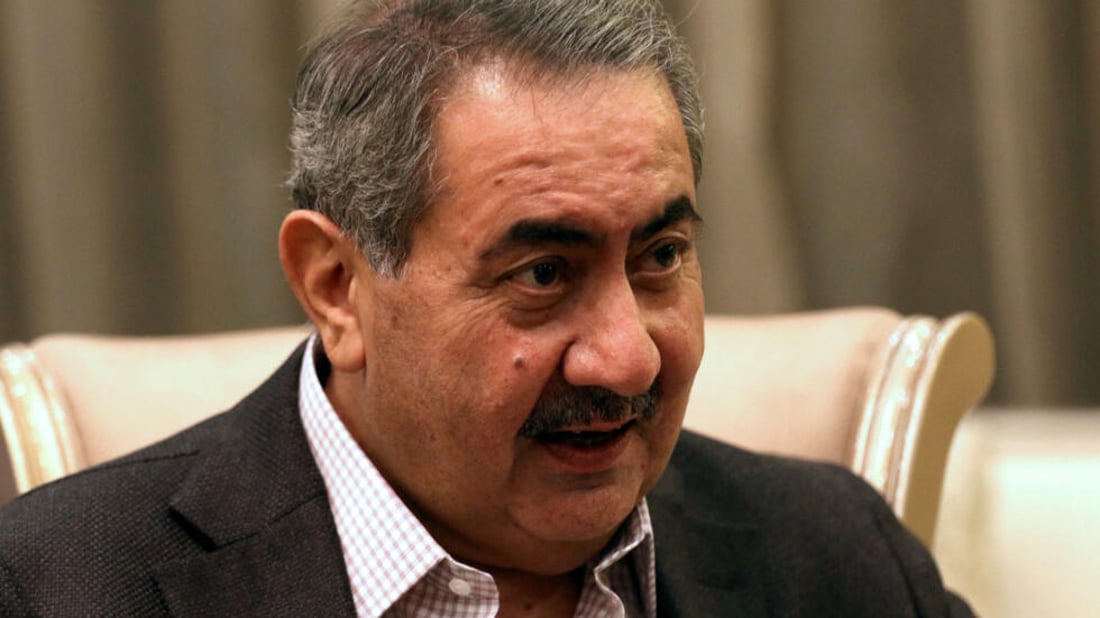
Hoshyar Zebari, Iraq's former Foreign Minister
Media monitor
Iraq tracks 200 military flights a day but cannot stop them, Zebari says
BAGHDAD — Iraqi forces track about 200 military flights a day over the country but have no means of dealing with them, and drones operated by armed factions are now a greater threat than the Islamic State group, senior Kurdistan Democratic Party official Hoshyar Zebari said.
Zebari, a former foreign and finance minister, also praised Prime Minister Ali al-Zaidi’s devaluation of the dinar as a step earlier governments had been too afraid to take.
“Drones today are certainly more dangerous than ISIS,” Zebari told Iraq 24 TV. “Jordan is a small country with limited resources, yet it has 15 air defense systems. Ask our security commanders how many systems we have.” He had spoken with security commanders on Saturday, he said. “Iraqi forces can see these flights, but they have no capability to deal with them.”
The coalition’s departure had left Iraq exposed, he said. “When the international coalition was present in Iraq, it coordinated with Iraqi forces to prevent Israeli attacks and interventions. But the coalition’s cover is gone. Who guarantees our security now? Our skies are open.” Zaidi formally declared the end of the U.S.-led coalition’s mission on Sept. 30, 12 years after it began, under a 2024 agreement with Washington. The Kurdistan Region’s Peshmerga Ministry has warned of an air defense gap since the withdrawal and on Oct. 7 denied reports that a system had been delivered.
Zebari called Saturday’s Houthi strike on Riyadh airport, which killed 12 people, “a devastating blow and a very dangerous escalation,” and pointed to Israel’s elections on Oct. 27 and U.S. midterms on Nov. 3 as dates to watch. “If this period passes peacefully, we may see some calm, but all expectations point toward escalation,” he said. Baghdad and the Kurdistan Region Presidency condemned the attack on Sunday; Kataib Hezbollah praised it on Monday.
Neighboring countries were not worried about an independent Iraqi government, he said, but about armed factions. “They are not afraid of an independent national Shiite government making its own decisions in Iraq. Their concerns are about armed factions launching rockets and drones at their facilities and strategic infrastructure.” If federal authority collapsed, Iraq could fragment, he said. “Balkanization could happen, God forbid, if federal authority collapses and disintegrates, meaning no one listens to the government anymore. That is what happened in Yugoslavia.” Washington, he said, respected countries that dealt with it “as a state with institutions, not as factions, militias or separate forces.”
ISIS had been defeated as a territorial entity but survived as an ideology, he said, blaming its rise partly on the exclusion of Sunnis and the vacuum left by Syria’s civil war. “I believe the marginalization of Sunni governorates continues to this day.”
Zebari said the KDP backed Zaidi because many of his ideas matched its positions. “I have met Zaidi on several occasions. He has no complexes and has a clear and sound approach.” The devaluation was a necessary measure that previous governments had considered and shelved for fear of public reaction, he said. “We examined these options during our time but did not adopt them because we feared the public consequences. He was not afraid to proceed.”