
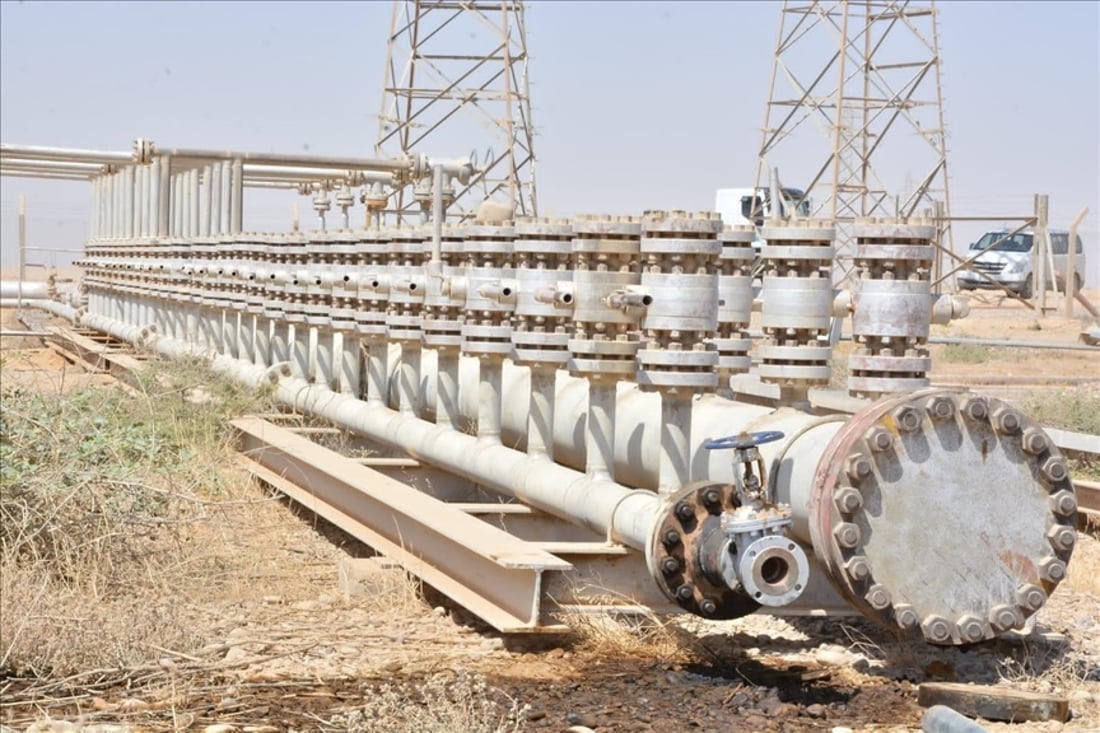
Pipelines and valves at the Khurmala oil field in Erbil governorate
Hormuz crisis shifts Iraq’s oil export priorities toward Turkey as supplies to Jordan remain halted
BAGHDAD — Iraq has kept Kirkuk crude flowing to world markets through Turkey’s Ceyhan port while supplies to Jordan have been suspended since the start of the year, a suspension the Oil Ministry attributes to a shortage of Kirkuk light crude, as disruption in the Strait of Hormuz reshapes Baghdad’s export priorities.
About 1.76 million barrels of Kirkuk crude, roughly 57,000 barrels a day, were exported through Ceyhan in August, according to figures from the State Organization for Marketing of Oil, or SOMO, along with 2.17 million barrels from the Kurdistan Region, for a total of nearly 4 million. The ministry has said the Jordan deliveries stopped because there was not enough Kirkuk light crude and Basra medium crude is unsuitable for Jordanian refineries.
Exporting Kirkuk crude through Ceyhan while Jordan goes without reflects competing claims on limited supply, including export commitments, domestic refinery needs and different pricing, an Oil Ministry source told 964media. The two routes have to be compared on transport costs, volumes, commercial viability and contracts, not just the price per barrel, the source said.
Under the previous arrangement, Jordan took 10,000 to 15,000 barrels a day, about 300,000 to 450,000 a month, at a discount of about $16 a barrel to Brent: $7.75 for transport, $3.40 for quality and $4.76 in savings for the Jordanian treasury.
“The issue is not solely related to the unavailability of Kirkuk light crude, but also involves a combination of technical, logistical and commercial factors, as well as Iraq’s priorities in managing its oil exports during the crisis,” oil expert Asim Jihad told 964media. The Hormuz disruption had pushed Iraq to rely more on the northern route through Turkey while keeping contracts, protecting revenue and supplying northern refineries, he said. “Supplying Jordan depends on the availability of suitable crude, transportation costs and commercial feasibility compared with other export routes.” Iraq could look at blending Basra medium with lighter grades or supplying Basra light instead, he said.
Selling at deep discounts makes less commercial sense when Iraq needs to sell at higher prices on world markets, said oil expert Sadiq al-Rikabi, though Jordan remained an important partner and an outlet toward the Red Sea. Baghdad has an interest in keeping oil cooperation with Amman, he said, but its current needs limit its room to restore the old terms.
Crude from Ceyhan reaches refineries in Europe, North Africa and the Americas at international prices, while Jordan received small volumes at preferential prices, said oil expert Ziad al-Hashimi. Flows through the Turkish pipeline are now 200,000 to 230,000 barrels a day and could rise to 700,000 to 1 million under the new agreement with Ankara, earning Iraq far more than the Jordan deliveries, he said. Iraq has also been trucking crude from its southern fields to northern facilities for export through Ceyhan despite the extra cost, and Iraqi-Turkish arrangements aim to raise northern capacity to about 750,000 barrels a day.
Revenues covered only 76% of salaries and welfare in the first seven months of the year, according to economist Nabil al-Marsoumi. Iraq has had no budget this year, with spending governed by the one-twelfth rule since the three-year law covering 2023 to 2025 expired, and the government acknowledged a fiscal crisis in late July, when salaries went out in stages. Oil provides more than 90% of federal revenue. Exports fell from more than 99 million barrels in February to 18.6 million in March and fewer than 10 million in April after shipping through the Strait of Hormuz was disrupted, and recovered to about 2.6 million barrels a day in September, against 3.3 to 3.5 million before. Iraq agreed with Turkey in August on a minimum of 750,000 barrels a day through Ceyhan.