
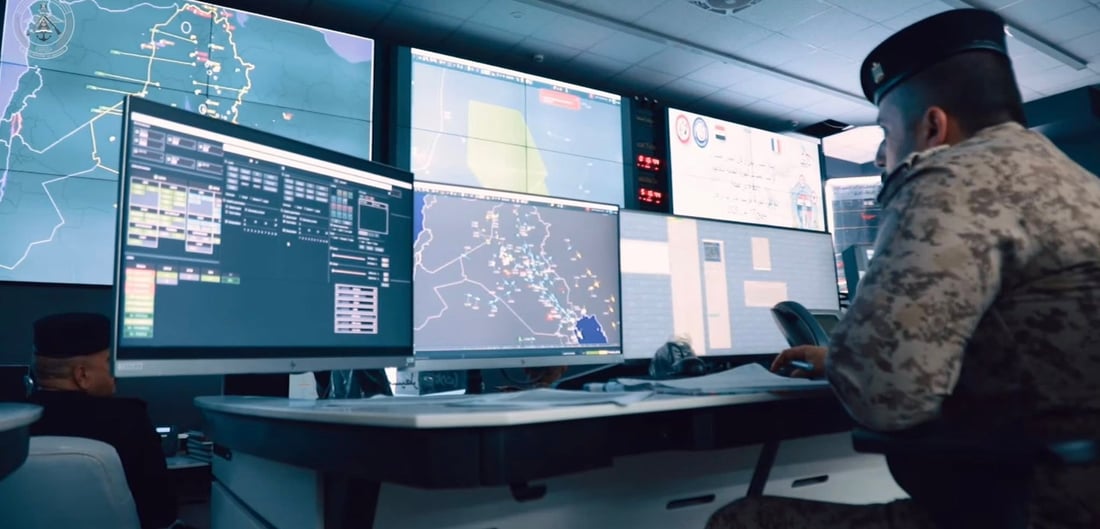
An Iraqi military officer monitors radar and air surveillance systems at a command center, where multiple screens display maps and operational data.
Iraq investigating unidentified aircraft over west and south since coalition exit
BAGHDAD — Iraqi authorities are investigating unidentified aerial activity over western and southern Iraq since the U.S.-led coalition left on Sept. 30, as reports that Israeli jets have flown through Iraqi airspace toward Iran raise questions about Baghdad’s control of its skies.
Authorities monitored aerial movements between Oct. 1 and 12 but have not established what they were or identified the aircraft, a security source told 964media on condition of anonymity. Baghdad remains in contact with coalition commanders through several channels, particularly those now based in Jordan, on military coordination and airspace, the source said.
Lawmakers are examining reports of American aircraft operating over Iraq, whether for training, exercises or other operations, said Mazen Gharib, a member of parliament’s Security and Defense Committee. “Such movements require monitoring and verification by the relevant security and military authorities to establish their nature, objectives and compatibility with agreements and understandings between Iraq and other countries,” he said.
The Turkish defense publication Times of Defence claimed on Oct. 7 that Israeli F-35I Adir stealth fighters had flown east through Iraqi air corridors, supported by KC-707 and KC-46 Pegasus tankers, and that U.S. Air Force F-35As from Muwaffaq Salti Air Base in Jordan had flown long-range training missions along the Iraq-Iran border. It attributed the claims to preliminary operational intelligence without naming sources or offering verifiable flight records.
Neither the United States nor Israel has confirmed the reported exercises, and Iraqi authorities have not established whether the activity they detected is connected.
Kataib Hezbollah has said it will target “hostile” aircraft in Iraqi airspace. When its secretary-general ordered a halt to military operations on Sept. 30, he exempted attacks on aircraft violating Iraqi airspace until the government’s air defenses are complete.
With the coalition’s mission over, its anti-ISIS task force is now headquartered in Jordan, and Baghdad and Washington have moved to bilateral security cooperation. KDP official and former federal Foreign Minister Hoshyar Zebari said on Oct. 12 that Iraqi forces track about 200 military flights a day but cannot deal with them, a figure that has not been independently verified. Iraq operates French Thales GM403 and U.S. TPS-77 radars, but their coverage and the military’s ability to respond to aircraft at different altitudes and ranges remain in question.
Current radar and surveillance systems do not cover all altitudes and distances, military expert Imad Allo told 964media. “The problem is not only about purchasing weapons and radars,” he said, calling for an integrated command-and-control system and coordination among the armed forces.
Iraq returned large parts of its western airspace to civilian control on Sept. 18 after nine years of military restrictions, but managing civilian air corridors is a different task from detecting, identifying and intercepting unauthorized aircraft. Defense Ministry officials said in September that Prime Minister Ali al-Zaidi had ordered the air defense modernization timetable cut from six years to three, and authorities have reported progress on acquiring systems from South Korea, Turkey and the United States without giving delivery dates. The first batch, including surveillance radars, interceptors and aircraft, is expected within six months, Sabah al-Numan, spokesperson for the commander-in-chief, has said.