
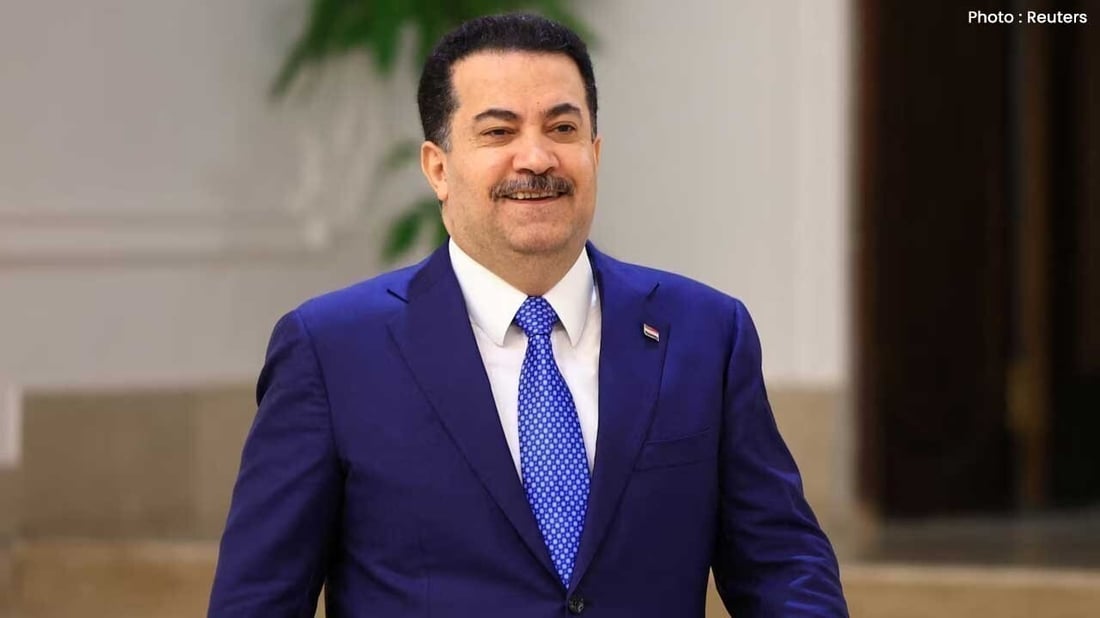
Reconstruction and Development Coalition leader Mohammed Shia Al-Sudani
Media Monitor
Sudani’s bloc MP accuses Zaidi of doing whatever Washington asks
BAGHDAD — A lawmaker from former Prime Minister Mohammed Shia al-Sudani’s bloc accused Prime Minister Ali al-Zaidi of agreeing too quickly to the halt on Iranian flights and of implementing whatever the United States asks, as the governing alliance’s divisions over his approach to Washington become more public.
“I was surprised by the government’s rapid approval regarding the ban on Iranian flights in Iraq, as though there was a quick response without studying what could result from such a decision,” Haider al-Fuadi of the Reconstruction and Development Coalition told Al-Rasheed TV. “The decision is difficult. We share 1,200 kilometers with Iran, and we have commercial, economic, energy and gas interests. Iraqi citizens study in Iran, and there are also patients.” He suggested Zaidi pay for Iraqis who used to seek treatment in Iran to be treated in the United States instead.
Iraq had secured 23 exemptions from U.S. measures since 2018, Fuadi said, crediting Sudani with several of them. The best known, a waiver allowing Iraq to pay Iran for electricity, was granted in 2018 and ended under Sudani’s government in March 2025, when Washington declined to renew it.
“I believe the United States’ decision is unwise,” he said. “The Americans no longer manage the process in the Middle East wisely. The United States was a main player in the Middle East and took the lead, but the equation has changed. In addition, this mistake that it will make in Iraq will push it further into the dark tunnel.”
Coordination Framework leaders object to Zaidi’s approach, he said. “Ali al-Zaidi, we do not doubt your patriotism, but Zaidi went toward the United States, and whenever the United States asks for something, Zaidi implements it, with the aim of saving Iraq from some issues, particularly restricting weapons and others.” He disagreed with how the weapons policy was being carried out, saying Zaidi should have told U.S. officials it needed discussing with the State Administration Coalition, the alliance of parties that forms the government.
His own bloc’s leader, Bahaa al-Araji, said this week that a majority of factions had accepted the latest weapons agreement but that some want two years rather than six months to hand over. Zaidi’s plan begins with a 90-day halt to attacks from Sept. 30 and ends by June 30, 2027, a date former Prime Minister Haider al-Abadi said no one could guarantee.
The government said on Saturday it is in direct talks with Washington to exempt some airports so flights for treatment, education and religious visits can resume. Baghdad stopped receiving Iranian aircraft on Tuesday, and Najaf suspended all flights to and from Iran on Friday on a directive an airport source said came from the prime minister’s office. The U.S. Treasury sanctioned 27 Iranian airlines on Sept. 8, and Treasury Secretary Scott Bessent said they would be effectively shut out of international aviation from Sept. 23.