
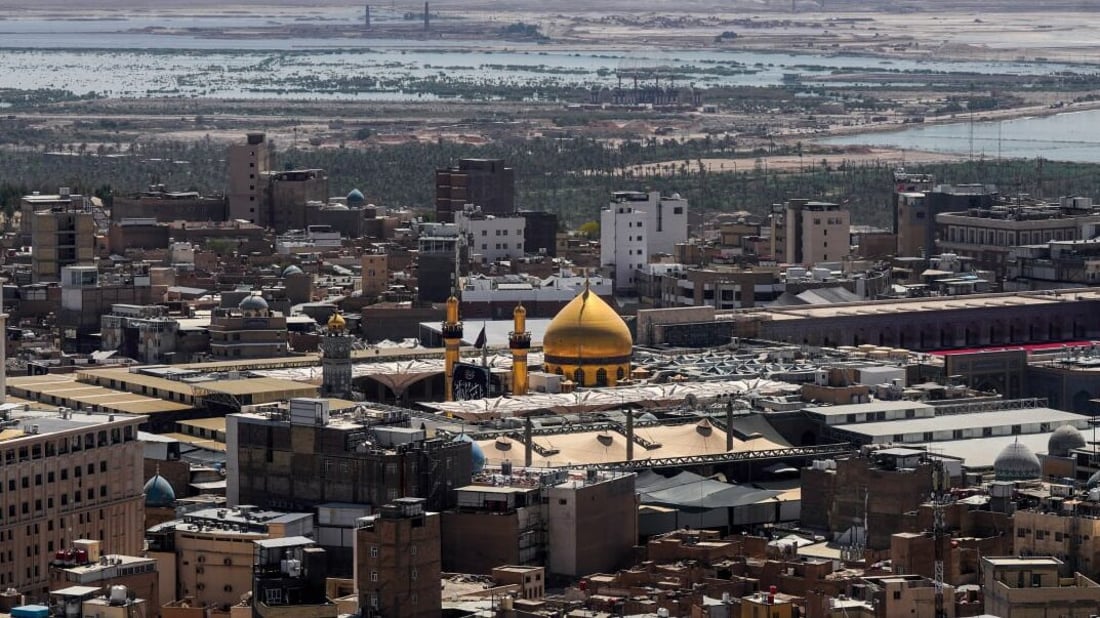
A view of Najaf city
Najaf airport stops Iran flights on orders from the prime minister’s office, source says
NAJAF — Najaf International Airport suspended all flights to and from Iran from 2 a.m. on Friday, stranding passengers who arrived for morning departures, on a directive an airport source said came from the prime minister’s office.
It undercuts the government’s account two days earlier that private handling companies, not the state, had stopped servicing Iranian aircraft.
The airport said all incoming and outgoing Iran flights were suspended until further notice on “official directives from relevant authorities.” An airport administration source, who asked not to be named, told 964media the order reached Najaf governorate from the prime minister’s office, without giving further detail.
Dozens of passengers gathered outside the terminal. “We booked yesterday, and the flight was at 10 a.m. When we arrived at 6 a.m., we were told that flights to Iran had been suspended,” said Ahmed Aidan. “As for the money we paid, we don’t know what will happen to it, and there have been no instructions so far.” Hassan Ali said they were first told to wait for a possible 7:30 a.m. flight that never materialised. “We had to book a car through the Shalamcheh border crossing,” he said. “There are families and patients who have become exhausted from waiting without knowing what is happening, and no one from the airport came out to explain the situation. Who bears responsibility for this? We will pay twice, once for the canceled flight booking and again for ground transportation.”
An Iraqi official said on Wednesday that private ground-handling companies had stopped serving Iranian aircraft for fear of U.S. sanctions and that neither the Transport Ministry nor the Civil Aviation Authority was responsible. A day earlier another official said the Foreign Ministry had told the Transport Ministry to halt support for Iranian aviation. The government has still made no official statement.
Najaf travel agents told 964media this week that about 90% of their business depended on Iranian airlines and warned that a long suspension would push travellers onto long overland journeys to Mashhad and Qom. The Badr parliamentary bloc warned the government against “submitting to these unlawful decisions,” and Harakat al-Nujaba called the halt a submission to “the American occupier.”