
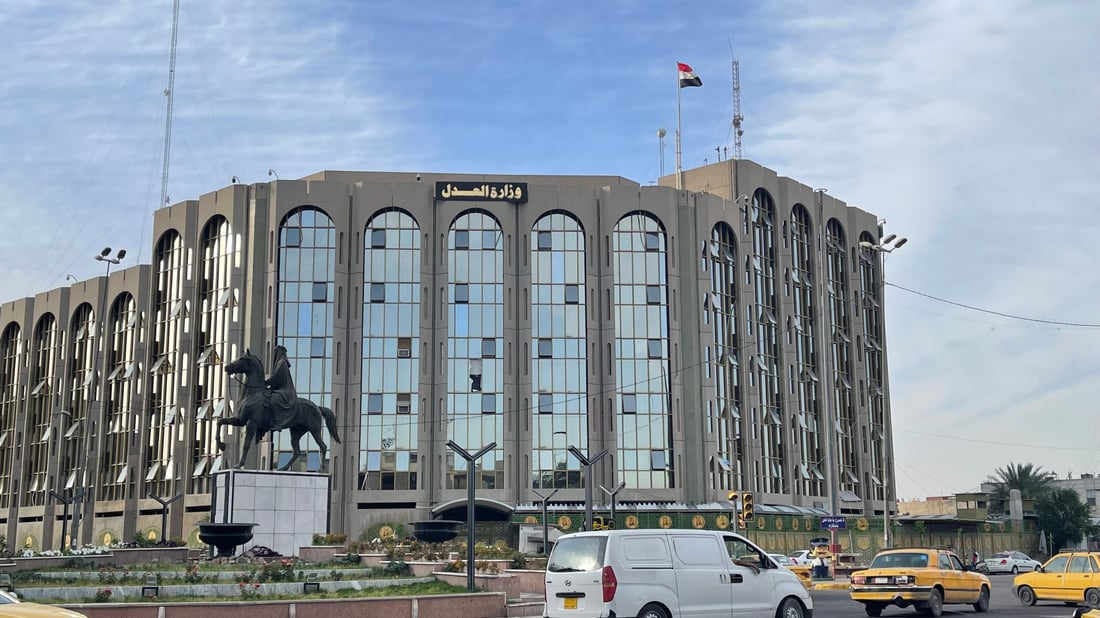
The Iraqi Ministry of Justice building in Baghdad is seen in this photo. The ministry recently announced new projects aimed at prison reform, including the launch of inmate-run factories and a digital payment system.
Centralized surveillance
Iraq to monitor all prisons from one operations center, ministry says
BAGHDAD — Iraq’s Justice Ministry is setting up a central operations center to keep continuous watch on the country’s prisons, track security and administrative procedures and speed up the response to emergencies, the ministry’s media director said in remarks published Monday.
Murad al-Saadi told the state-run newspaper Al-Sabah that the center would run a central system to follow conditions in prisons and keep their operations under constant review. It would bring oversight of all correctional institutions together and improve communication between prison administrations and the ministry’s departments, he said.
Justice Minister Khalid Shwani ordered the center on Nov. 2 at a meeting with administrators of the Iraqi Correctional Department, which runs the ministry’s prisons, according to a ministry statement. The meeting reviewed steps to tackle overcrowding, inmates’ health and rehabilitation programs, as well as the security and administrative problems the department faces.
Saadi said the center would raise security readiness, make prisons run more efficiently, reduce risks and support decisions based on information from direct monitoring.
He did not say when the center would open, what it would cost or whether it would bring new surveillance equipment to individual prisons.
The ministry is also strengthening protection of the legal and human rights of inmates and expanding educational, rehabilitation and vocational programs to help them build skills and return to society after serving their sentences, Saadi said. Prisons should do more than carry out court rulings, he said.
The ministry is working with the Interior Ministry to issue national ID cards and other official documents to inmates. Saadi said this would make sure their personal details are recorded accurately, simplify their paperwork and remove the obstacles they face in getting identity papers.
The center builds on earlier steps to watch prisons from the ministry. In January 2024, the ministry’s Justice Council, chaired by Shwani, ordered the completion of a project linking surveillance cameras in all prison sections to a central center at the ministry and decided that committees overseeing prison food would be rotated regularly. In October 2025, a ministry spokesperson said prisons had been fitted with surveillance camera systems linked to the director general’s office.
In March, Shwani ordered prison forces to the highest level of readiness and closer coordination with the security forces guarding the prisons. The order came a day after air defenses shot down a drone approaching Abu Ghraib prison west of Baghdad, in the first days of the U.S.-Israeli war with Iran.
Overcrowding remains one of the system’s biggest problem. Shwani said in September 2025 that releases under the General Amnesty Law had eased overcrowding from 300% to 132% of capacity. In May, the Iraqi Observatory for Human Rights, a rights group, said at least 400 people died in prisons and detention centers in 2025, blaming torture, medical neglect and severe overcrowding. It estimated that nearly 67,000 prisoners and detainees were held in facilities built for no more than 25,000.
On Oct. 7, National Security Adviser Qasim al-Aboudi discussed overcrowding with Majid al-Mandhour, the Correctional Department’s director general, Aboudi’s office said. They also discussed putting inmates to work, classifying them, separating convicts according to their cases, finishing prisons still under construction and running education courses to rehabilitate inmates.