
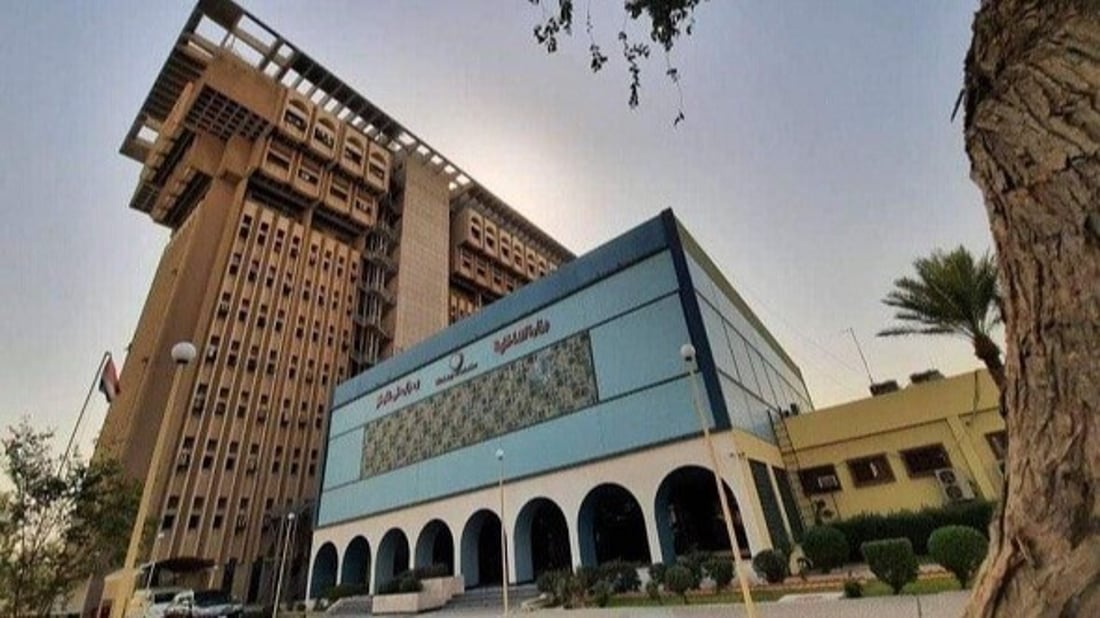
Exterior view of Iraq’s Interior Ministry building in Baghdad
Federal Police chief visits Jurf al-Sakhar after oil smuggling dismissals
BAGHDAD — Lt. Gen. Mohammed Qasim al-Fahd, commander of Iraq’s Federal Police, inspected his forces in Jurf al-Sakhar on Sunday, a day after Prime Minister Ali al-Zaidi relieved nine officials over oil smuggling in the area.
Fahd visited units of the 16th Brigade of the Federal Police, an Interior Ministry force, stationed in Jurf al-Sakhar in northern Babil governorate, the ministry said in a statement. The brigade commander received him.
Fahd called for constant field monitoring, better performance and greater readiness to carry out security tasks efficiently, the statement said. It did not mention the smuggling inquiry.
On Saturday, Zaidi relieved nine security and oil officials, among them Babil’s police chief, the Popular Mobilization Forces commander in Babil and the director of the Oil Ministry’s Oil Pipelines Company. He ordered everyone accused of smuggling referred to the courts. The government has not named the officials or the accused.
The committee Zaidi formed confirmed information in a Federal Intelligence and Investigations Agency report on oil smuggling and the existence of oil refineries, and found cases of manipulation, Sabah al-Numan, spokesperson for the commander-in-chief of the armed forces, said in a statement. Zaidi received the findings at an emergency security meeting.
The statement did not mention Kataib Hezbollah, the Iran-aligned faction widely regarded as controlling Jurf al-Sakhar, or say who ran the smuggling.
Ayad al-Janabi, spokesperson for the tribes of Jurf al-Sakhar, told Al-Rasheed TV on Saturday that Kataib Hezbollah had massed armored vehicles at the area’s main entrance. The Federal Police are deployed on the area’s edges, while the faction controls all of it, he said. 964media could not independently verify the deployment.
Earlier Saturday, sources told 964media that Zaidi had let a PMF security official lead the inquiry under a deal with PMF Chief of Staff Abdul Aziz al-Muhammadawi, after Kataib Hezbollah refused to let his first committee into the area. The official is from the Popular Mobilization Commission, the state body that runs the PMF. Under the deal, investigators visited only sites agreed in advance, the sources said.
The PMF is the state-sanctioned umbrella of mostly Shiite armed groups formed in 2014 to fight the Islamic State group. Kataib Hezbollah has brigades in the PMF, and the United States designated it a terrorist organization in 2009.
The intelligence report began circulating Monday. It alleges that oil is drawn from a pipeline in Jurf al-Sakhar through an unauthorized opening and carried away in tanker trucks. The Federal Intelligence and Investigations Agency, an Interior Ministry body, was one of five bodies Zaidi named Wednesday to carry out the inquiry. A document dated Thursday lists 11 committee members.
Babil Governor Ali Turki rejected the allegations Tuesday, saying the site named in the report was an old fuel station used to fuel Federal Police and PMF vehicles. He said Thursday that he had resigned over the case, and a source told 964media he quit under pressure from Qais al-Khazali, leader of the Iran-aligned faction Asaib Ahl al-Haq. At a news conference Saturday, Turki declined to answer reporters’ questions about his resignation. He said the event was about services projects, “not a political conference.”
Jurf al-Sakhar, in northern Babil, was officially renamed Jurf al-Nasr in 2014 after Iraqi forces and allied armed groups recaptured it from Isis. It has been closed since then, and many of its displaced residents still cannot return.