
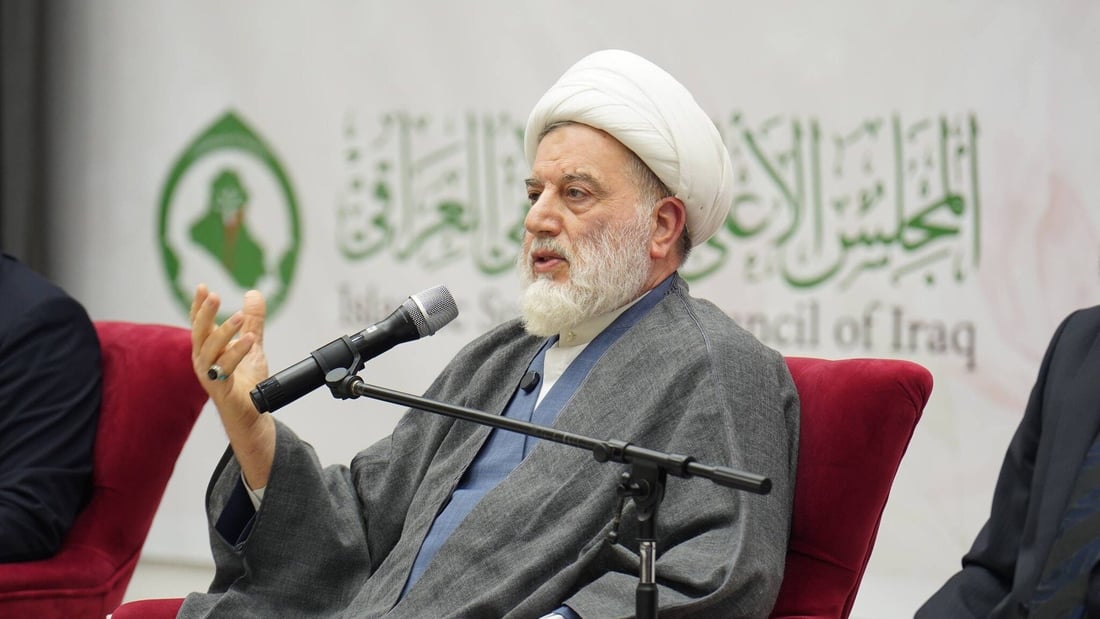
FILES: Hummam Hamoudi, head of Iraq’s Islamic Supreme Council, speaks during a political forum in Baghdad.
Hammoudi says oil belongs to all Iraqis, rejects PMF ‘militias’ label
BAGHDAD — Humam Hammoudi, head of the Islamic Supreme Council of Iraq, said Sunday that any infringement on Iraq’s oil was an infringement on public wealth and rejected the description of the Popular Mobilization Forces as “militias.”
Speaking at the Dialogue Forum in Baghdad, Hammoudi said, “Oil belongs to all the Iraqi people, and any infringement upon it is an infringement upon the people’s wealth. Protecting it must be a shared responsibility involving everyone, without mixing different issues together.”
His remarks came a day after Prime Minister Ali al-Zaidi relieved nine security and oil officials and ordered everyone accused of oil smuggling in Jurf al-Sakhar, in northern Babil, referred to the courts after his inquiry presented its findings. Kataib Hezbollah, an Iran-aligned faction with brigades in the PMF that the United States designated a terrorist organization in 2009, is widely regarded as controlling the area.
Hammoudi said the PMF was a government institution linked to the prime minister, and he rejected some Arabs calling it militias. The media should remember the force’s fallen fighters and highlight its role and importance, he said.
The PMF was formed in 2014 after Grand Ayatollah Ali al-Sistani’s call to fight the Islamic State group and was recognized by law in 2016 as part of Iraq’s security forces under the commander-in-chief. It is an umbrella of dozens of brigades, some closely tied to Iran. A new PMF law approved by the cabinet on Sept. 29 would replace the 2016 law and set out the force’s structure, powers and the rights of its personnel.
Hammoudi’s party belongs to the Coordination Framework, the ruling alliance of Shiite parties. He also defended Iraq’s ties with Iran. “The Islamic Republic of Iran played an important role in supporting the Iraqi state in confronting Isis and sacrificed martyrs. Between us are visits involving millions of people, trade exchanges and energy support,” he said.
“The Iraqi people’s participation in the funeral of the martyred Sayyid Khamenei was an expression of loyalty. Therefore, the Framework and the prime minister consider participation in the blockade of Iran a position that is inconsistent with the values and ethics of our Iraqi people,” he added.
Iran’s supreme leader Ali Khamenei was killed on Feb. 28, the first day of the U.S.-Israeli war with Iran. His body was received in Najaf in July for an Iraq leg of the funeral. Hammoudi did not say what participation in a blockade he meant. Kataib Hezbollah’s security official, Abu Mujahid al-Assaf, said on Nov. 3 that Iraq’s ruling alliances had approved the country’s part in a blockade of Iran. He gave no evidence.
On Tuesday, Iraq reopened the al-Sheib border crossing with Iran, nearly three weeks after closing it on Zaidi’s instructions. Government spokesperson Haider al-Aboudi had said its technical and logistical facilities needed upgrading. The Mandali crossing was due to close temporarily from Friday for maintenance before the rainy season. Foreign Minister Fuad Hussein said in an interview with Al Jazeera on Nov. 7 that the United States had formally asked Iraq to close all but two of its crossings with Iran.
Hammoudi said the Framework had chosen the government, and that everyone bore responsibility for cooperating with it and making its program succeed while working to improve the economy and living standards. “What we need today are statesmen, not men seeking positions: officials who strengthen the institutional foundations of the state and make the public interest their first and last priority,” he said.
On the constitution, Hammoudi, who chaired the committee that drafted it in 2005, said it “was written to suit Iraq’s circumstances, crises and identity, and sought to ensure everyone’s participation in governance. What was written consisted of principles, leaving the legislative institution room to keep pace with developments through legislation.”
Supreme Judicial Council President Faiq Zaidan took a different view on Wednesday at Chatham House’s annual Iraq Initiative conference in London. He said many of Iraq’s problems since 2003 came from constitutional provisions open to more than one reading and that he had proposed several times that the ambiguous texts be amended. “There are provisions that are not read on the basis that one plus one equals two. Some say three, and others say four,” he said.