
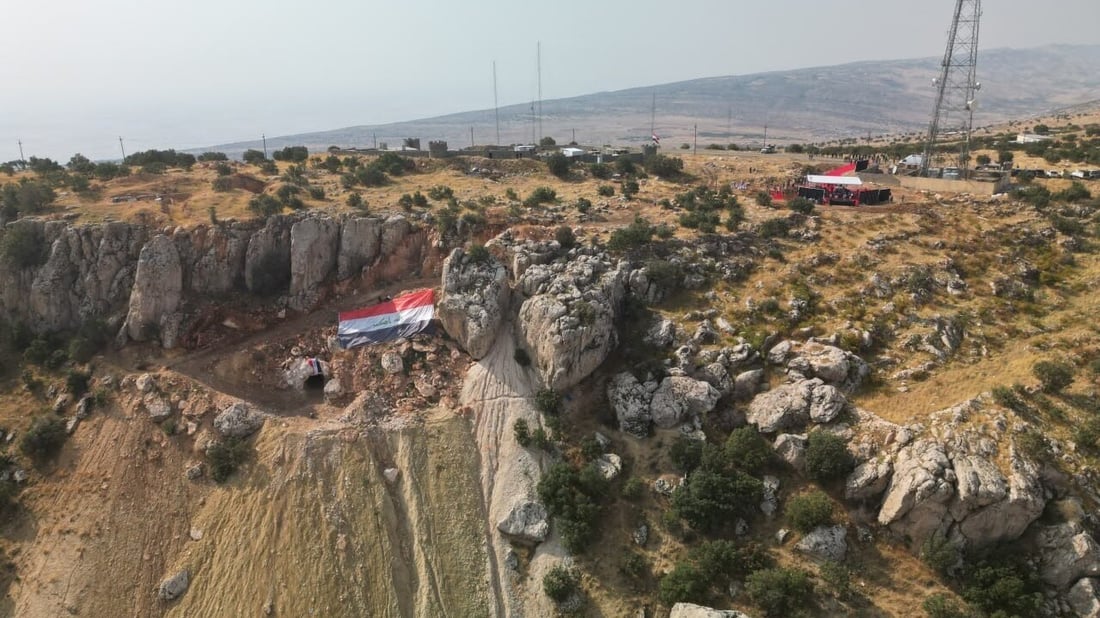
An Iraqi flag flies over a rocky section of Mount Sinjar in Nineveh governorate, northern Iraq.
Baghdad says Sinjar security is a federal matter after Erbil objects
BAGHDAD — Baghdad said Wednesday that security in Sinjar is for the federal government alone, pressing ahead with merging the district’s Yazidi-majority armed groups into state forces a day after the Kurdistan Regional Government accused it of acting unilaterally.
Sabah al-Numan, spokesperson for the commander-in-chief of the armed forces, said in a statement that the steps taken in Sinjar were field and military measures, part of the work of the committees charged with bringing all weapons under state control. The issue is the exclusive responsibility of the federal government and its security commanders, he said.
Putting the army and other security forces in full control, including taking over the Mount Sinjar area, is a pillar of state authority and the rule of law, Numan said. He added that the government was open to resolving problems over how weapons are handed over and how the fighters are absorbed, under the laws in force.
Federal authorities are working with Sinjar’s local government on reconstruction, compensation for victims’ families and a faster return for displaced residents, Numan said, with the aim of electing a local government for the district under the law.
The KRG Interior Ministry said in a statement late Tuesday that it was watching “with concern” the understandings Baghdad was reaching on Sinjar unilaterally and without consulting Erbil. Any such step violates the Sinjar Agreement, signed in October 2020 under UN supervision, the ministry said.
“Imposing an unwanted security and administrative reality outside legitimate institutions makes the area’s situation more complicated and aborts the normalization process,” the statement said.
Full implementation of the agreement is the only correct solution and the only guarantee of a legitimate administration run by the area’s true representatives, of reconstruction and of security, the ministry said. Those are the conditions for the return of hundreds of thousands of Yazidis, it said.
If the agreements cannot be carried out, the ministry said, Sinjar’s people, especially the Yazidis, should decide who and what they want, and everyone should back their choice.
It also reminded Baghdad that Sinjar and Mount Sinjar “were liberated with the red blood of 500 martyrs and 3,000 wounded of the heroic Peshmerga.” Peshmerga forces, with Yazidi fighters and U.S.-led airstrikes, retook the town of Sinjar from the Islamic State group in November 2015.
On Monday, the Sinjar Resistance Units, including their women’s units, agreed to merge their 4,165 fighters into federal security forces, ending their separate military command. The Yazidi-majority force, which has ties to the Kurdistan Workers’ Party, or PKK, was formed after Isis’s 2014 genocide against Yazidis and says 530 of its fighters were killed in the years that followed.
The government said the same day that federal authorities would take over security on Mount Sinjar under the supervision of Prime Minister Ali al-Zaidi. The groups asked for guarantees of their members’ legal status and of the rights of the wounded and the families of those killed. Neither side has given a timetable or said how the fighters will be divided among the security forces. Zaidi told state-run Al-Iraqiya TV on Friday that they would join the Popular Mobilization Forces.
Baghdad and Erbil signed the UN-backed agreement on Oct. 9, 2020, to restore local administration in Sinjar, place security under official forces and remove armed groups operating outside state control. Its implementation stalled, and the KRG Interior Ministry said in October 2025 that none of its provisions had been carried out. Sinjar has had rival local administrations since federal forces took control of the district in October 2017, one of them working from Duhok.
Sinjar also weighs on Iraq’s relations with Turkey, which regards the Sinjar Resistance Units as a PKK affiliate. Iraq agreed with Turkey on Sept. 23 to establish full state authority in Sinjar and end the presence of banned foreign armed groups there, and Turkey agreed to gradually hand its Bashiqa-Zilkan base, northeast of Mosul, to the federal government.
Numan told the state-run Iraqi News Agency on Tuesday that Ankara had cited the PKK’s presence to justify keeping troops in Iraq. Bringing all weapons under state control would take that argument away, he said, and the merger would help the government’s efforts to end the Turkish military presence.