
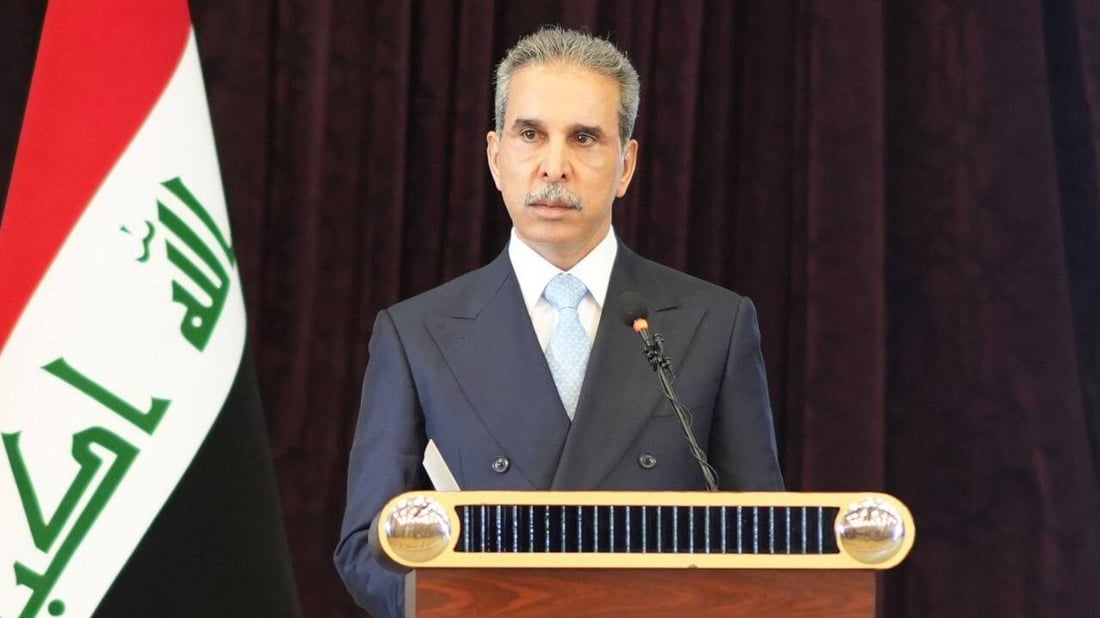
Iraq’s Supreme Judicial Council head Faiq Zaidan
Iraq’s top judge gives post-2003 political system 4 out of 10
LONDON — Iraq’s post-2003 political system has not lived up to what Iraqis hoped for and deserves no more than 4 out of 10, Supreme Judicial Council President Faiq Zaidan said Wednesday at Chatham House’s annual Iraq Initiative conference.
Zaidan, whose council runs Iraq’s courts, spoke at the conference’s closing session, on the judiciary and political stability. He defended Iraq’s ties with Iran, called for rewriting the constitutional article on forming governments and rejected criticism that the courts had failed to tackle corruption.
On whether the political system set up after 2003 had lived up to the hopes and ambitions of Iraqis, he said: “Frankly, no. If the full mark is 10 and I wanted to give a reasonable score, I do not think it would exceed 4, in my assessment as a citizen.”
“But the road after 2003 was not paved with roses,” he said. He contrasted Iraq with Syria, which he said had won the backing of Arab and other governments after Bashar al-Assad was ousted in December 2024.
“In Iraq, everyone stood against us, except the countries that sponsored freeing Iraq from dictatorship, I mean America and Britain,” Zaidan said. Some European countries opposed the new system because they had personal and economic ties with Saddam Hussein, he added.
“That is why I believe the democratic system in Iraq was born by cesarean section,” he said.
Several Arab governments kept their distance from the new Baghdad for years. Saudi Arabia reopened its embassy in Baghdad only in December 2015, 25 years after closing it over Iraq’s 1990 invasion of Kuwait.
Zaidan said Iraq should deal with Iran as it does with Turkey, Syria, Saudi Arabia and Kuwait, on the basis of good neighborly relations, mutual benefit and noninterference in internal affairs. “Iran represents a geographical reality from which we cannot be isolated,” he said.
Iraq has long relied on Iranian gas for a large share of its electricity.
To make the point, Zaidan told a story that he said a friend had told him. A U.S. ambassador visiting the late President Jalal Talabani at home noticed three portraits hung side by side: former UN Secretary-General Kofi Annan, Ayatollah Ruhollah Khomeini, the founder of Iran’s Islamic Republic, and former U.S. President George W. Bush.
When the ambassador asked why, Talabani said Annan had pushed for the 36th parallel line that protected the Kurds from Saddam after the 1991 uprising, Bush had led the liberation of Iraq from Saddam and Khomeini stood for a 1,400-kilometer border with Iraq, according to Zaidan.
The United States, Britain and France set up the no-fly zone north of the 36th parallel in 1991. Annan became UN secretary-general in 1997. Talabani, who founded the Patriotic Union of Kurdistan, was Iraq’s president from 2005 to 2014 and died in 2017.
Zaidan said sensitivity about Iraq’s relationship with Iran was greatly exaggerated. “We always send the message that Iraq is an independent country that makes its own sovereign decisions and has a parliament,” he said.
He acknowledged that many Iraqi party leaders had lived in Iran under Saddam. Some Arab countries would not let them live on their soil, he said, because Saddam’s government could impose its political will even on neighboring states.
Zaidan said many of Iraq’s problems since 2003 came from constitutional provisions open to more than one reading. He said he had proposed several times that the ambiguous texts be amended. “There are provisions that are not read on the basis that one plus one equals two. Some say three, and others say four,” he said.
The provisions on the Kurdistan Region’s right to extract and sell oil were still interpreted in two ways, both of them wrong, Zaidan said. He did not say how they should be read. Baghdad and Erbil have disputed control of the Region’s oil for years, and the Federal Supreme Court struck down the Region’s oil and gas law in 2022.
Every election is followed by a struggle to form a government because the article that governs the process is read in different ways, Zaidan said. In what he called his personal view, Article 76 should be rewritten to give the party that wins the election the right to form the government, not the bloc put together after the results.
“The principle of giving the winning party the right to form the government is consistent with the principles of democratic competition,” he said.
Zaidan made the same case in March, when he proposed revisiting the Federal Supreme Court’s 2010 ruling that lets a bloc formed after the vote claim the right to name the prime minister. The ruling helped Nouri al-Maliki to a second term, although Ayad Allawi’s Iraqiya list had won 91 seats to 89 for Maliki’s State of Law Coalition.
In the November 2025 election, former Prime Minister Mohammed Shia al-Sudani’s Reconstruction and Development Coalition won the most seats, 46. The Coordination Framework, the ruling Shiite alliance that includes it, declared itself the largest bloc, and Ali al-Zaidi, now prime minister, was named prime minister-designate on April 27.
Zaidan rejected criticism that the courts had not matched the scale of corruption in Iraq. He said judges rule on the findings of investigations by executive and oversight bodies.
“If oversight and investigative agencies are weak in performing their duties, this will be reflected in the judiciary’s work because the judiciary will not find a case file to work on,” he said.
What had changed recently, Zaidan said, was that the current government had “a real will to fight corruption.” For the first time, he said, large numbers of politicians, lawmakers and even ministers faced corruption charges, with no red lines. “I do not exaggerate if I say that no Arab country can achieve what we have achieved under the law,” he said.
Since September, courts have jailed sitting and former lawmakers in cases that followed the June 28 “Dawn Strike” raids in Baghdad’s Green Zone. They include Azm Alliance leader Muthanna al-Samarrai, jailed for six years over refinery contracts on Oct. 29.
Freedom of expression was one of the blessings that came after 2003, Zaidan said. Before then, he said, people were executed just for criticizing the government. He said he knew a TV presenter who was referred to the Revolutionary Court and sentenced to life in prison after saying that Saddam, who was not wearing a tie, was not dressed like a president. She got a life sentence because she had a young daughter and is still alive, he said.
The problem in Iraq was the line between free expression and breaking the law, Zaidan said, because some people take free speech to mean “insults and abuse” and leveling accusations at others.
“I challenge anyone to point to a journalist held in prison on a charge of violating freedom of expression, or because he criticized the government, the judiciary or parliament. There is none,” he said.
The Press Freedom Advocacy Association in Iraq documented 34 arrests and detentions of journalists across the country in 2025, along with 28 lawsuits tied to their work. Baghdad recorded the most violations, 62. The group also accused the government of relying on lawsuits brought under laws dating from Baath Party rule, which ended in 2003.
Zaidan has headed the Supreme Judicial Council since 2017. On Tuesday he met U.S. envoy Tom Barrack in London, who called for closer ties between the Iraqi and U.S. judiciaries.