
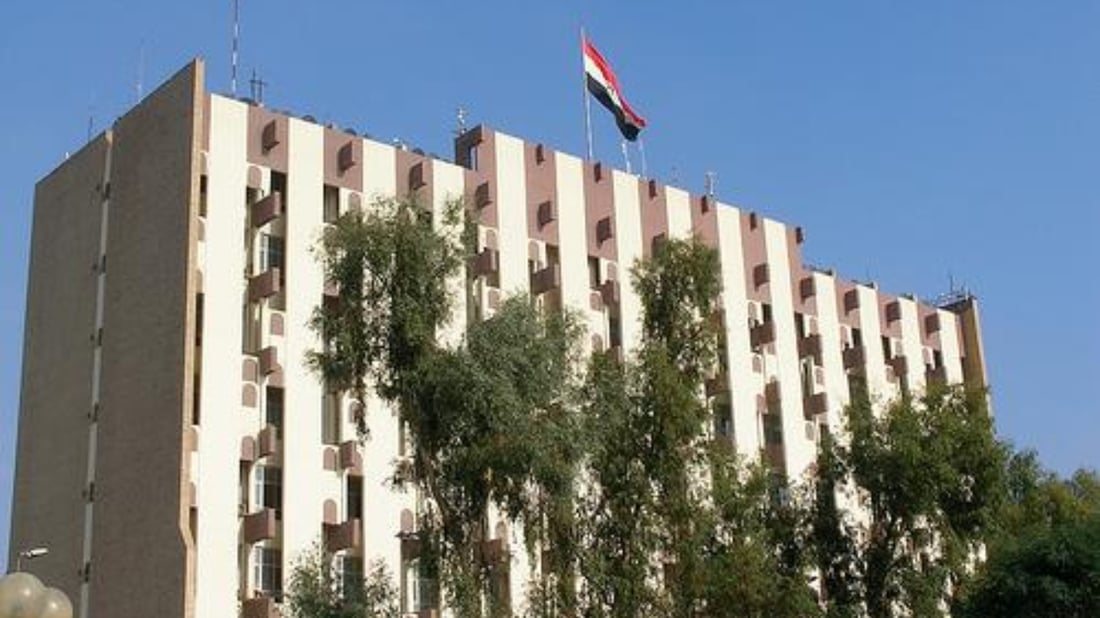
The Iraqi National Intelligence Service headquarters in Baghdad’s Mansour area
Factions seek Iraq intelligence post despite US veto, paper says
BAGHDAD — Six days after Prime Minister Ali al-Zaidi removed Hamid al-Shatri as head of the Iraqi National Intelligence Service, the government has not named a successor.
On Thursday Zaidi said the service must be kept out of the quota system that shares out government posts among parties, factions and sects. Two days earlier the government’s Security Media Cell denied claims of a plan to appoint a figure from a particular region or group to lead the service, and said any new head would be announced officially.
At least four armed factions are competing for the post and plan to get around U.S. objections by putting forward candidates presented as independent technocrats, the Baghdad daily Al-Mada reported Sunday. Citing political sources and leaders of the Coordination Framework, the ruling alliance of Shiite parties, it said signals had reached Baghdad that Washington would be unlikely to accept an intelligence chief tied directly to the factions. The fallback is to name candidates who declare themselves independent while remaining under the factions’ influence, the newspaper said.
Anyone outside the factions’ circle who goes for the post risks accusations that could carry the death penalty, Al-Mada reported. Sunni circles argue that the post belongs to Sunnis under the informal sharing of posts that has shaped Iraq’s political system since 2003, it said, but Shiite sources close to the Framework ruled that out.
A Framework leader who asked Al-Mada not to publish his name said Mohammed al-Halbousi, leader of the Sunni Taqaddum Party and a former speaker of parliament, had been floated for the post. So had Waqas al-Hadithi, an official who the newspaper said has faced accusations in the past. Then-National Security Adviser Qasim al-Araji described Hadithi in March as the service’s deputy head.
The pressure included hints that old allegations against Mohammed al-Halbousi of contacts with Israel could be reopened, with signals that this could lead to life imprisonment or execution under Iraq’s 2022 law criminalizing normalization with Israel, the leader said. The allegations surfaced after the Federal Supreme Court ended Mohammed al-Halbousi’s term as speaker in a forgery case in November 2023, and concerned an election publicity company said to have Israeli links, according to the newspaper. Mohammed al-Halbousi has acknowledged that he was investigated over them, but he was not convicted.
Kataib Hezbollah, an Iran-aligned faction the United States designates a terrorist organization, named Hadithi in a statement after a drone strike on the service’s headquarters in Baghdad’s Mansour district killed an officer on March 21. The statement alleged close ties between him and Israel’s Mossad, Al-Mada said. The group denied carrying out the strike and blamed an officer inside the service.
Shiite circles also say Kataib Hezbollah could join the government for the first time as about 50 sensitive posts are redistributed, Al-Mada reported. According to leaks cited by the newspaper, its share could include border crossings, five deputy minister posts, 32 director general posts and security posts in the intelligence service. A lawmaker from the Reconstruction and Development Coalition said last week that Zaidi planned to change 50 posts.
People close to Zaidi told Al-Mada that he had made progress in direct talks with the factions, but that the dispute over the intelligence post remained unsettled and he was running the service himself in an acting capacity. The government has not announced who is running it. Former Prime Minister Mohammed Shia al-Sudani also kept the service in his own hands for about two years before appointing Shatri in December 2024, the newspaper said.
The service sits where U.S. and Iranian influence meet, Ahmed al-Yasiri, head of the Arab-Australian Center for Strategic Studies, told Al-Mada. It was set up under U.S. sponsorship after 2003 and tied directly to the prime minister’s office, he said, and while Tehran keeps trying to take control of it, Washington tries with each new government to keep it out of the factions’ reach.
The service holds much of the central data on the factions, what Yasiri called “shadow factions,” and on networks linked abroad, especially to Iran, he said. In his view, that explains its role in major U.S. operations, including those against Islamic State group leader Abu Bakr al-Baghdadi and Qassem Soleimani, commander of the Quds Force of Iran’s Islamic Revolutionary Guard Corps.
Baghdad has set June 30, 2027, as the deadline for armed factions to hand their weapons to the state. Kataib Hezbollah said on Sept. 30 that it was not bound by any timetable for handing over weapons.