
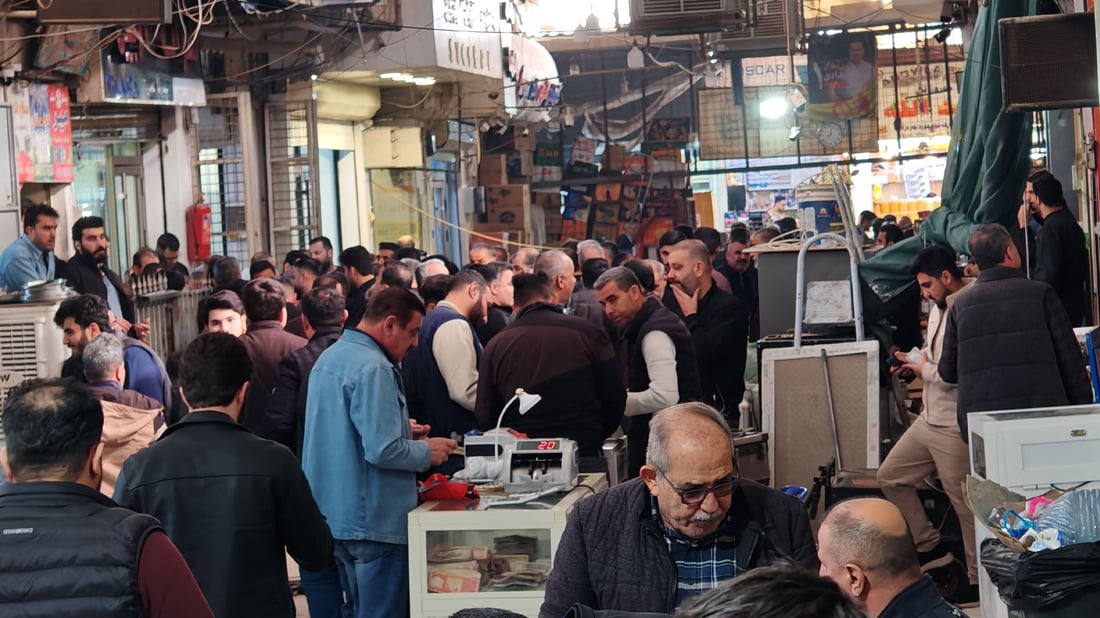
Dollar climbs in Erbil as market spokesperson blames Khor Mor attack
ERBIL — The dollar kept climbing in Erbil on Wednesday, reaching 169,500 dinars per $100, and the spokesperson for the city’s dollar market blamed a shortage of dollars and the attack on the Khor Mor gas field.
Exchange shops in Erbil sold $100 for 169,500 dinars on Wednesday morning, 1,000 more than on Sunday morning, before the attack, according to 964media’s daily rate check. They bought it for 169,200.
In Baghdad and Basra, $100 sold for 169,250 dinars and was bought for 168,750. On Sunday morning it sold for 169,000 in Baghdad and 168,750 in Basra. The Central Bank’s official rate is 152,000 dinars per $100, which puts the Erbil price about 11.5% higher.
A lack of dollars in the market is driving the price up, Kaifi Khoshnaw, the market’s spokesperson, told 964media. In 2014, when Iraq was at war with the Islamic State group, the dollar traded at 120,000 dinars per $100, he said.
“We hope Ali al-Zaidi keeps his promise, because now everything is done in dollars,” Khoshnaw said.
Zaidi, the prime minister, said on Oct. 23 that the parallel rate would soon fall to 155,000 dinars per $100, with Washington sending $1 billion in cash.
Deputy Prime Minister Mohammed Ali Tamim said on Nov. 1 that the parallel rate would come very close to the official one. He credited $3 billion in cash that he said Washington had decided to send over two months.
Even the attack on Khor Mor had an effect, adding 500 to 600 dinars to the price of $100, Khoshnaw said.
The attack late Sunday on the field, in Sulaymaniyah governorate’s Chamchamal district, knocked nearly 3,000 megawatts off the Kurdistan Region’s grid. Its operators, the UAE-based Dana Gas and Crescent Petroleum, say the field fuels more than 80% of the Region’s electricity generation.
The budget deficit and the closure of the Strait of Hormuz are also behind the rise, Khoshnaw said. If Iraq found $400 million, the shortfall would disappear, he said.
Shipping through the strait, Iraq’s main oil export route, has been disrupted since the U.S.-Israeli war with Iran began on Feb. 28.
Mahmoud Dagher, an adviser to the Central Bank governor and the bank’s spokesperson, said in a television interview on Tuesday that the gap between the official and market rates would last as long as some borders were not fully controlled and foreign trade bypassed official channels.
Since Oct. 7, the Central Bank buys dollars from the Finance Ministry at 1,500 dinars, sells to banks at 1,510 and sets the public rate at 1,520, up from 1,300, 1,310 and 1,320.