
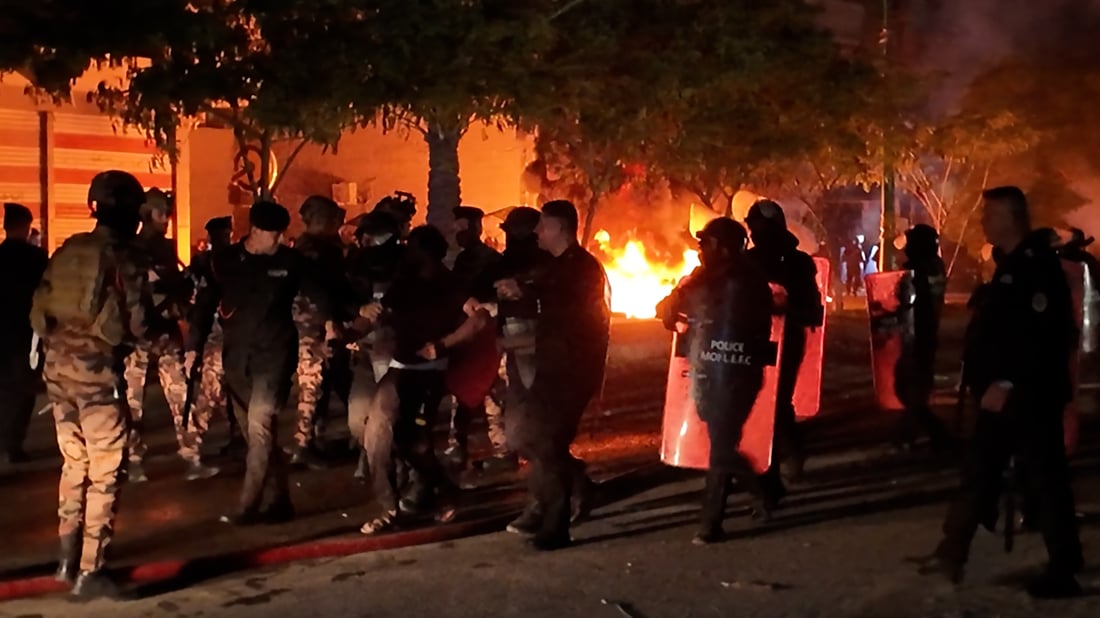
Security forces confront demonstrators in Kirkuk on the night of Nov. 1, 2026, as fires burn in the background during protests over increased private electricity generator fees.
Revised tariffs
Kirkuk cuts generator fees after night of clashes over price rise
KIRKUK — Kirkuk authorities on Monday cut private generator fees to 15,000 dinars (about $8.90) per ampere a month from 18,000 (about $11), after a night of clashes that injured security personnel and protesters.
The new rate partly reverses an increase that set off protests across the city Sunday evening. It remains 1,000 dinars (about 59 cents) above the previous rate of 14,000 dinars (about $8.30).
The Kirkuk district administration’s directive cited difficult economic conditions, rising household costs and the need to ease the financial pressure on residents. The 15,000-dinar rate applies to every neighborhood in Kirkuk city, with no exceptions.
Generator owners may not charge subscribers any additional fees. Inspection committees will monitor compliance, record violations and take legal and administrative action against operators who ignore the new rate, according to the directive, which also revoked all earlier decisions and instructions that conflict with it.
Hawri Zangana, an administrative affairs official at the district administration, announced on Sunday that the rate for October consumption across the city would rise by nearly 29%, from 14,000 to 18,000 dinars per ampere. The rate was set after the district administration met the generator owners’ association.
Zangana said the national grid supplies only a few hours of power a day and diesel on the black market had reached 280,000 dinars a barrel (about $170 at the street rate). That is about 1,760 dinars a liter, more than four times the subsidized price of 400 dinars. He said the subsidized allocation of 20 liters per kilovolt-ampere covers only about 109 hours of generator running time a month.
Protests began that evening in Kirkuk’s June 1 neighborhood. Residents told 964media the increase would place an additional burden on families already struggling with rising living costs.
“My words are for the politicians: Kirkuk belongs to no one. Kirkuk is not just for posts and ranks, Kirkuk is not just for profit and interests. You must find a solution for these people,” one protester told 964media.
The demonstrations spread to the Asra neighborhood and Airport Street, where protesters blocked roads with burning tires. At least three security personnel and several protesters were injured in clashes, according to preliminary information from 964media correspondents on the ground. Security forces dispersed protesters with batons and detained four.
The unrest escalated late Sunday in the June 1 neighborhood, where some protesters threw Molotov cocktails at security forces. Hundreds of officers were deployed as riot police tried to disperse the crowds and civil defense teams put out fires. The protests came hours after Interior Minister Yasser al-Maliki arrived in Kirkuk, where he said security must be kept out of political rivalries.
Private diesel generators remain an essential source of electricity for homes and businesses across Iraq because the national grid cannot supply power around the clock. Subscribers pay a monthly fee for the number of amperes they take, with prices generally set by local authorities according to grid supply, fuel costs and required operating hours.
The dispute comes after private generator owners announced a nationwide shutdown in August over taxes, fuel allocations and fees. Prime Minister Ali al-Zaidi then ordered subsidized fuel for generators through September at 400 dinars a liter (about 30 cents at the official rate at the time), double the price set in May, and required operators to provide at least 20 hours of power a day in combination with the national grid.
The Baghdad Provincial Council on Monday cut its November rates to 12,000 dinars (about $7.10) per ampere for premium service and 8,000 dinars (about $4.70) for regular service.
The Kirkuk district administration also set the November schedule for private generators: power from 6 a.m. to 9 a.m. and from noon to 1 a.m., or 16 hours a day.