
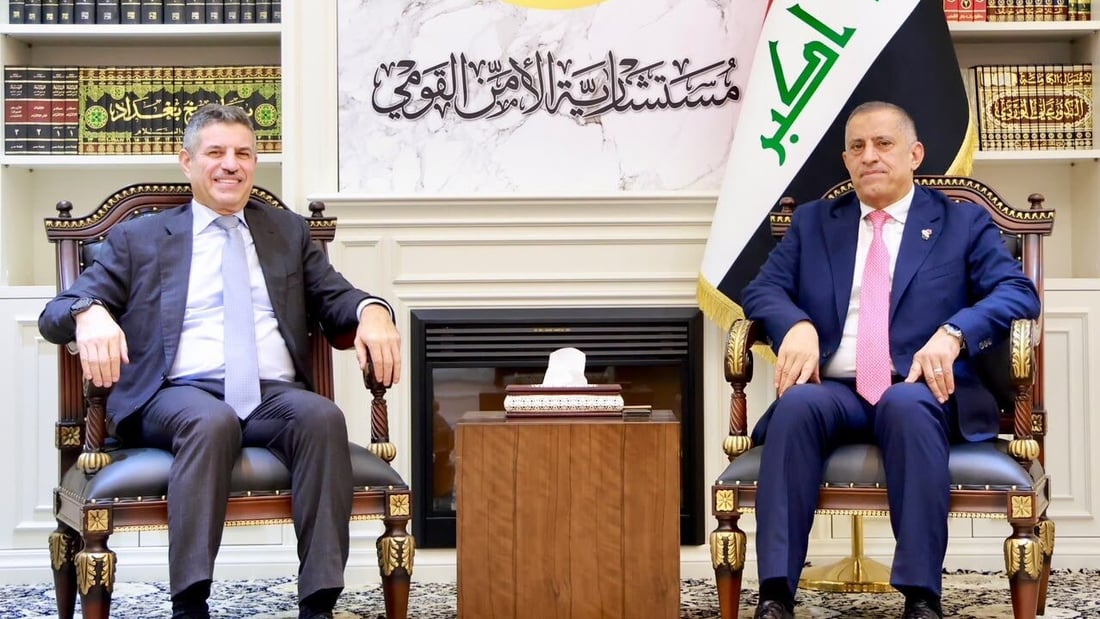
Iraq’s National Security Adviser Qasim al-Aboudi (right) meets U.S. Chargé d’Affaires Steven Fagin in Baghdad on Oct. 28, 2026.
Iraq’s security adviser and US diplomat discuss rebuilding Sinjar
BAGHDAD — National Security Adviser Qasim al-Aboudi and U.S. Chargé d’Affaires Steven Fagin discussed rebuilding Sinjar on Wednesday, the same day Baghdad told the Kurdistan Regional Government that security in the Yazidi-majority district is for the federal government alone.
The two also discussed bringing all weapons under state control, strengthening state institutions and enforcing the rule of law, Aboudi’s office said in a statement after the meeting at the National Security Advisory in Baghdad.
The statement said they discussed the importance of rebuilding Sinjar and restoring its damaged areas so displaced residents can return. Aboudi told Fagin that Prime Minister Ali al-Zaidi’s government was giving the issue attention and would address it as one of the priorities of its program.
Fagin said the United States supported the Iraqi government and its program and was ready to keep cooperating and coordinating with Baghdad, according to the statement. It announced no new agreement and no U.S. funding for Sinjar’s reconstruction.
Aboudi also raised Sinjar when he met Fagin on Sept. 22, calling for support for its reconstruction and telling him the government remained committed to restricting weapons to the state. The government has set June 30, 2027, as the deadline for armed factions to hand over their weapons, and Tom Barrack, the U.S. special presidential envoy to Iraq and Syria, told Al-Monitor in September that Washington and Baghdad had agreed on it.
Wednesday’s meeting followed two days of dispute between Baghdad and Erbil over Sinjar. On Monday, the Sinjar Resistance Units, including their women’s units, agreed to merge 4,165 fighters into federal security forces, ending their separate military command. The government said the same day that federal forces would take over security on Mount Sinjar, west of Mosul in Nineveh governorate.
The Yazidi-majority force, which has ties to the Kurdistan Workers’ Party, or PKK, was formed after the Islamic State group’s 2014 genocide against Yazidis in Sinjar.
The KRG Interior Ministry said in a statement late Tuesday that Baghdad was reaching understandings on Sinjar unilaterally and without consulting Erbil, in violation of the Sinjar Agreement, which Baghdad and Erbil signed with UN backing in October 2020.
Sabah al-Numan, spokesperson for the commander-in-chief of the armed forces, replied Wednesday that security in Sinjar is the exclusive responsibility of the federal government and that the army and other forces would take full control, including of Mount Sinjar. Federal authorities are working with Sinjar’s local government on reconstruction, compensation for victims’ families and a faster return for displaced residents, he said.
The 2020 agreement was meant to restore local administration in Sinjar, place security under official forces and remove armed groups operating outside state control. Its implementation stalled, and Sinjar has had rival local administrations since federal forces took control of the district in October 2017.