
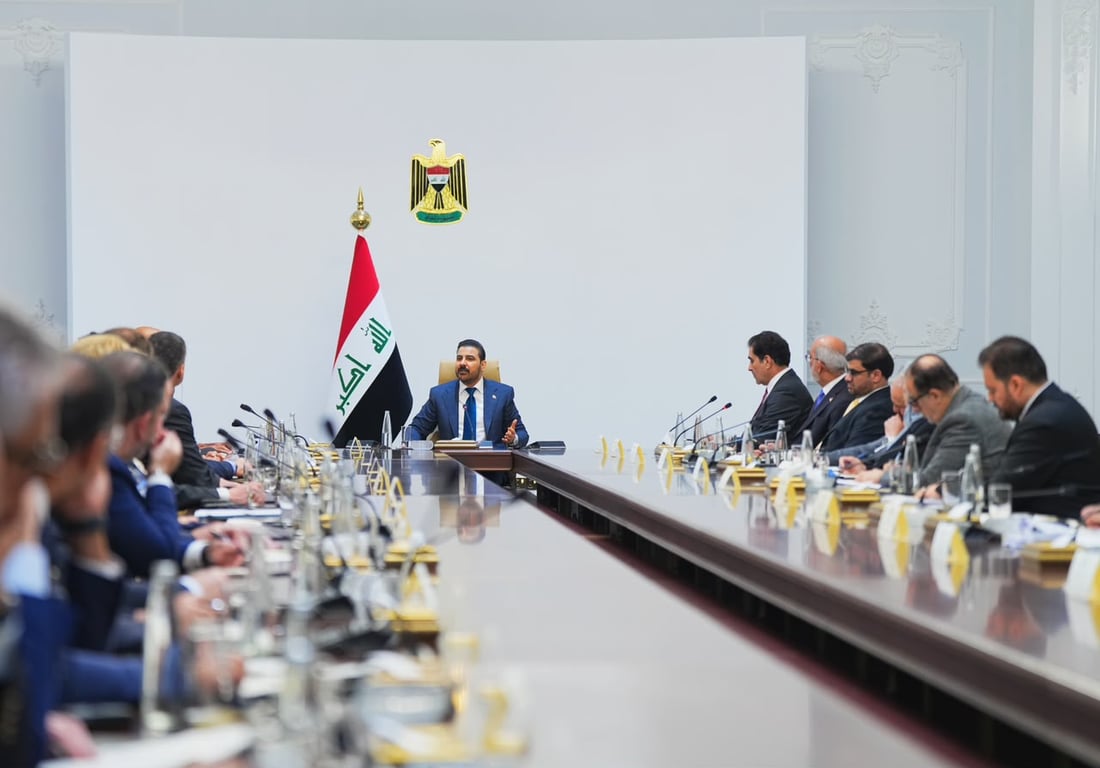
Iraqi Prime Minister Ali al-Zaidi chairs a meeting with representatives of American and multinational companies in Baghdad on Nov. 5, 2026, to discuss plans for oil pipelines linking Iraq to Mediterranean and Red Sea ports.
Export diversification
Iraq’s PM Zaidi pledges to clear way for oil pipeline to Mediterranean, Red Sea
BAGHDAD — Prime Minister Ali al-Zaidi on Thursday promised to remove every obstacle to a planned pipeline carrying Iraqi crude to ports on the Mediterranean and the Red Sea, his media office said.
Zaidi made the pledge to representatives of the consortium of U.S. and multinational companies taking part in the project, the office said in a statement received by 964media. It did not name the companies or say which ports the line would reach, and it gave no route, cost or timetable. In a separate meeting the same day, Zaidi told ExxonMobil’s representative in the Middle East that the government was pressing ahead with plans to expand Iraq’s oil exports, production and refining.
Zaidi linked the pipeline to his government’s goal of raising oil production to 10 million barrels a day, a target his government has set for 2030. The project would support development in Iraq by raising state revenue and would confirm the country’s place in securing the world’s energy supplies, he said.
Opec+ has set Iraq’s production quota at 4.431 million barrels a day through December. Oil Minister Basim al-Abadi put the country’s exports at more than 3.4 million barrels a day in October.
Zaidi said the government had adopted an open-door policy toward foreign companies to get past obstacles and bureaucracy, despite the difficulties it faces. Improving the economy and developing the oil sector would have a direct, positive effect on citizens’ lives, he said, adding that the government would adopt realistic prices in line with production costs and the quality provided.
“The partnership with American and multinational companies has important positive effects,” Zaidi said. He said the United States and U.S. companies supported a stronger economic partnership with Iraq, and he stressed the importance of preserving Iraq’s sovereignty and stability.
In July, during Zaidi’s visit to Washington, Iraq signed a memorandum of understanding with Syria on a crude export pipeline to Baniyas, Syria’s Mediterranean port. The Oil Ministry said at the time that a consortium of the U.S. companies Chevron and TI Capital and Qatar’s UCC would carry out the project. Earlier that month, the cabinet had authorized Basra Oil Company to sign preliminary agreements with the same group to study two export routes, Basra-Haditha-Kirkuk-Ceyhan and Basra-Haditha-Baniyas, with no financial commitment at that stage.
On Aug. 29, Zaidi ordered faster work on the Basra-Haditha-Fishkhabur and Haditha-Baniyas lines at a meeting with Abadi and representatives of the companies carrying out the projects, his office said at the time. Thursday’s pipeline statement did not say whether the companies Zaidi met were the July consortium or those at the August meeting.
Zaidi and Syrian interim President Ahmed al-Sharaa discussed exporting up to 2 million barrels a day through a line to Baniyas in Damascus on Oct. 28. Abadi has described the Syrian line as one branch of a wider network: a pipeline from Basra to Haditha in Anbar, with a branch from Haditha to Baniyas and another north to Fishkhabur in Duhok governorate, where it would join the pipeline to Turkey.
The statement did not name a Red Sea route. Iraq and Jordan have long discussed a pipeline from Basra to Jordan’s port of Aqaba on the Red Sea, first agreed in a 2012 framework deal and never built. Zaidi visited Amman on Oct. 26.
964media reported in May that Iraq was also examining a revival of the old pipeline from Basra to Saudi Arabia’s Red Sea port of Yanbu, built before the Gulf War.
At the ExxonMobil meeting, Zaidi received the company’s regional representative, Mohammed al-Amin, with Deputy Prime Minister for Energy Affairs Mohsen al-Mandalawi, Abadi, Iraq’s ambassador to the United States and several advisers, his office said in a second statement. The two sides discussed cooperation toward the government’s goal of raising crude production, the office said. Zaidi said Iraq wanted the best modern technology and expertise and was open to productive partnerships, technology transfer and foreign investment, helped by incentives the government is preparing for investors.
ExxonMobil returned to Iraq in October 2025 with a preliminary agreement, after leaving the West Qurna 1 field in early 2024. On Oct. 21, Basra Oil Company signed a memorandum of understanding with the company for the second phase of a project to pump 2.5 million barrels of seawater a day into oil fields to maintain reservoir pressure, the Oil Ministry said.
Baghdad has looked for new export routes since the U.S.-Israeli war with Iran disrupted shipping through the Strait of Hormuz, Iraq’s main outlet, from Feb. 28. Exports fell from more than 99 million barrels in February to 18.6 million in March.
This article has been updated with details from the ExxonMobil meeting