
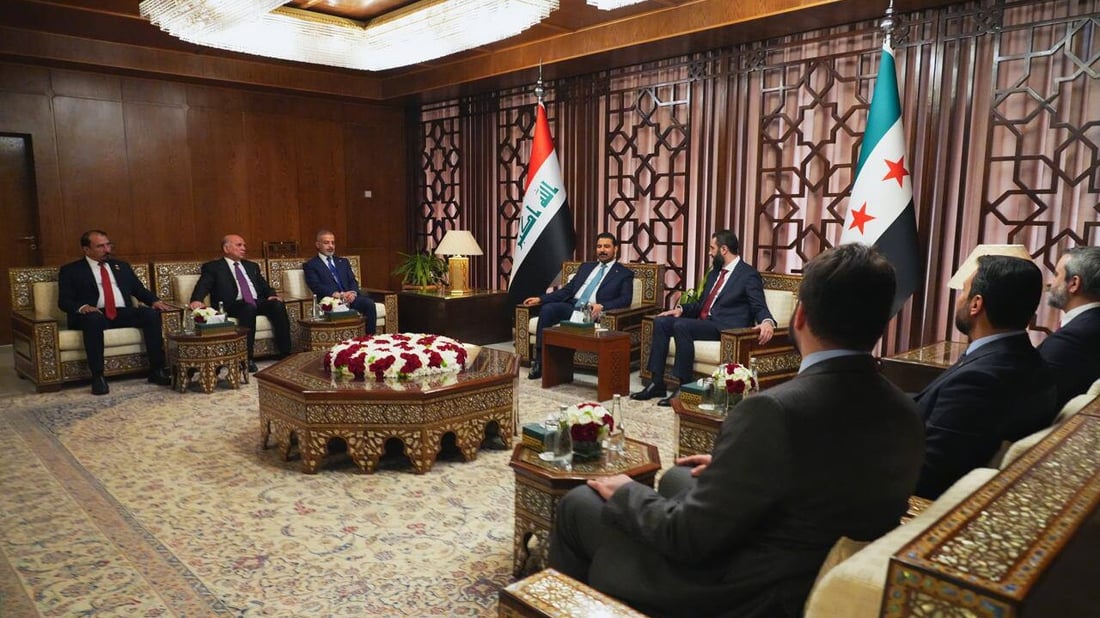
Iraqi Prime Minister Ali al-Zaidi (center) meets Syrian President Ahmed al-Sharaa (right) and senior officials during bilateral talks in Damascus, Syria, on Oct. 28, 2026.
Zaidi and Sharaa discuss 2 million-barrel Iraqi oil pipeline to Baniyas
BAGHDAD — Prime Minister Ali al-Zaidi and Syrian interim President Ahmed al-Sharaa on Wednesday discussed exporting up to 2 million barrels a day of Iraqi oil through a pipeline to Syria’s Mediterranean port of Baniyas, Zaidi’s office said.
The two leaders raised the plan at expanded talks between their delegations in Damascus, according to a statement from the prime minister’s office. It gave no timetable, cost or financing for the line, and no agreement was announced.
Two million barrels a day would be more than half of Iraq’s oil exports, which Oil Minister Basim al-Abadi put at more than 3.4 million barrels a day in October.
The talks also covered raising bilateral trade, developing agriculture to support food security, closer security coordination and aligning positions on regional and international issues, the statement said. Zaidi said Iraqis and Syrians were one people in two countries, and Sharaa said Syria wanted the highest level of cooperation between them, according to the statement.
Sharaa made the case for the route a day earlier, in an interview with host Nabil Jassim on Dijlah TV aired Tuesday. “Syria is considered Iraq’s seafront on the Mediterranean, whether we are two states or one state,” he said. “Iraqi oil needs corridors for export, and one of the easiest corridors was through Syria to the Mediterranean.”
In July, Iraq signed a memorandum of understanding with Syria to develop a crude export pipeline to Baniyas, to be carried out by a consortium of U.S. companies Chevron and TI and Qatar’s UCC, the Oil Ministry said at the time. A memorandum sets out an intention to cooperate and is not a construction contract.
Abadi has described the Syrian line as one branch of a wider network: a pipeline from Basra to Haditha in Anbar, with a branch from Haditha to Baniyas and another north to Fishkhabur in Duhok governorate, where it would join the pipeline to Turkey. Zaidi ordered faster work on the project at a meeting with Abadi and contractors on Aug. 29.
Iraqi crude last flowed to Baniyas through the Kirkuk-Baniyas pipeline, which has been out of service since it was damaged during the 2003 U.S.-led invasion.
Iraq sends no crude through Syria at present, the Oil Ministry says. Asked by the Washington-based energy news platform Attaqa whether crude exports through Syria and Jordan had resumed, ministry spokesperson Salim al-Rikabi said: “There is no crude oil export to Syria or Jordan, only fuel oil.” Fuel oil is a heavy refined product, not crude. Iraq shipped its first fuel oil cargo from Baniyas to Europe in April.
Baghdad has looked for new export routes since the U.S.-Israeli war with Iran disrupted shipping through the Strait of Hormuz, Iraq’s main outlet, from Feb. 28. Exports fell from more than 99 million barrels in February to 18.6 million in March.
In June, Foreign Minister Fuad Hussein met Sharaa in Damascus, and the two countries agreed to rehabilitate the oil pipelines linking them and to set up a committee covering energy, agriculture, water, transport and border crossings.
During the visit, Zaidi also went to the Sayyida Zeinab shrine, a major Shiite pilgrimage site south of Damascus, and the Umayyad Mosque with Syrian Foreign Minister Asaad al-Shaibani. He gave $10 million from his personal account, $5 million to each site, his office said.