
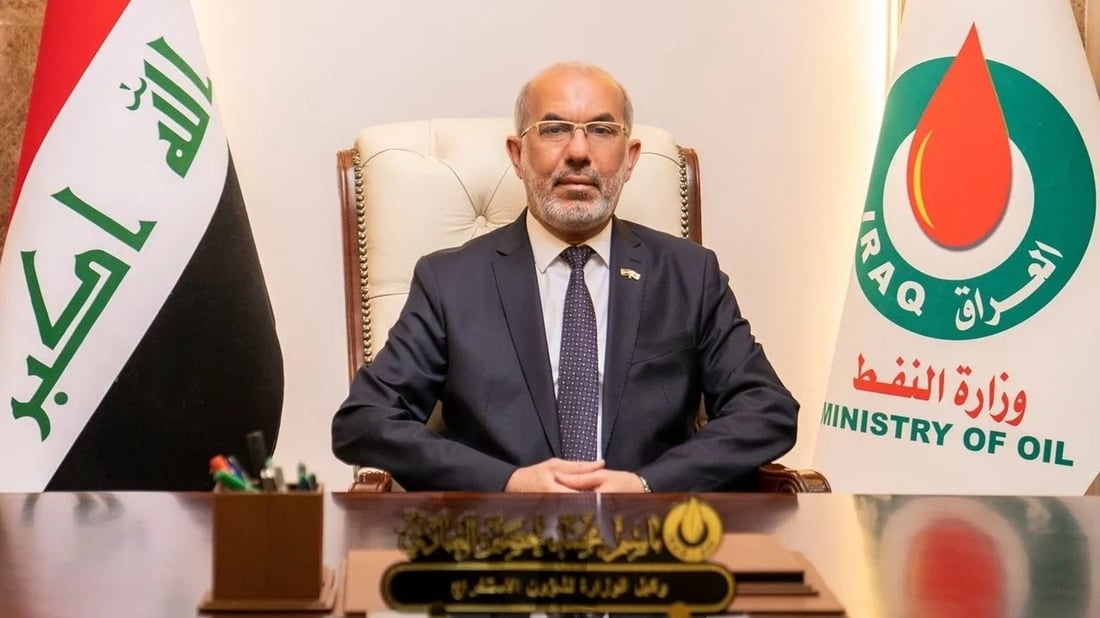
Iraqi Oil Minister Bassem al-Abadi
Media Monitor
Iraq’s monthly oil revenue down to $1.5 billion, oil minister says
BAGHDAD — Iraq’s monthly oil revenue has fallen to about $1.5 billion from between $7 billion and $8 billion before the regional war between the U.S. and Iran and the closure of the Strait of Hormuz, Oil Minister Bassem al-Abadi said Tuesday.
“The regional war had a major impact on Iraq,” Abadi said in an interview with Al Iraqiya TV. “The Ministry of Oil used to deposit between $7 billion and $8 billion into the state treasury every month, but today oil revenues do not exceed $1.5 billion.”
Exports fell from nearly 100 million barrels in February to 18.6 million in March after the closure of the strait cut southern export routes, with revenue dropping from more than $6.8 billion to about $1.95 billion. Because oil accounts for most state income, the disruption quickly translated into pressure on public finances.
Abadi said the ministry signed seven major agreements with international energy companies during Prime Minister Ali al-Zaidi’s recent visit to the United States, with a combined value exceeding $200 billion. Iraqi government agencies and private companies signed 48 agreements, memoranda of understanding and other cooperation arrangements with U.S. companies across the oil, electricity, industrial, technology and financial sectors, the Prime Minister’s Media Office said earlier this week.
The oil agreements were signed with Chevron, HKN, BP and other companies, Abadi said. HKN will develop the Hamreen fields, while Chevron signed agreements on operating and developing the West Qurna 2 field, previously managed by Russia’s Lukoil, along with four exploration blocks in the Nasiriyah area and the Balad field. Halliburton will take over full management of the Nahr Bin Omar and Sindbad fields. A separate agreement involves a consortium of Chevron, TI Capital and Qatar’s UCC to develop pipeline infrastructure.
Iraq is self-sufficient in diesel and kerosene but not yet in gasoline, Abadi said. It previously imported about 5 million liters of gasoline a day before commissioning a fluid catalytic cracking unit at the Southern Refineries Company, and plans to end gasoline imports were delayed after Japanese personnel working on the project withdrew because of the regional conflict.
“Iraq currently produces about 30 million liters of gasoline per day,” he said. “But we have excessive consumption without restrictions, and no country in the world sells fuel at such low prices and in unlimited quantities.” He said the ministry is seeking to reform distribution so citizens receive fuel allocations under a regulated system.
Iraq is in discussions with OPEC to increase its production quota and export ceiling, Abadi said. “We have active dialogue with our partners in OPEC,” he said. “The current government insists that Iraq should receive the share it deserves.” Production capacity now exceeds 4.8 million barrels per day and is expected to reach about 6 million through projects under development, he said.
Abadi said Iraq is negotiating with Turkey to renew the agreement governing exports through the Ceyhan pipeline, and that Turkey wants future cooperation to include Turkish investment in Iraq’s energy sector, a proposal Baghdad welcomed. He said Iraq also plans a pipeline from Basra to Fishkhabour connecting with the Iraq-Turkey pipeline, along with a branch from Haditha to Baniyas in Syria, with a later phase extending from Haditha to Aqaba in Jordan.
During the Washington visit, Iraq signed a memorandum of understanding with Syria to develop a crude export pipeline linking Iraqi fields to the Mediterranean port of Baniyas, a project Zaidi backs and officials say is intended to diversify export routes. Iraq ships the vast majority of its crude through Gulf terminals, leaving it exposed to disruption in the Strait of Hormuz. Previous pipeline routes through Syria ceased operations decades ago because of regional conflict and political instability, and successive governments have discussed reviving a Mediterranean route without moving beyond planning.
A memorandum of understanding sets out an intention to cooperate and is not a construction contract. Cross-border pipeline projects typically require engineering studies, commercial agreements, environmental assessments, financing and approvals from multiple governments before construction begins.
The agreements came during Zaidi’s Washington trip, where he held talks with President Donald Trump at the White House and met Defense Secretary Pete Hegseth and Treasury Secretary Scott Bessent. Those discussions focused on expanding economic cooperation and U.S. investment, security cooperation and Iraq’s transition after the planned conclusion of the U.S.-led coalition mission in September.