
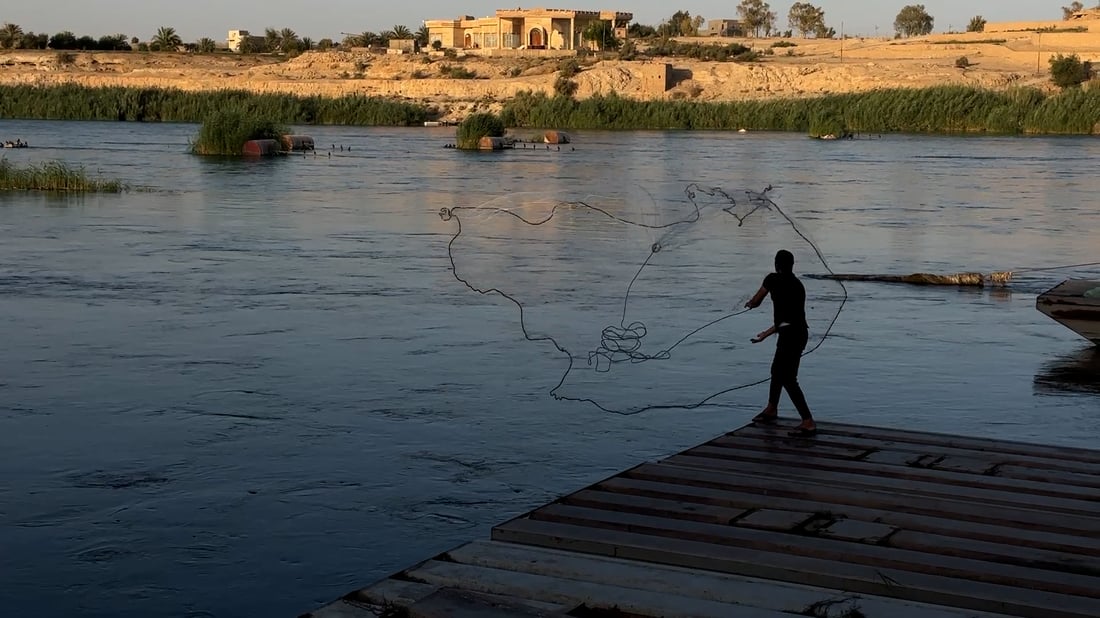
A man casts a fishing net into the Euphrates River near Haditha. Photo by 964media
Environment Ministry runs 67 river monitoring stations and new Baghdad air network
BAGHDAD — Iraq is monitoring water quality at 67 stations along its rivers and has switched on an electronic network in Baghdad that measures air quality and traces pollution sources, with readings linking rising pollution in busy areas partly to fuel quality, the Environment Ministry said.
There are 34 stations on the Tigris, 22 on the Euphrates, five on the Shatt al-Arab and six elsewhere, said Jawad al-Jubouri, the ministry’s technical undersecretary, calling for the environment and water ministries and other agencies to pool their data “to identify problem locations and address them.” The Baghdad air network gives direct readings of pollution and its sources. “The experiment has achieved good results, and there is a direction to expand it to the governorates according to priorities and available capabilities,” he told the Iraqi News Agency.
Readings have risen in heavy traffic, which Jubouri said was partly down to fuel quality, with dust storms also driving pollution up. The meteorological organization has cited raised pollutant concentrations in Baghdad’s morning visibility almost daily this month. River pollution comes from industry, medical waste, sewage and encroachments on the Tigris and Euphrates, he said, calling for “a strategic plan to establish and develop sewage treatment plants and reduce the discharge of untreated water into rivers.”
Meetings of local governments, ministries, parliament’s investigating committee, the Board of Supreme Audit, the Supreme Judicial Council and the prime minister’s advisory office produced recommendations including a national emergency team, removing encroachments, dredging rivers and improving treatment plants, he said. The committee’s chairman described conditions in the rivers last week as catastrophic and linked them to cancer and kidney failure.
Jubouri was frank about the ministry’s reach. “Addressing environmental challenges requires integrated national action among state institutions, local governments and society, because the Environment Ministry is a monitoring and diagnostic body, while responsibility for implementation is distributed among a large number of sectors and relevant entities,” he said.
The environment minister has given ministries no more than a year to finish pollution