
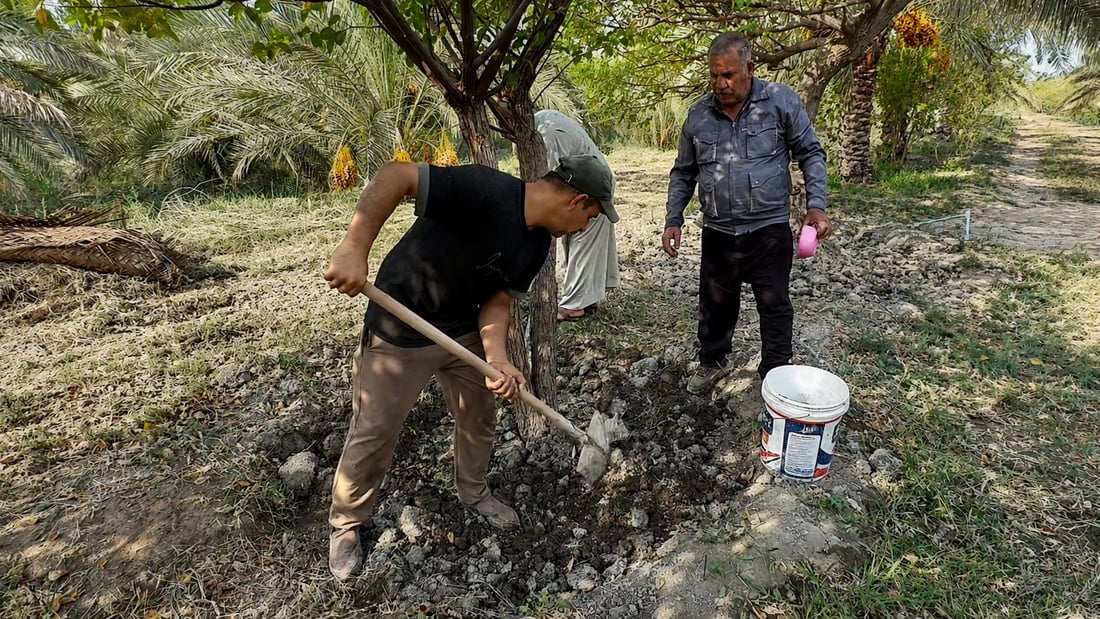
Farmers tend a jujube tree in Basra governorate. Photo by 964media.
Basra’s jujube growers start fertilizing as the heat drops
BASRA — Growers across Basra are fertilizing their sidr orchards and adjusting irrigation as summer temperatures fall, starting the stage that determines this year’s nabag crop.
The work runs through the sidr belt from al-Faw to Qurna. High temperatures in June and July hold the trees back, and late summer into early fall is when they need to put out new stems, branches and leaves before flowering, said farmer and orchard owner Saad Salman al-Shawi, with fertilizer quantities varying by the age and size of each tree. Growers concentrate fertilizing at the end of August and the start of September, after pruning in April and May, and combine it with regulated irrigation and close watching of branches and leaves.
Choice of fertilizer depends on the season, said farmer Ayoub Yassin Ouda. Animal manure works better in winter and cooler weather, while growers lean on chemical fertilizers at this time of year. Heat and water shortages turn leaves yellow and drop them, which pushes farmers to irrigate more to keep moisture in the soil and the branches. DAP, a phosphate fertilizer, can take a month to six weeks to show, he said, while white fertilizer can begin working within a day or two.
Ezz al-Din Salim district, formerly al-Huwair, has more than 42,000 sidr trees across al-Huwaish, al-Thawra, al-Fathiya, al-Shallah, Khamisa, Tawanisa, Abu Gharba and other areas, said Abbas al-Hamdi, who heads the district’s agriculture division. The orchards hold local and imported varieties including American Tuffahi, Thai, Amrouti, Bambawi, Zaytouni and Mallasi, alongside local sidr known for standing up to conditions.
The fruit, known locally as nabag, goes to markets across Iraq in season. The trees also carry cultural weight locally, and their blossom is known for its scent when it opens around mid-February.