
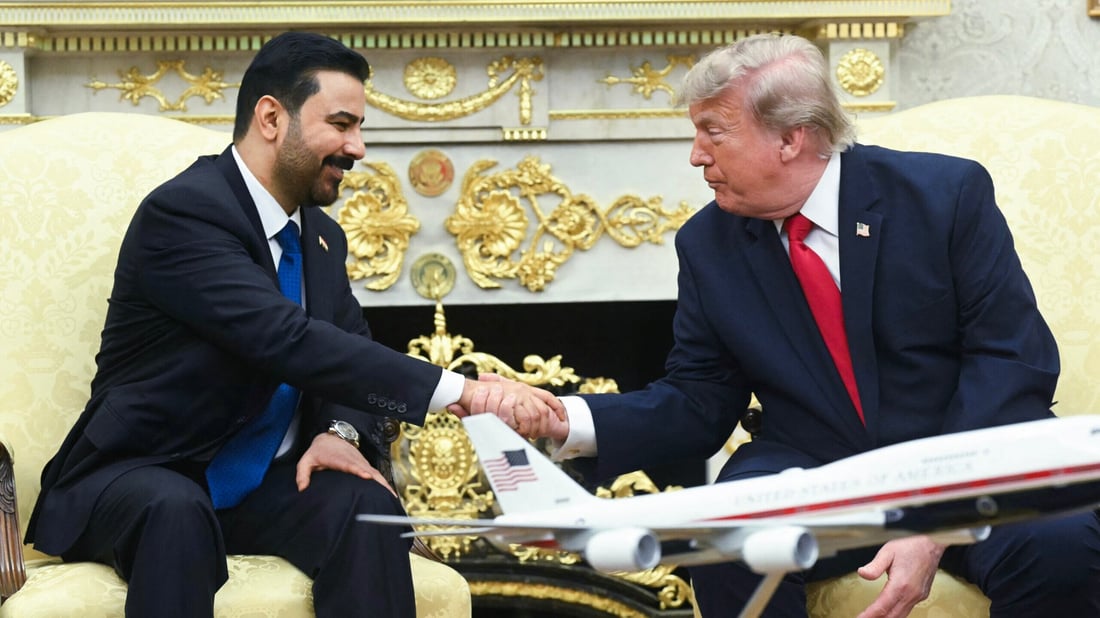
U.S. President Donald Trump meets Iraqi Prime Minister Ali Al-Zaidi at the White House in Washington, D.C., July 14, 2026.
Trump hosts Zaidi at White House, touts ‘massive’ oil partnership
WASHINGTON — U.S. President Donald Trump hosted Iraqi Prime Minister Ali al-Zaidi at the White House on Tuesday, where the two highlighted plans for closer economic cooperation, including a proposed energy partnership, and discussed Iraq’s security transition ahead of the scheduled withdrawal of the U.S.-led international coalition in September.
Before the meeting, Trump told reporters, “We love Iraq,” adding that the country was “well represented.” During the meeting he said the Iraqi prime minister “has been amazing” and “won an election that a lot of people didn’t anticipate could be won by anyone else.”
Zaidi, a businessman with no previous political office, was nominated as prime minister-designate by the Shiite Coordination Framework in April, after months of deadlock following Iraq’s 2025 parliamentary elections. Parliament approved his government in mid-May, though several cabinet posts remained vacant pending political agreement.
Trump also appeared to allude to former Prime Minister Nouri al-Maliki, whose return he had publicly opposed. “He is not, in my opinion, a good person. Not good for America. I don’t think good for Iraq,” Trump said. Zaidi’s nomination followed a Trump warning that the United States would end support for Iraq if Maliki became prime minister, which prompted the Coordination Framework to drop Maliki’s candidacy and select Zaidi as a compromise.
Trump said backing Zaidi had mattered to him. “I played a role in it. It was very important to me to have somebody get in there that can do the job and do it well,” he said, calling him “a great fighter and a great fan of America.”
Trump also said the two countries were developing an oil partnership. “Iraq has tremendous oil reserves and wealth,” he said. “We have a tremendous oil partnership all of a sudden being formed.” He said he expected an agreement to be announced “this week or next week,” describing it as “massive” and “among the largest.”
Zaidi called the visit “not like any visit, but rather an announcement of an economic partnership.” He said the partnership would bring more U.S. companies into Iraq and coincide with the scheduled Sept. 30 conclusion of the anti-ISIS coalition’s mission and the departure of American troops.
Zaidi also said the government intended to bring all weapons under state control after the coalition mission ends. “Whoever surrenders their weapons will turn into a political and civil entity,” he said. “After Sept. 30, there is no need for any faction. Factions are a need, not a profession. There is no justification for their existence after Sept. 30.”
Zaidi’s government is pursuing a plan to place weapons under state control, a policy dividing the Iran-aligned factions. Asaib Ahl al-Haq, Saraya al-Salam and the Imam Ali Battalions have moved to comply, while Kataib Hezbollah, Harakat al-Nujaba and Kataib Sayyid al-Shuhada have rejected disarmament, arguing their weapons remain necessary as long as U.S. forces are in Iraq. On Monday, the coalition known as the Islamic Resistance in Iraq rejected the visit, warning the government against signing agreements during the trip and calling for an end to the U.S. military presence in Iraq.