
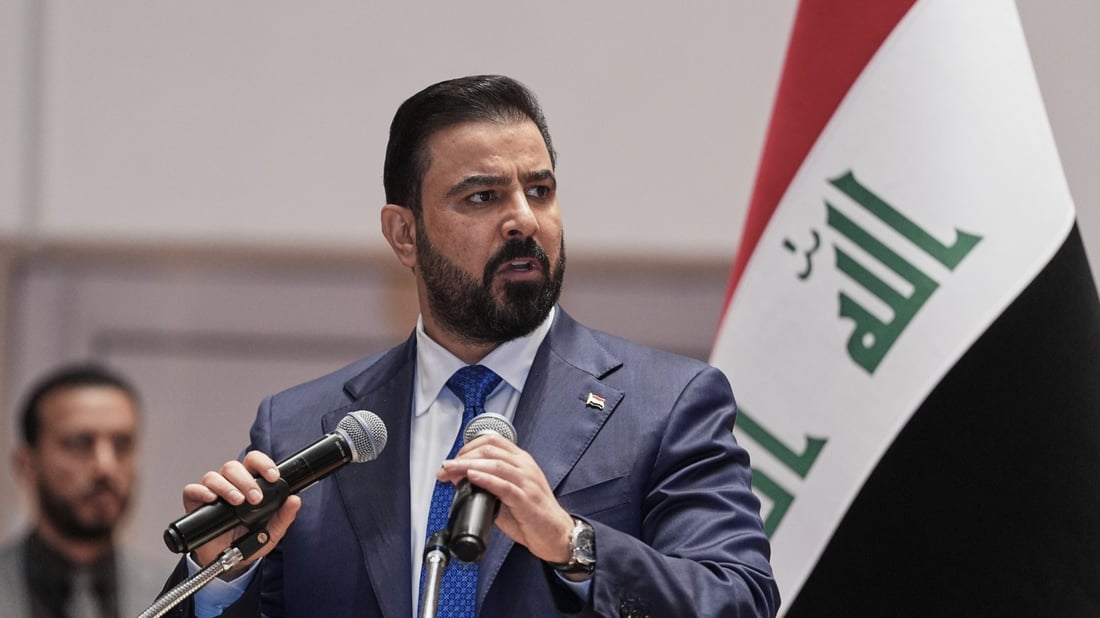
Iraq's Prime Minister Ali Al-Zaidi. (Photo: Al-Zaidi's media office)
'Principled rejection'
Iran-aligned armed factions in Iraq speak out against Zaidi’s Washington visit
BAGHDAD — The coalition known as the Islamic Resistance in Iraq on Sunday rejected Prime Minister Ali al-Zaidi’s visit to Washington, issuing a nine-point statement that warned the government against signing agreements or economic contracts during the trip and called for an end to the U.S. military presence in Iraq.
Zaidi is set to travel to Washington on Monday at the head of a high-level delegation for his first official foreign trip since taking office. Government spokesman Haider al-Aboudi said Sunday the visit focuses on economic cooperation.
The Islamic Resistance is a coalition of Iran-aligned Iraqi armed factions that has repeatedly opposed close ties with the United States and demanded the withdrawal of American forces. Several factions under its umbrella, which include Kataib Hezbollah and Harakat al-Nujaba, have claimed drone and rocket attacks on U.S. installations in Iraq and Syria since the Gaza war began in October 2023 and through this year’s U.S.-Israeli war with Iran.
The group said it opposed the visit because of the conflicts in Iran, Gaza, Lebanon and Yemen, announcing its “principled rejection of this visit” at a time it said believers and “free people around the world” were grieving the continuation of those wars.
It said its support for the government’s anti-corruption campaign should not be read as broader endorsement, warning against “projects that mortgage the future of coming generations to companies linked, directly or indirectly, to the interests of the occupation.” The statement followed recent corruption investigations including the case of former Deputy Oil Minister Adnan al-Jumaili, in which authorities say they have seized more than $121 million in cash, about 375 kilograms of gold, and luxury properties and vehicles.
The statement renewed the demand for a U.S. withdrawal, calling the American military presence an occupation the government should work to end “through all available means.” Baghdad and Washington announced in September 2024 that the U.S.-led coalition would begin transitioning its military mission under a timetable, with Iraqi officials saying future security cooperation would run through bilateral arrangements rather than the coalition.
On the economy, the group warned against “replacing military occupation with an economic occupation that is even more dangerous,” said freeing Iraq’s economy from U.S. influence should be a national priority, and cautioned the government against trading sovereignty for international acceptance. It said any agreement concluded abroad should go to parliament for ratification rather than be relabeled a memorandum of understanding to bypass the law.
On Israel, the group said any normalization would be “high treason, whether it comes under the Abraham Accords or under any other name.” Iraq criminalized normalization with Israel in 2022 under legislation carrying severe penalties.
Aboudi said there was “no change to the Strategic Framework Agreement,” the 2008 accord governing U.S.-Iraq cooperation, and that all understandings would rest on it. He said memorandums of understanding would be signed “in the fields of oil and gas,” adding that “Iraq intends to bring in U.S. oil companies to increase oil production.”
Zaidi became prime minister in May after parliament approved his government, ending months of deadlock following the November 2025 elections. He succeeded Mohammed Shia al-Sudani.
The rejection comes as Zaidi’s government pursues its plan to place weapons under state control, a policy dividing the Iran-aligned factions. Asaib Ahl al-Haq, Saraya al-Salam and the Imam Ali Battalions have moved to comply, while Kataib Hezbollah, Harakat al-Nujaba and Kataib Sayyid al-Shuhada have rejected disarmament, arguing their weapons remain necessary as long as U.S. forces are in Iraq.