
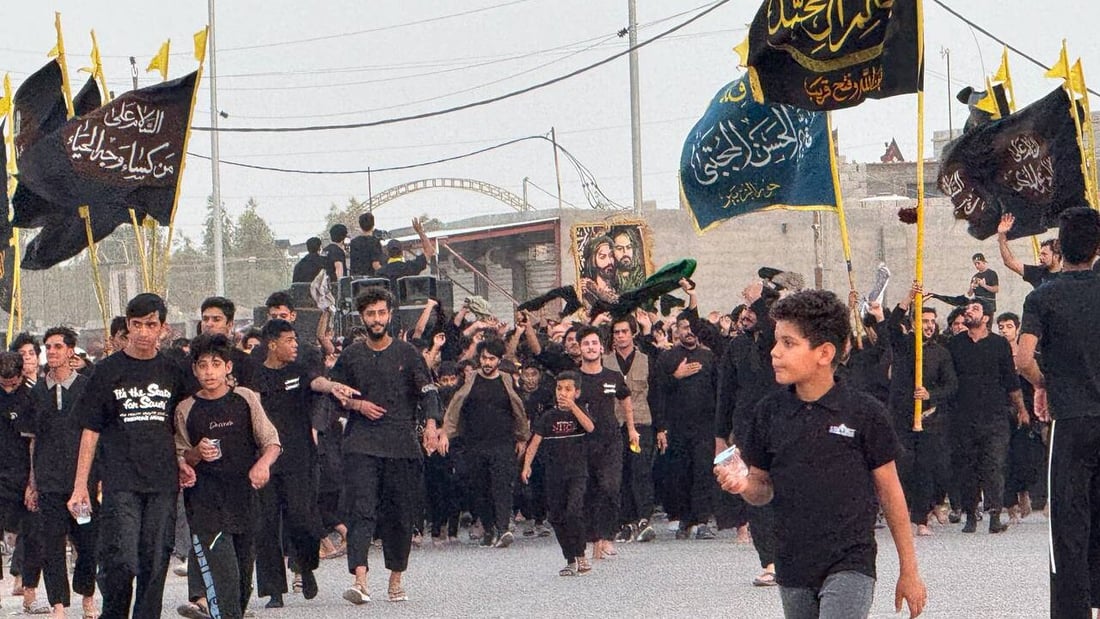
FILES: A scene from the Ashura procession in Khor Al-Zubair, organized by the Imam Hassan Camp. (Photo: 964media)
Committee reviews security and service plans for Arbaeen pilgrimage
BAGHDAD — Iraq’s Higher Committee for Mass Pilgrimages reviewed security and public-service plans Sunday for the Arbaeen pilgrimage, including arrangements at border crossings and measures to manage the movement of millions of pilgrims from Iraq and abroad.
Qais al-Muhammadawi, deputy commander of the Joint Operations Command and head of the committee, chaired the meeting with the head of the Border Crossings Authority and Interior Ministry commanders and directors. Police commanders from Babil, Najaf, Diwaniyah, Muthanna, Dhi Qar, Wasit and the city of Samarra took part by video conference.
The committee said Muhammadawi continues to hold specialized conferences with the relevant authorities as state institutions prepare for the annual pilgrimage to Karbala. Sunday’s meeting followed a June 30 session chaired by Prime Minister Ali al-Zaidi that brought together army and police commanders, governors, religious institutions and service agencies, where the government directed agencies to coordinate transportation, health, municipal and security services.
The committee said participants discussed carrying out the Border Crossings Authority’s plans to receive pilgrims, along with an Interior Ministry plan for the commemoration. Large numbers of foreign pilgrims, particularly from neighboring Iran, enter Iraq by land and air before traveling to Najaf and Karbala. Iraqi and Iranian transport officials discussed coordination in June to ease travel through land borders and airports during this year’s pilgrimage.
The committee said officials reviewed the latest security and service preparations and discussed high-level coordination among security units and service authorities to protect pilgrims and keep them moving smoothly. Officials also discussed the ability to redeploy security units and sustain operations throughout the pilgrimage.
Arbaeen marks the end of the 40-day mourning period for Imam Hussein, the grandson of the Prophet Muhammad, who was killed in the Battle of Karbala in 680. Millions of pilgrims from Iraq and abroad travel on foot to Karbala to visit his shrine, with many also stopping in Najaf at the shrine of Imam Ali. Pilgrims have already begun walking from Ras al-Bisha in Basra’s al-Faw district toward Karbala, one procession telling 964media its journey from Iraq’s southernmost point would take about 17 days.
Muhammadawi instructed agencies to organize passenger pickup and drop-off areas to avoid congestion, and called for traffic police and Civil Defense teams along all pilgrimage routes, ordering additional emergency patrols to secure roads and assist pilgrims. He urged particular attention to pilgrim movement at night, when many continue walking along the roads linking southern and central governorates with Karbala.
For 2026, Arbaeen is expected to fall on Aug. 5, though the exact date depends on the sighting of the moon.
Transportation and crowd management are central to the annual government plan because pilgrims cross several governorates before reaching Karbala. During the 2025 pilgrimage, the Imam Hussein shrine authority said more than 22 million pilgrims took part, while Najaf authorities said 17 million entered that governorate, with public agencies, religious institutions and private operators deploying buses and other vehicles.
Muhammadawi described Arbaeen as “a global event attended by millions that embodies the values of solidarity and giving,” calling for all security and service efforts to be combined to organize the commemoration.