
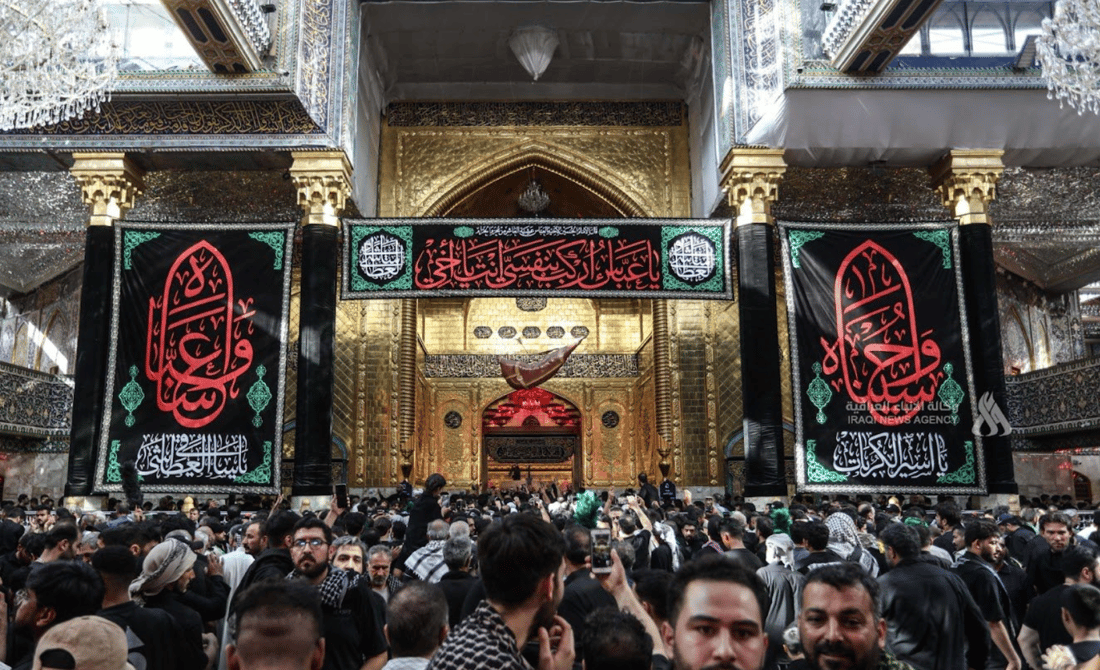
FILES: Pilgrims gather at the Imam Hussain Shrine in Karbala during the Arbaeen pilgrimage in 2025.
Karbala shrine authority says more than 22 million pilgrims marked Arbaeen in 2025
KARBALA — The administration of the Imam Hussain Shrine in Karbala said that more than 22 million people took part in this year’s Arbaeen pilgrimage, one of the world’s largest annual religious gatherings.
In a statement, the shrine authority said the number of visitors was counted through the electronic tally system installed at the main entrances to the holy city between Safar 1 and Safar 20, 1447 AH, corresponding to Aug. 7 to Aug. 15, 2025.
The authority said the total reached 22,354,578 visitors. It added that “these statistics were prepared with modern electronic systems and with high accuracy to provide official figures for state institutions and media outlets.”
The statement also listed previous figures, showing steady growth in attendance over the past years: 11.2 million in 2016, 13.8 million in 2017, 15.3 million in 2018, 15.2 million in 2019, 14.5 million in 2020, 16.3 million in 2021, 21.6 million in 2022, 22 million in 2023, and 22.1 million in 2024.
The shrine authority said the statistics are meant to “serve researchers and institutions concerned with religious, social, and security studies.” It praised the role of volunteers, service providers, and security forces in supporting the pilgrimage and emphasized that the city successfully accommodated the visitors throughout the period.
Arbaeen marks the end of the 40-day mourning period for Imam Hussain, the grandson of the Prophet Muhammad, who was killed in the Battle of Karbala in 680 AD. Millions of pilgrims from Iraq and abroad travel on foot to Karbala to visit his shrine, with many also stopping in Najaf to pay respects at the shrine of Imam Ali, making both cities central destinations during the pilgrimage.
In Najaf, Gov. Yousef Kanawi said that 17 million pilgrims entered the governorate during Arbaeen, highlighting the extensive security and service measures that were put in place. He said Najaf International Airport handled 1,242 arriving flights and 1,242 departures, with 185,957 incoming passengers and 135,822 outgoing.
Kanawi added that 44,520 vehicles were mobilized by the private sector, in addition to 1,000 free buses provided by state agencies, the Popular Mobilization Forces, and religious shrines. The Oil Products Distribution Company supplied 484,222 gas cylinders, 159,000 ice blocks, and 64 million liters of fuel, while the mosques of Kufa and Al-Sahla distributed 12.3 million cups of water, 175,000 ice blocks, and provided meals, alongside the removal of 120,000 tons of waste.
He said health services in the governorate handled about 139,000 medical cases, while the Electricity Directorate provided 1,300 to 1,400 megawatts of power, installed 400 transformers, and repaired 35 faults. Nearly 10 million cubic meters of drinking water were delivered to processions through pipelines, in addition to thousands of ice blocks.
Kanawi concluded that Najaf has “a promising plan linked to budget allocations” to expand streets and bridges in order to accommodate the growing number of pilgrims in coming years.
Iraq’s Communications and Media Commission said Saturday that during the Arbaeen pilgrimage in Karbala, held from Aug. 7 to Aug. 15, 2025 (Safar 1–20, 1447 AH), more than 277 million phone calls were recorded, including 272 million domestic and 4.4 million international, along with 47 million text messages, of which 38.5 million were local and 8.6 million international. Commission head Naufal Abu Ragheef said total internet use reached about 17,977 terabytes, including 3,812 terabytes on TikTok, 2,463 on Facebook, 1,628 on YouTube, 867 on WhatsApp, 337 on Telegram, and 220 on Instagram.