
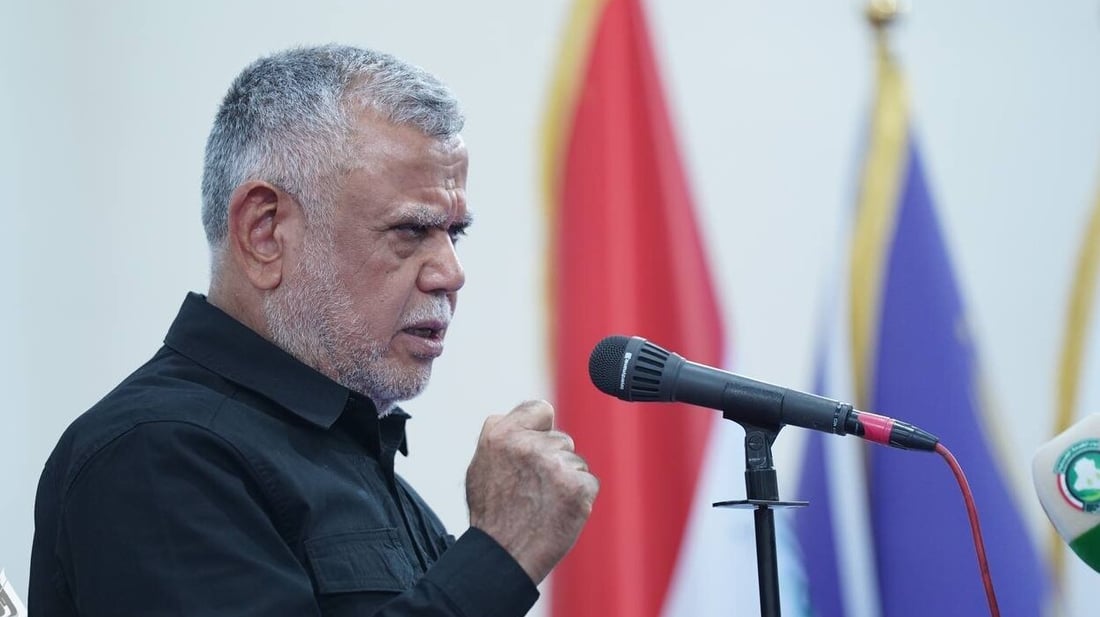
Badr Organization leader Hadi Al-Amiri
Amiri urges restraint and says weapons decisions must be Iraqi
BAGHDAD — Badr Organization leader Hadi al-Amiri called on all sides to avoid inflammatory positions over the government’s weapons policy, saying decisions on the issue could only be taken by Iraqis and warning against handing outsiders a pretext to interfere.
“We call on all parties to exercise the restraint and avoid inflammatory positions, while holding firmly to the elements of Iraq’s strength and resilience,” Amiri said in a statement. “This is a national Iraqi issue, and any decision taken regarding it can only be Iraqi. Iraqis are capable of managing it with great competence and a sense of responsibility.” He said he hoped everyone would act “in a spirit of national responsibility, and that no opportunity will be given to foreign parties seeking the pretexts to extend their influence and impose their dominance.”
Amiri said he had “full confidence in the soundness of the intentions, good judgment and firm commitment to safeguarding the national dimension by both Prime Minister Ali al-Zaidi and men of Resistance groups,” and called for coordination between the state’s executive, legislative, judicial and security institutions. “Weapons — any weapons — derive their legitimacy from the extent to which they respond to the national interest decided collectively by the national actor, not individually,” he said.
The statement followed a warning from Kataib Hezbollah security official Abu Mujahid al-Assaf, who accused the government of storming homes and terrorising the families of dead and wounded fighters under American supervision and said patience was running out. Assaf set three conditions for any accommodation over weapons: a full American withdrawal from Iraqi land and airspace, the expulsion of Turkish forces from northern Iraq, and the dissolution of the Peshmerga, whose standing rests on Article 121 of the constitution.
Amiri brokered the stand-down this month when Iran-aligned factions postponed a planned attack on Saudi Arabia and U.S. bases at his request. Badr has more than 20 brigades inside the PMF and has agreed to place its weapons under state control. Kataib Hezbollah, Harakat al-Nujaba and Kataib Sayyid al-Shuhada have refused.