
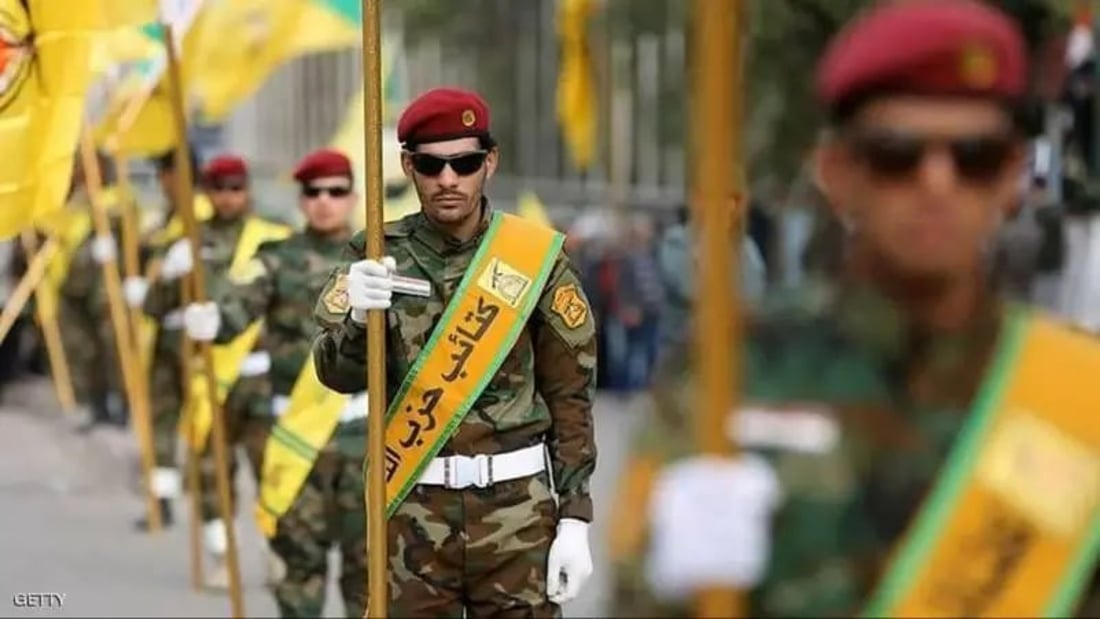
Kataib Hezbollah members
Kataib Hezbollah demands dissolution of the Peshmerga as condition for disarming
BAGHDAD — Kataib Hezbollah has set the dissolution of the Kurdistan Region’s Peshmerga forces as one of three conditions for any accommodation with the government over its weapons, a day after drones struck the Kurdistan Region prime minister’s office.
The group’s security official, Abu Mujahid al-Assaf, listed the conditions for what he called rapprochement with any government over “the weapon of dignity”: the complete and genuine departure of American forces from Iraqi land and airspace with assurance they would not return, and the freeing of political and economic decision-making from American hegemony; the expulsion of Turkish occupying forces from northern Iraq; and “dissolving the Peshmerga forces, considering them the most heavily armed militias and the most dangerous to Iraq’s unity, in addition to their suspicious links with the Zionist-American enemy.”
The Peshmerga’s standing rests on Article 121 of the constitution, which makes regional governments responsible for establishing internal security forces including police, security services and guards of the region. The KRG said in July that 88,900 personnel were organised into 38 brigades under its Ministry of Peshmerga Affairs, and the United States has treated them as part of Iraq’s broader security forces.
Assaf said the group had been patient “for more than a hundred days with the empty bravado of the young designated head of government Ali al-Zaidi,” hoping he would grasp the domestic, regional and international realities and heed older politicians. Instead, he said, Zaidi had insisted on listening to figures hostile to Shia Iraqis and to U.S. envoy Tom Barrack, whom he mocked as head of a body he called the Authority for the Liberation of Iraq and Damascus.
He accused the government of storming homes and terrorising the families of dead and wounded fighters and of sheikhs under direct American supervision, and said patience was running out. The group might act on the principle of “an eye for an eye, and the one who started it is the greater wrongdoer,” he said.
Assaf also attacked Zaidi personally. “You were practising commerce and enjoying safety and luxury and filling your coffers with billions, while our blood was being shed to preserve the country’s sovereignty and protect the state and the holy sites,” he wrote. “Do not forget yourself, for you stand before men who fear no reproach in God.” He closed by appealing to “the senior brothers” to correct what he called the “security crookedness” caused by the prime minister.
Security Media Cell chief Lt. Gen. Saad Maan said Sunday that Iraq would not accept forces operating in parallel with official institutions after Sept. 30. “The decision of peace and war is exclusively in the hands of the state, and it is not possible to accept multiple decisions or the creation of forces parallel to the official forces,” he said. “The country is governed by one state, one government and one law.”
Kataib Hezbollah, Harakat al-Nujaba and Kataib Sayyid al-Shuhada have refused to disarm while U.S. forces remain; Saraya al-Salam, Asaib Ahl al-Haq and the Imam Ali Battalions have moved to comply.