
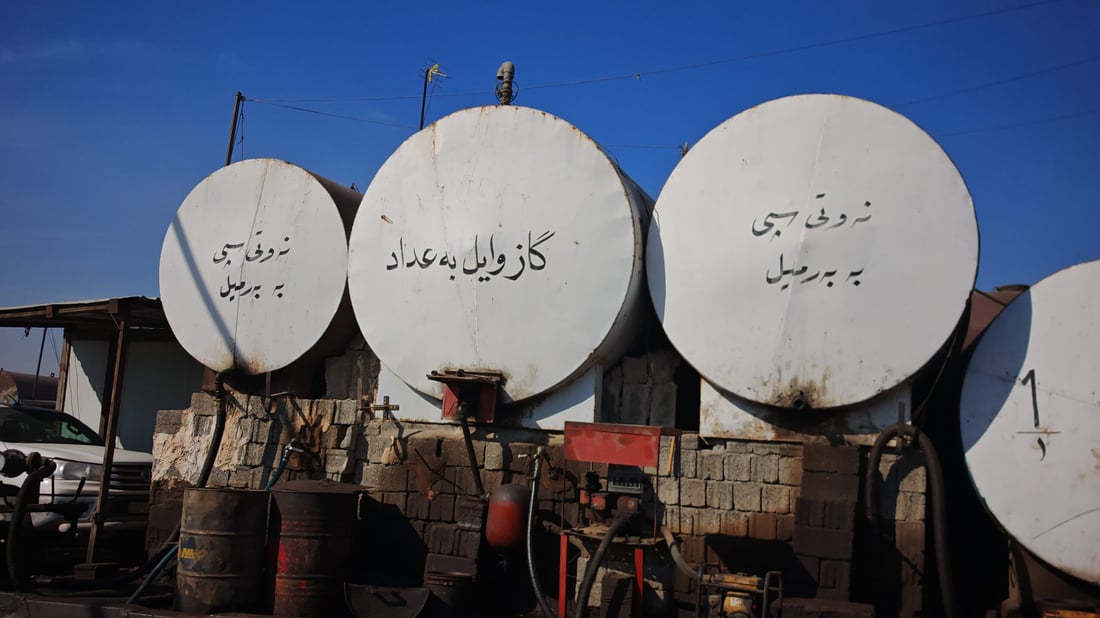
Kerosene storage tanks at a fuel depot in Erbil
Erbil kerosene prices hit 400,000 dinars as winter cold and power shortages strain households
ERBIL — Kerosene delivered to homes in Erbil reached 400,000 dinars (about $240 at the street rate) for a 200-liter barrel on Saturday morning, as households wait for Baghdad’s subsidized winter supply.
A barrel sold for 380,000 dinars (about $220) at the city’s wholesale market on Saturday morning and reached households at 400,000 dinars with delivery, said Sherwan Ahmed, a kerosene trader and member of the Erbil Oil Market Council. Traders later cut the wholesale price by 15,000 dinars (about $9) a barrel, he said.
Prices have risen by about 60,000 dinars (about $35) a barrel over the past month, Ahmed said. He blamed falling temperatures and delays in the subsidized kerosene Baghdad has allocated to the Kurdistan Region.
Kerosene, known locally as white oil, is the main heating fuel for most households in the Region, where winter temperatures drop sharply in the mountains. Many families are waiting for the subsidized supply, and those who cannot wait are buying at market prices.
Households will pay 62,000 dinars (about $41 at the official rate) for a 200-liter subsidized allocation, plus transport. Saturday morning’s wholesale price was more than six times that.
Officials at the Erbil Directorate of Oil and Minerals were not available to comment on the price rise when 964media contacted them.
Falah Sayed Mawlud, director general of oil and minerals at the Kurdistan Regional Government’s Natural Resources Ministry, told the state-run newspaper Al-Sabah in remarks published Thursday that the 50 million liters of kerosene Baghdad has approved would arrive next week. Distribution in Erbil, Duhok, Sulaymaniyah and Halabja governorates will start in mountainous and rugged areas, he said.
The shipment covers less than a fifth of the Region’s estimated winter need of 269 million liters, Mawlud said. Sulaymaniyah governorate alone needs 110 million liters, more than twice the whole shipment, Salam Omar, spokesperson for the Sulaymaniyah Directorate of Oil and Minerals, told 964media on Nov. 5.
Prime Minister Ali al-Zaidi ordered the Region’s subsidized winter kerosene released on Nov. 1, the Oil Ministry said, without giving an amount or a start date.
The price rise comes days after a suspected drone attack on the Khor Mor gas field in Sulaymaniyah governorate late Sunday. The attack halted gas to the Region’s power stations, knocking nearly 3,000 megawatts off the grid and cutting electricity in parts of Erbil, Duhok and Zakho. Many households heat with electricity as well as kerosene.
The power loss had eased to about 1,000 megawatts by Monday, 964media found. Dana Gas, the field’s UAE-based operator, said Monday that production was suspended while it assessed the damage, and it has not said when production will resume.
Khor Mor fuels more than 80% of the Region’s electricity generation, according to Dana Gas and its partner, Crescent Petroleum. The attack also hit the field’s loading depot for liquefied petroleum gas, the household gas used for cooking and heating. Zaidi has ordered the federal Oil Ministry to supply the Region’s household gas until the field restarts.
Last winter, the KRG set an allocation of 200 liters per household at a subsidized 103,500 dinars (about $78 at the time). By Jan. 4 this year, nearly 135 million liters had gone to 674,501 families, the Natural Resources Ministry said, and another 415,222 households were still waiting.