
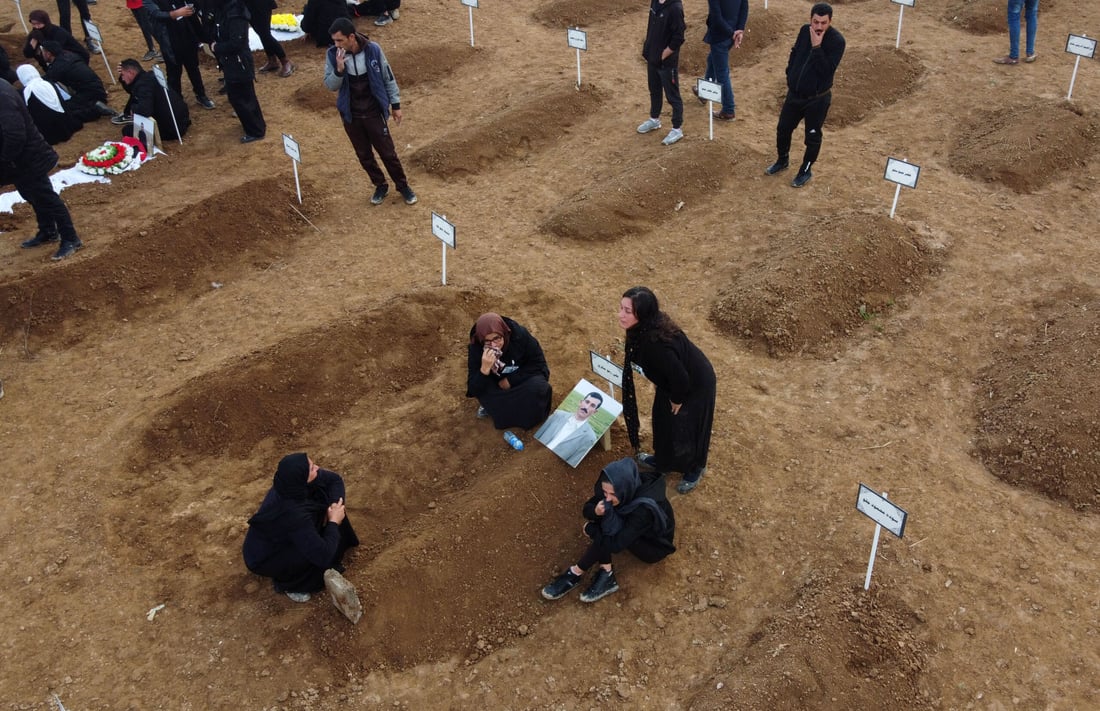
FILES PHOTO An aerial picture shows mourners gathering around graves during a mass funeral for Yazidi victims on Feb 6, 2021. (Photo by Zaid AL-OBEIDI / AFP)
Fate of 2,822 Yazidis taken by Isis still unknown, rescue office says
ERBIL — The fate of 2,822 Yazidis abducted by the Islamic State group in 2014 is still unknown, and many are likely in Syria, the head of the Kurdistan Region office that searches for them said Saturday.
Hussein Qaidi, director of the Office for Rescuing Kidnapped Yazidis, part of the Kurdistan Region Presidency, told the state-run Iraqi News Agency that Isis abducted 6,417 people when it attacked Sinjar and the surrounding area of Nineveh governorate. The office has rescued 3,595 of them, he said.
“More than half of those whose fate is still unknown, who number 2,822 people, are women and girls,” Qaidi said. Large numbers of children are also among those not yet found, he said.
He said most of the Yazidis rescued recently were found in Syria and that many of the missing are probably still there, particularly in al-Hol camp. Others are likely held inside Iraq by families of Isis members, he said, and he did not rule out that some had been taken beyond Iraq and Syria.
Syrian government forces took al-Hol, in northeastern Syria, from the Kurdish-led Syrian Democratic Forces in January, and Syrian authorities announced on Feb. 22 that they had emptied and closed it. The camp had held tens of thousands of people, mostly women and children, after Isis lost its last territory in 2019.
The office follows up all information it receives from different areas and sends teams to investigate it, Qaidi said, with the main focus for now on Syrian territory.
The rescue count has risen by 14 in more than two years. It stood at 3,581 after two abductees were found in al-Hol in August 2024, among them a 10-year-old girl from Kocho who had been 3 months old when she was taken. It was 3,594 in May, when the office announced the release of a woman from Tel Qasab, and the Kurdistan Regional Government gave the current figure of 3,595 on Aug. 3.
Qaidi’s count of the missing is higher than the KRG’s. In its Aug. 3 announcement the KRG put the number still missing at 2,526 and said 296 victims had been identified through DNA testing and returned to their families. That is the same as the gap between the two counts. Officials have not said whether the KRG figure leaves out the identified dead.
Dindar Zebari, the KRG’s coordinator for international advocacy, repeated the 2,526 figure on Aug. 30 and said 1,215 of the missing were women and 1,311 were men.
On Aug. 3, the 12th anniversary of the assault, hundreds of Yazidis gathered at the genocide memorial in Sinjar to demand justice, the recovery of the missing and the excavation of mass graves. Kurdistan Region President Nechirvan Barzani pledged that day to keep searching, saying his office’s team would keep working to rescue the missing and establish their fate “as long as even one abducted individual remains missing.”
Isis seized Mosul in June 2014 and attacked Sinjar on Aug. 3 that year. It killed more than 5,000 Yazidis, held women and girls in sexual slavery, took boys to be trained as fighters and drove hundreds of thousands from their homes. Iraq recognizes the atrocities as genocide, and a UN investigative team found in 2021 that Isis had committed genocide against the Yazidis.