
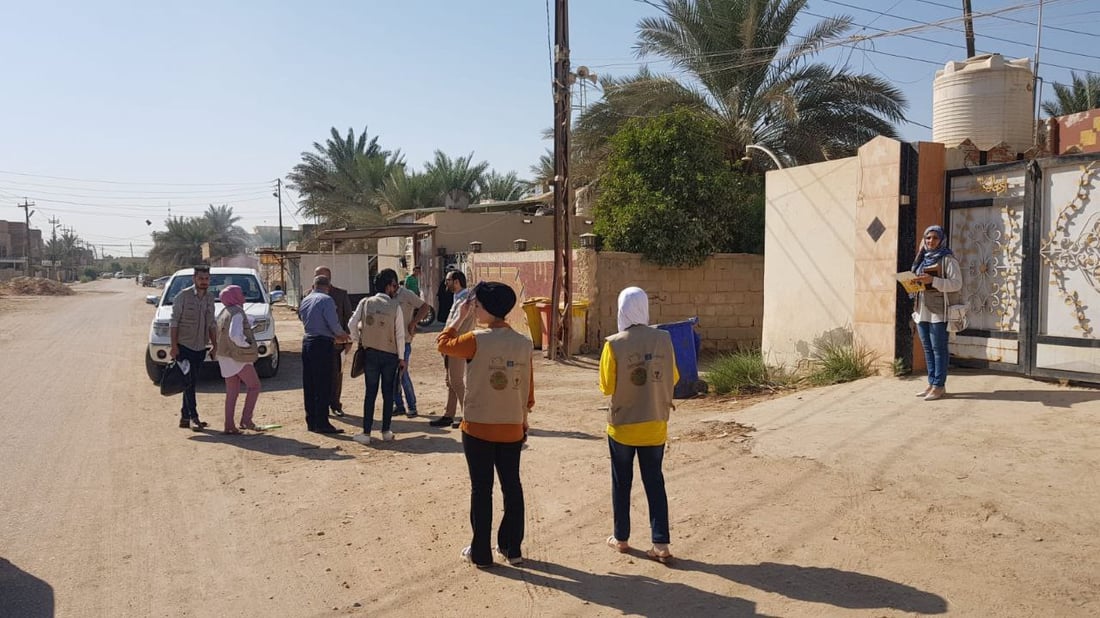
Education outreach teams visit a residential neighborhood in Iraq as part of a campaign to return school dropouts to classrooms.
Nearly 200,000 dropouts back in Iraq’s schools since 2024, official says
BAGHDAD — Nearly 200,000 children who had dropped out of school in Iraq returned to education through campaigns run from 2024 to 2026, an Education Ministry official said Saturday, naming poverty and family hardship as the main causes.
Falah al-Qaisi, director general of Baghdad’s Rusafa First Education Directorate, told the state-run Iraqi News Agency that the ministry’s 2024 campaign identified 260,000 out-of-school children and brought about 100,000 of them back.
In 2025, a project run with Unicef contacted the families of 238,000 children, and about 92,800 more enrolled, he said. Unicef said in October that its 2025 count of 92,843 included children who joined other learning programs or sat exams outside regular schooling.
The 2024 and 2025 figures alone add up to about 192,800. Qaisi did not give a nationwide figure for 2026.
Financial hardship and worsening economic and social conditions were among the main reasons children left school, Qaisi said, with some families unable to cover the costs of their children’s education.
The government’s student grant and the opening of schools for orphans had helped families overcome those barriers and allowed more children to resume their studies, he said.
This year the ministry set up field teams, overseen by Education Minister Abdul Karim Abtan and working with education directorates across the country, to find children who had left school and encourage them to return. In late October, it sent mobile teams to visit families in the governorates.
Qaisi said the Rusafa First directorate ranked first in the country in this year’s campaign, bringing about 7,000 children back into education.
The ministry will keep working with directorates to place returning students in pathways suited to their age and schooling, Qaisi said. These include regular schooling and alternatives for children past the official age for primary school enrollment.
In September, the ministry said it would expand the Unicef-backed Back to Education campaign in the 2026-2027 school year to reach another 150,000 children, after returning more than 92,000 in 2025. It also announced a central electronic platform to register out-of-school children, track their return and record why they left, and launched it in October.
The ministry announced a three-year project in November 2025 to return 42,000 out-of-school children to classrooms with Save the Children International, supported by the Educate a Child program. It covers Baghdad, Nineveh, Kirkuk, Anbar, Salah al-Din, Muthanna and Diwaniyah governorates.
Household visits have been part of the effort since at least 2024. In November that year, the ministry said more than 6,000 students in Kirkuk had returned through a Unicef-supported campaign, enrolling in regular schooling, accelerated learning and external study programs.
Iraq’s schools also face a shortage of buildings. In October, Abtan said the country needed about 11,000 more schools, with 102 still operating in mud buildings and 840 in prefabricated classrooms.