
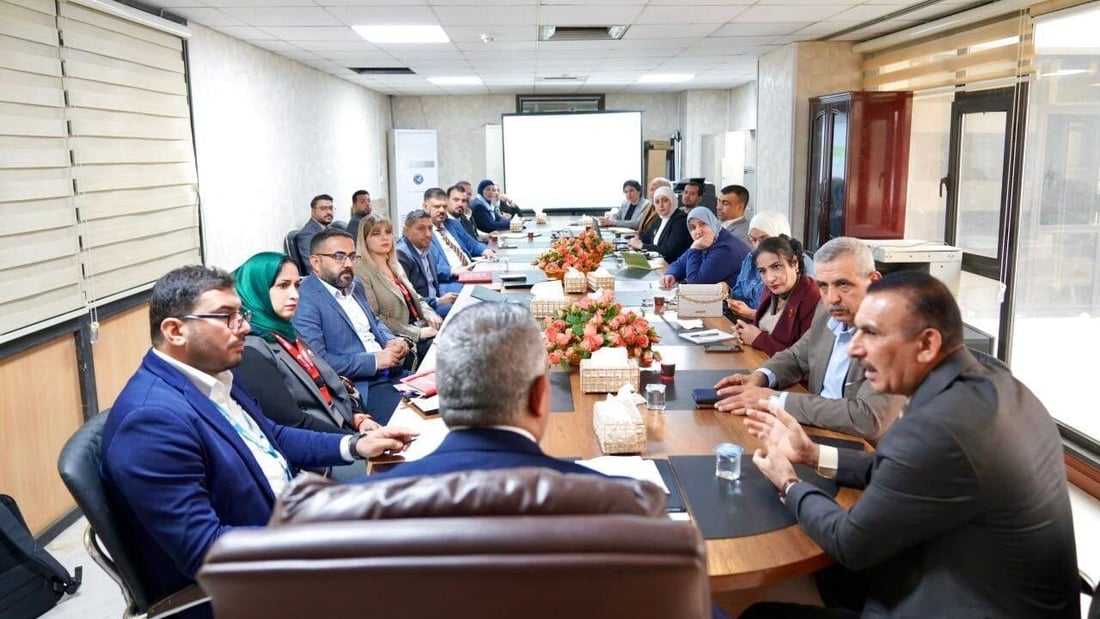
Education Ministry officials meet with representatives from international organizations to prepare the launch of a three-year campaign aimed at returning out-of-school children to classrooms.
Iraq’s Education Ministry launches plan to return 42,000 children to classrooms
BAGHDAD — The Ministry of Education said Sunday it plans to return 42,000 out-of-school children to classrooms over the next three years through a new project called “Opportunity for Access to Education,” launched in partnership with international organizations.
In a statement, the ministry said the campaign will be implemented with Save the Children International and supported by the “Educate a Child” program. It will target children who have dropped out or never enrolled in schools across Baghdad, Nineveh, Kirkuk, Anbar, Salah al-Din, Muthanna and Diwaniyah.
The plan aims to enroll 13,000 children in the first year, 19,000 in the second and 10,000 in the third. According to the statement, 60% of places will be allocated for boys and 40% for girls, with 10% of positions reserved for children with disabilities.
The ministry said details were finalized during a preparatory meeting attended by senior officials including general director of financial affairs Ahmed Abbas Rashk, general director of assessments and exams Naama Harbi, general director of educational supervision Dr. Raad al-Jubouri, Save the Children director of operations and programs Rojan Abdul Habib, a UNICEF representative and other partners and directorate officials.
Iraq has struggled with high dropout rates, a problem deepened by years of conflict, displacement and damage to school infrastructure, especially in areas previously controlled by ISIS. Many children were unable to return to school because of violence, economic hardship or the destruction of school buildings, leaving long gaps in their education.
To address this, the government launched a national return-to-school campaign in partnership with UNICEF, starting in Nineveh and expanding to other governorates with high dropout levels. Officials say the program has brought more than 261,000 children back into the education system, far above its original target of 156,000.
UNICEF has supported the effort by studying the root causes of dropout and training nearly 3,000 education workers across Baghdad and other regions.
Earlier this year, Prime Minister Mohammed Shia al-Sudani approved a five-year extension of the campaign, which the government describes as a core part of its long-term strategy to reduce dropout nationwide. A specialized committee working under his direction continues to coordinate with governors, education authorities and local officials to adapt measures to each area.