
No restart date
Khor Mor still unable to produce any gas after attack, Dana Gas says
SULAYMANIYAH — UAE-based Dana Gas said Saturday that the attack-hit Khor Mor gas field in Sulaymaniyah governorate cannot produce any gas, rejecting what the company called incorrect statements by some local media about the facility’s condition.
A company spokesperson said in a statement that the facility had suffered heavy damage, as official sources had already announced, and that it was unable to produce any quantity of gas at present.
The statement asked media outlets to avoid irresponsible coverage and baseless predictions and analysis. It did not say when repairs could begin or when production might resume.
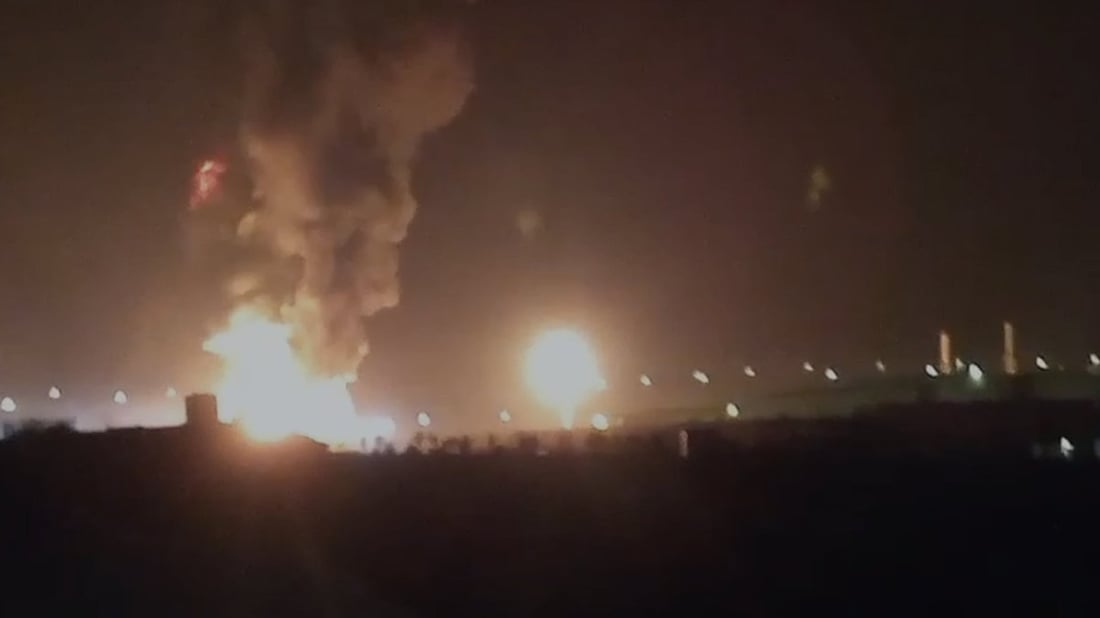
A suspected drone attack late Sunday, Nov. 8, set off a fire and halted the gas that feeds the Kurdistan Region’s power stations, knocking nearly 3,000 megawatts off the grid and cutting power in parts of Erbil, Duhok and Zakho. No group has claimed responsibility.
On Monday Dana Gas said the fire had been put out and no staff were hurt, and that production would stay suspended while it assessed the damage. By then the Region’s power loss had eased to about 1,000 megawatts, 964media found.
Grid power fell to three to four hours a day right after the attack and has since been raised to six to seven hours, Omed Ahmed, spokesperson for the Kurdistan Regional Government’s Electricity Ministry, told 964media. On the night of the attack, the ministry said it was turning to the hydropower stations at the Dukan and Darbandikhan dams and to plants that can run on other fuels.
The attack also hit the field’s loading depot for liquefied petroleum gas, the household gas used for cooking and heating, which loads 1,500 metric tons a day, field sources told 964media. At the request of the KRG’s Ministry of Natural Resources, Prime Minister Ali al-Zaidi on Monday ordered the federal Oil Ministry to supply the Region’s household gas until Khor Mor resumes production.
Zaidi on Wednesday ordered investigators to speed up their final report on the attack and called for legal action against anyone proven to be involved. A day earlier, Sabah al-Numan, spokesperson for the commander-in-chief of the armed forces, said authorities had identified where the attack was launched from and who was involved. He gave no details.
Basim al-Badri, head of the National Security Service, said at a Chatham House event in London on Wednesday that the government had indicators about the attack and that he had information on its nature and path, which he would leave to the investigating committees. Asked about media reports on where the drones were launched from, he said such reports could not be relied on, since one could just as well say a Kurdish or a foreign party was behind the attack. On Thursday the service’s spokesperson, Arshad al-Hakim, said in a statement that Badri had been giving a hypothetical example, not an accusation or a finding of the investigation.
Khor Mor, in the Qadir Karam subdistrict of Sulaymaniyah governorate’s Chamchamal district, can process about 750 million cubic feet of natural gas a day. Its operators, Dana Gas and Crescent Petroleum, say it fuels more than 80% of the Region’s electricity generation.
The field has been hit by repeated rocket and drone attacks. A drone strike in April 2024 killed four Yemeni workers, and one on Nov. 26, 2025, set a main storage tank on fire and caused widespread blackouts across the Region.