
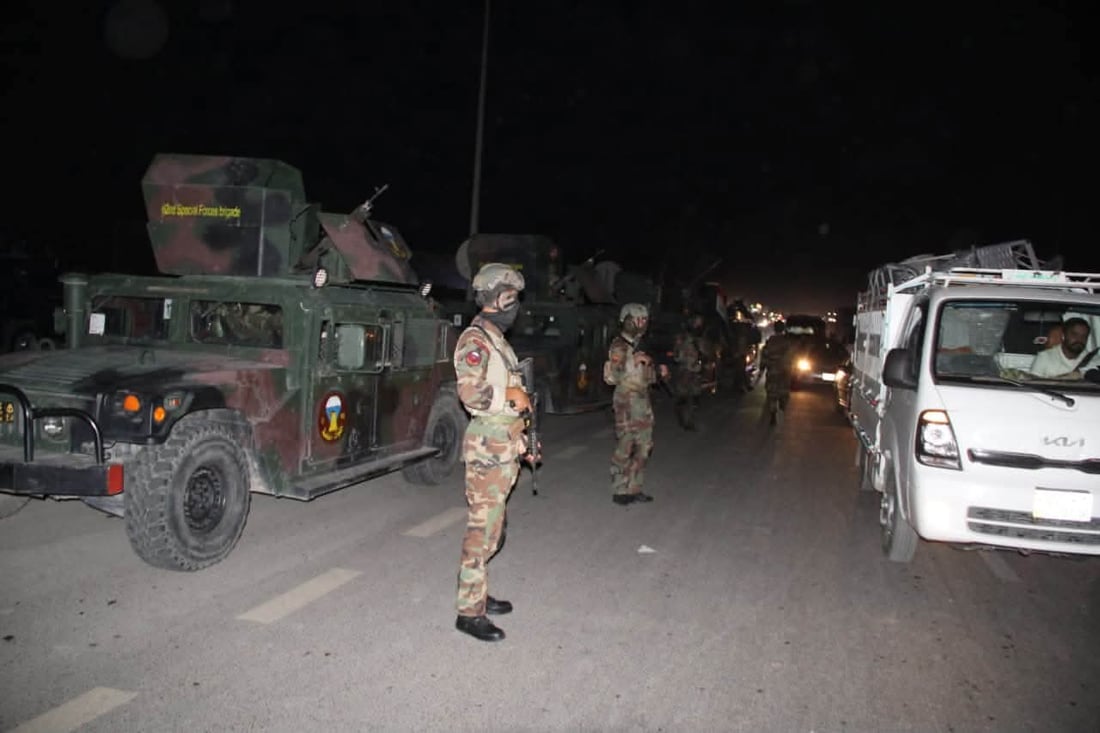
(Photo: the Baghdad Operations Command)
Tense night in Baghdad
Maliki rejects ‘internal confrontation’ after Amiri urges militias to ‘delay’ response to airstrikes
BAGHDAD — Nouri al-Maliki’s State of Law Coalition said Friday it backs bringing weapons under state control but not through internal confrontation, after a night in which security forces went on high alert and military reinforcements deployed across Baghdad.
“The position of the State of Law Coalition is clear and consistent: supporting the restriction of weapons to the hands of the state in accordance with the constitution and the law, but in a manner that preserves civil peace and spares Iraq any internal confrontation or bloodshed,” said Hisham al-Rikabi, head of the coalition’s media office, relaying Maliki’s position. “Establishing the authority of the state is not achieved through escalation, but through dialogue, legal measures, and national consensus.”
The statement follows the governing coalition’s declaration on Wednesday that armed activity outside state authority after Sept. 30 would be treated under the Anti-Terrorism Law.
Commanders and senior officers were at the Baghdad Operations Command overnight to oversee the deployment, which followed Prime Minister Ali al-Zaidi’s order to raise combat readiness. The command said security formations had begun taking measures “to ensure speed, precision and discipline in carrying out their assigned duties.” The night was tense in Baghdad and several other governorates. Authorities have not said what prompted the alert.
In a late overnight message, Badr Organization leader Hadi al-Amiri urged Iran-aligned factions to hold off on any response to last month’s U.S.-Saudi airstrikes. In a recorded video circulated by Badr-affiliated platforms, he appealed to “my sons and brothers in the Islamic Resistance in Iraq” to delay “any response to the American-Saudi aggression that targeted Iraq” and endure the pain in Iraq’s higher interest. “We promise all the fighters that we will pursue the rights of the martyrs and the wounded through diplomatic means, and we will achieve all of that,” he said. Amiri leads one of the largest factions inside the Popular Mobilization Forces and demanded a review of all Iraq’s agreements with the United States after the strikes.
Factions said after the strikes that their response would come once Arbaeen ended. The pilgrimage fell on Tuesday. Kataib Hezbollah said Monday it would keep and expand its weapons rather than hand them over, and along with Harakat al-Nujaba and Kataib Sayyid al-Shuhada has refused to join the disarmament plan. Asaib Ahl al-Haq, Saraya al-Salam and the Imam Ali Battalions have moved to comply.
U.S. and Saudi aircraft struck Popular Mobilization Forces sites in Baghdad, Wasit, Nineveh, Basra, Kirkuk, Karbala and Diyala in late July, killing at least 20 members and wounding 32, according to the force. U.S. Central Command said the strikes hit weapons-storage and logistics sites linked to Iran-backed groups after more than 30 drone attacks it attributed to Iran’s Revolutionary Guard.