
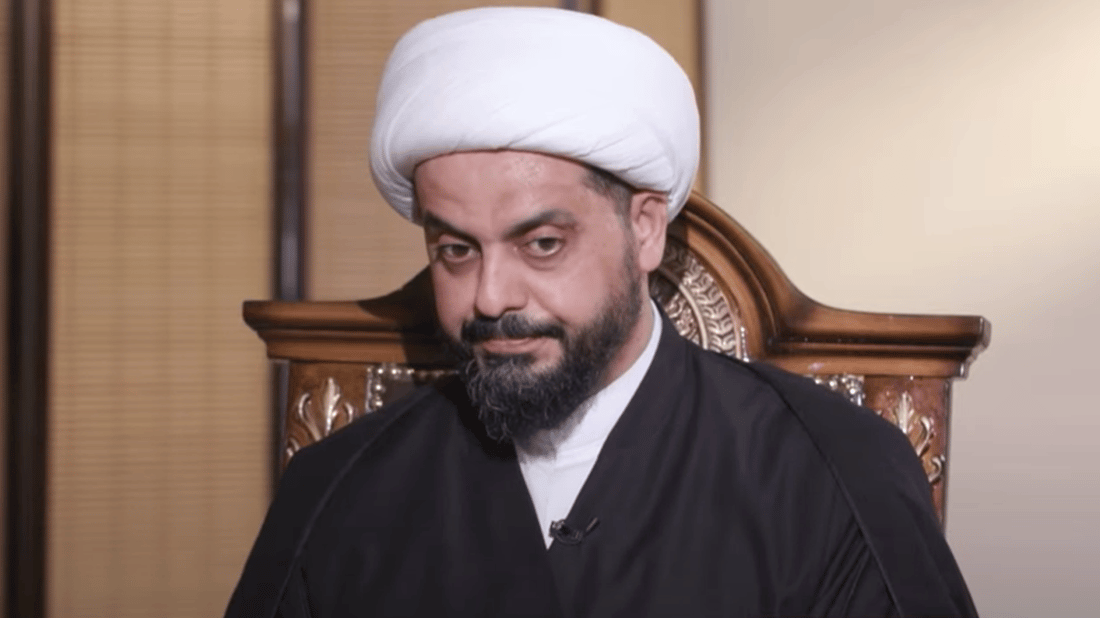
Qais Al-Khazali, leader of Asa’ib Ahl Al-Haq Movement
Asaib bloc demands one account of why Iraq shut Iran crossing
BAGHDAD — Asaib Ahl al-Haq’s Sadiqoun parliamentary bloc on Sunday demanded a single official explanation for closing the al-Sheib crossing with Iran, saying the foreign minister’s account of a U.S. request contradicted the reasons the government gave earlier.
Foreign Minister Fuad Hussein told Al Jazeera on Saturday that the United States had formally asked Iraq to close all its border crossings with Iran except two. He did not name the two crossings or say how Baghdad had responded in the excerpts the Qatari broadcaster released, and the government had not commented publicly on his account by Sunday afternoon. Al Jazeera said it would air the full interview on Sunday.
“The decision to open or close border crossings is a sovereign Iraqi decision, taken according to Iraq’s interests, security and economy, not according to the wishes of any external party,” the bloc said in a statement.
The bloc said Hussein’s announcement meant the government had to give one official account of why it closed al-Sheib, in Maysan governorate, because its earlier explanations had cited technical and security reasons. “The contradiction in the statements between the government and the foreign minister raises many questions that need a clear explanation from the government,” it said.
When the government shut al-Sheib to goods and travelers on Oct. 21 on Prime Minister Ali al-Zaidi’s instructions, it gave other reasons. Government spokesperson Haider al-Aboudi said the crossing’s technical and logistical facilities needed upgrading. Government adviser Abdul Amir Taiban said the closure was meant to stop drugs and counterfeit currency, and he ruled out U.S. pressure.
A Sadiqoun official had already linked the closure to Washington. Hussein al-Shihani, a member of the Sadiqoun Movement’s political bureau, told Kurdistan24 on Oct. 22 that Zaidi had proposed closing the crossings with Iran at the U.S. request. He said Zaidi made the proposal at a meeting of the Coordination Framework, the ruling alliance of Shiite parties, and that the alliance’s leaders rejected it.
In Sunday’s statement, the bloc said it supports controlling the borders and preventing every kind of smuggling. But that did not call for an open-ended closure paid for by traders, drivers and residents of Maysan and other southern governorates, it said. It urged the government to announce a clear timetable for reopening the crossing once the required procedures are complete, and to give redress to those hurt by the closure.
“We are keen that Iraq’s borders and crossings do not become an arena for settling scores between others,” the statement said. The bloc said it would pursue the issue in parliament using its constitutional powers.
Sadiqoun is the political wing of Asaib Ahl al-Haq, which is led by Qais al-Khazali and belongs to the Framework. Asaib sits in Zaidi’s government: Khazali’s brother, Laith al-Khazali, is a deputy prime minister. The United States designated Asaib a Foreign Terrorist Organization in 2020, and both brothers are under U.S. terrorism sanctions.
Earlier on Sunday, the Badr parliamentary bloc rejected U.S. demands to close most of the crossings and urged Zaidi’s government to reopen the closed crossings immediately and stand up to foreign pressure. It also rejected any Iraqi part in measures aimed at isolating Iran economically. “We categorically reject Iraq becoming an instrument in a project to besiege the Muslim Iranian people,” the bloc said. Badr, led by Hadi al-Amiri, is also part of the Framework.
On Oct. 27, Maysan Provincial Council Chairman Mustafa Idair al-Muhammadawi, an Asaib leader, was arrested on Zaidi’s complaint and freed hours later. The arrest was over his threat of civil disobedience unless al-Sheib reopened. In a message after his release, he thanked Qais al-Khazali, the judiciary, Maysan Governor Habib Zaher al-Fartousi and his fellow council members, and said he would keep defending the governorate’s rights.
No reopening of al-Sheib had been announced by Sunday.