
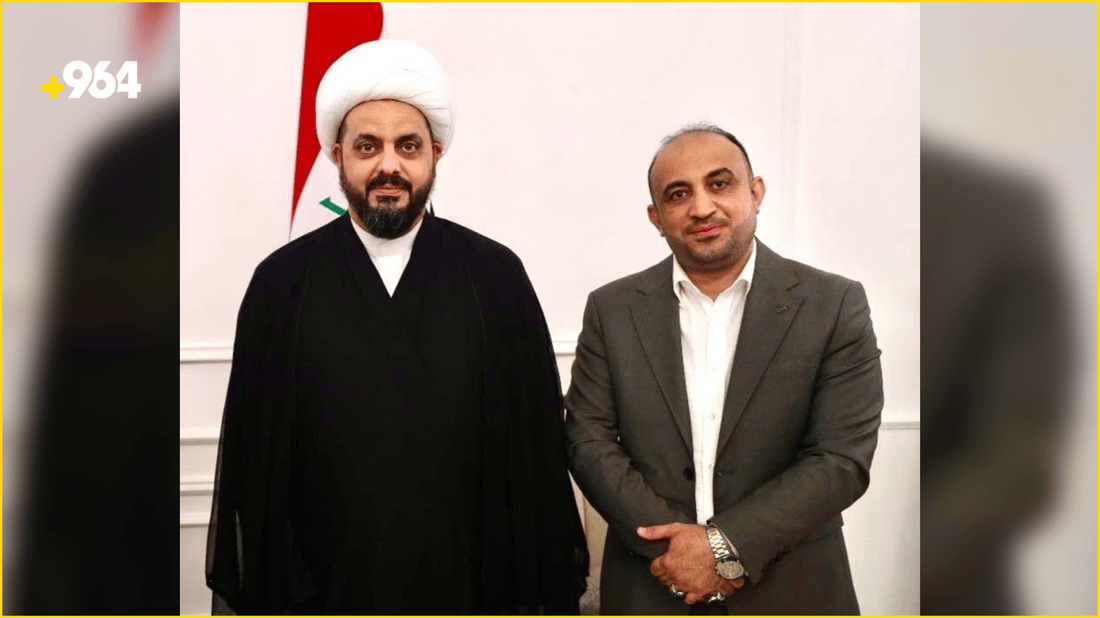
Maysan Provincial Council Chairman Mustafa Idair al-Muhammadawi (right) with Asaib Ahl al-Haq leader Qais al-Khazali.
Maysan council head freed hours after arrest over Iran-Iraq border comments
BAGHDAD — The Iraqi judiciary on Tuesday released Maysan Provincial Council Chairman Mustafa Idair al-Muhammadawi hours after his arrest over his threat of civil disobedience unless the al-Sheib border crossing with Iran reopens.
He was arrested on a warrant issued on Monday on a complaint from Prime Minister Ali al-Zaidi. The judiciary freed him after he complied with the relevant legal procedures, the provincial council said in a brief statement that gave no further details. He had been held for several hours, the council’s office said. The statement did not say whether he was released on bail or whether the case against him remains open.
In a message after his release, Muhammadawi thanked Asaib Ahl al-Haq leader Qais al-Khazali, the judiciary, Maysan Governor Habib Zaher al-Fartousi and his fellow council members. What he had borne in defending the governorate’s rights was a national duty, he said, and he would keep defending them.
“Thanks to His Eminence the secretary-general, Sheikh Qais al-Khazali, may God protect him, and thanks to the just judiciary,” Muhammadawi said. Khazali is under U.S. sanctions.
Late on Monday, Muhammadawi had said in a statement that he would appear before the judiciary himself, and he asked the prime minister not to send the Maysan Operations Command to arrest him. “I am not a criminal or an outlaw. Rather, I represent the legislative authority in Maysan governorate, and I am a statesman and the son of a large and noble tribe, and I belong to a respected political and jihadi group,” he said.
The Third Karkh Investigation Court in Baghdad issued the warrant on Monday over Muhammadawi’s threats to declare civil disobedience and block roads, according to the court’s decision, which 964media has seen.
Copies of the decision published online cite the second clause of Article 224 of Iraq’s Penal Code. It covers anyone who uses violence, threats or other unlawful means to force the prime minister, a minister or a lawmaker to take, or refrain from, an action within their legal powers. The penalty is more than five years and up to 15 years in prison.
Zaidi ordered an investigation into Muhammadawi on Monday over remarks he made on Sunday, which the prime minister’s media office said included a threat to declare disobedience if the demand to reopen the crossing was not met, as well as ‘inappropriate language.’
Muhammadawi joined dozens of truck drivers protesting the closure in Maysan on Sunday and threatened to cut the governorate off from the rest of Iraq if the roads through al-Sheib were not reopened by Thursday, Oct. 29. The council would not stay silent over what he called an attack on the livelihoods of Maysan’s people, he said.
Lawmakers from the blocs of two former prime ministers backed the warrant. Diaa al-Zaidi of Mohammed Shia al-Sudani’s Reconstruction and Development Coalition called it a fair step to assert the state’s authority and shut the door on political point-scoring. “We are not a tribal system, and we do not live in a jungle or in chaos,” he told Dijlah TV host Hussam al-Hajj on Monday.
Diaa al-Zaidi said he had personally asked for Muhammadawi to be summoned and questioned in parliament, and called for his dismissal followed by legal action by the judiciary. He also said smugglers moved weapons, banned goods, money and even people through about 22 unofficial crossings across Iraq. He gave no evidence for the figure.
Falah al-Khafaji of Nouri al-Maliki’s State of Law Coalition, also speaking to Hajj, praised the government’s quick action. “What we saw from the head of the Maysan Provincial Council is a dangerous turning point, and we thank God that the government took legal measures against him,” he said.
The prime minister is responsible for all 19 governorates and knows best how to run the border crossings, Falah al-Khafaji said. Leaving such decisions to the governorates would make the country collapse overnight, he claimed.
Others challenged the case. Two members of the provincial council objected in separate statements on Monday. Hussein Ali al-Muryani said the independence of provincial councils was a constitutional red line and “not a favor from anyone.”
He cited Article 122 of the constitution, which says a governorate council is not subject to the control or supervision of any ministry or any institution not linked to a ministry. No one is above the law, Muryani said, but legal accountability does not give any body powers the constitution has not granted.
Ali Jasib al-Zaidawi said Muhammadawi’s call to reopen the crossing answered residents’ appeals as prices rise. The constitution and the governorates law make provincial councils answerable to parliament alone, he said.
Lawmaker Mohammed Jassim al-Khafaji of the Ishraqat Kanoon bloc said in a Facebook post that the prime minister has no authority to investigate an elected oversight body. Any unlawful act by the chairman is for council members to deal with, since they can dismiss him by an absolute majority, he said. He has formally asked Speaker Haibat al-Halbousi to invite Muhammadawi to parliament to discuss the investigation and the effects of the closure.
The Badr parliamentary bloc on Monday urged the government to reopen al-Sheib quickly, warning that the closure could deepen public anger in Maysan and the loss of trust between the governorate and Baghdad. Any technical, security or administrative failings should be fixed and violators held to account under the law, rather than shutting a vital crossing, the bloc said in a statement.
The bloc rejected what it described as double standards in running the borders, saying the law must apply equally to all official and unofficial crossings, including those in the Kurdistan Region where violations or smuggling have been reported. It also rejected accusations against Maysan and its people in security cases without clear evidence, citing claims over the attack on a Saudi oil pipeline. Iraqi authorities said in September that the drones that struck Saudi Arabia’s East-West pipeline on Sept. 11 were launched from Maysan.
Badr called on the parliamentary committee following the al-Sheib issue to publish its findings, say who is responsible for the continued closure and set a timetable for reopening.
Truck drivers began a sit-in near the crossing on Monday. They said neither the prime minister nor anyone else had the right to close it, and urged Zaidi to close Iraq’s crossings with Jordan, which they called “crossings of extremism,” and to look at the Kurdistan Region’s crossings instead.
State of Law, Badr and Asaib, which sits in Zaidi’s government through its political wing, Sadiqoun, all belong to the Coordination Framework, the dominant alliance of Shiite parties. Muhammadawi, an Asaib leader, was elected council chairman in February 2024.
Al-Sheib, in Maysan in the southeast, closed to goods and travelers on Oct. 21 on Zaidi’s instructions, until further notice. Government spokesperson Haider al-Aboudi said its technical and logistical facilities needed upgrading, while government adviser Abdul Amir Taiban said the aim was to stop drugs and counterfeit currency from entering Iraq.
The newspaper Al-Mada reported on Tuesday, citing unnamed sources, that Washington had agreed to let Baghdad close one crossing with Iran instead of five. In return, Iranians arriving through Iraqi airports, and their money and luggage, would remain under strict checks reported to the U.S. Treasury, the newspaper said. The government has not commented on the report.