
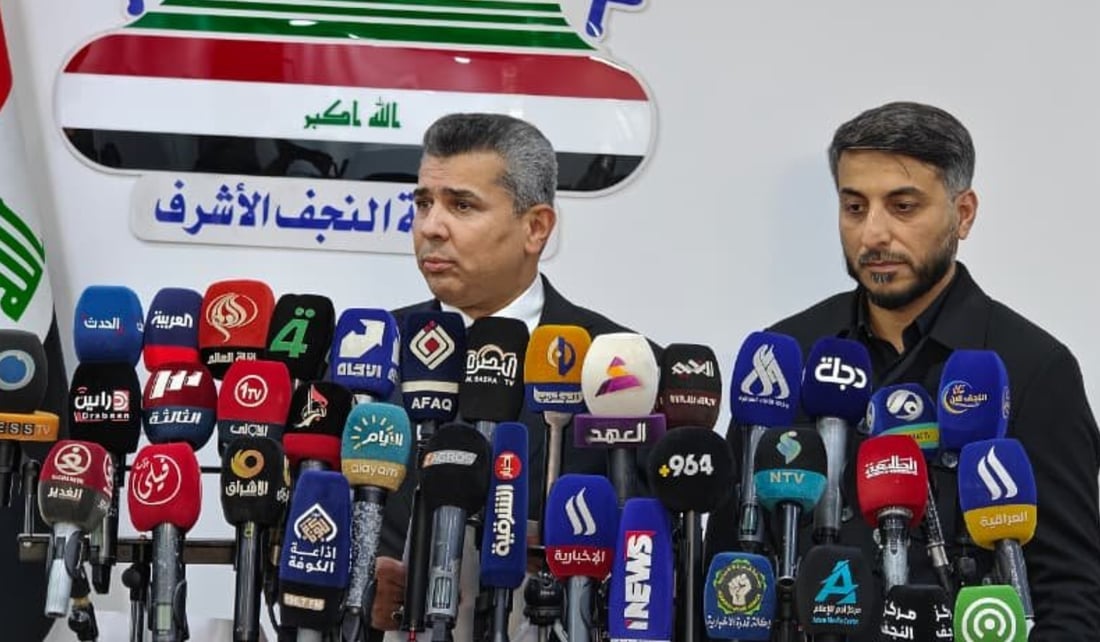
Security Media Cell chief Saad Maan, left, and Najaf Governor Youssef Kanawi speak at a news conference in Najaf outlining preparations for the funeral procession of Iran’s late Supreme Leader Ali Khamenei.
Iraq completes preparations for Khamenei funeral procession
BAGHDAD — Iraqi authorities have completed preparations for the funeral procession of Iran’s late Supreme Leader Ali Khamenei in the holy cities of Najaf and Karbala, with officials saying there will be no restrictions on who can attend.
Saad Maan, head of Iraq’s Security Media Cell, announced the completion of the plans at a joint news conference with Najaf Governor Youssef Kanawi, saying a higher committee had been formed to oversee the security and organizational arrangements.
Maan said the official reception will begin Tuesday at Najaf International Airport, where Iraqi officials and a high-level Iranian delegation are expected to attend.
Khamenei was killed on Feb. 28 in a U.S.-Israeli airstrike that targeted senior Iranian leaders in Tehran at the start of the 2026 war. His body is being brought to Iraq as part of a multi-city funeral that has passed through Tehran and Qom before the Najaf and Karbala ceremonies, with burial to follow in Mashhad, his Iranian birthplace.
Kanawi said Najaf is fully prepared to receive mourners and organize the event, with the capacity to accommodate large numbers of visitors. He said the governorate had arranged two programs: an official ceremony Tuesday at the airport, attended by the heads of the executive, legislative and judicial authorities alongside political bloc leaders, the Coordination Framework and members of parliament, and a public procession beginning at 6 a.m. Wednesday from the overpass near Al-Sadr Hospital on Airport Road, passing through Najaf’s old city before ending at the Imam Ali Shrine.
Maan said security agencies and Army Aviation have held continuous meetings to coordinate the operation. The procession in Najaf will run about 6 kilometers from the Al-Sadreen overpasses to the Imam Ali Shrine, with residents opening their homes along the route to receive mourners. The route in Karbala will extend 5.8 kilometers. A total of 751 Husseini processions are expected to take part across the two cities, with the number likely to rise.
More than 600 Arab and international journalists are expected to cover the event, alongside more than 3,000 Iraqi, Arab and foreign media workers, Maan said.
Authorities have installed 2,500 surveillance cameras and set up 23 live broadcast centers, he said. The health plan assigns 150 ambulances to Najaf and Karbala, and a special traffic plan has been prepared for the two governorates and neighboring areas to keep traffic moving during the funeral.
Preparations have drawn support from across the country. Basra Governor Asaad al-Eidani allocated 150 buses to carry mourners from Basra to Najaf and back, his media office said Sunday, while the Popular Mobilization Forces sent service and engineering vehicles to Najaf and Karbala on Saturday to help with logistical preparations.
The funeral follows days of coordination between Iraqi and Iranian authorities. On Friday, the Security Media Cell announced that no nationwide curfew would be imposed and that traffic restrictions would be limited to the designated procession routes. Iraqi authorities also declared Thursday a public holiday for Ashura, while Iranian Foreign Minister Abbas Araghchi traveled to Baghdad to coordinate arrangements. Senior Iraqi officials later visited Tehran for memorial events before the body’s transfer to Iraq.