
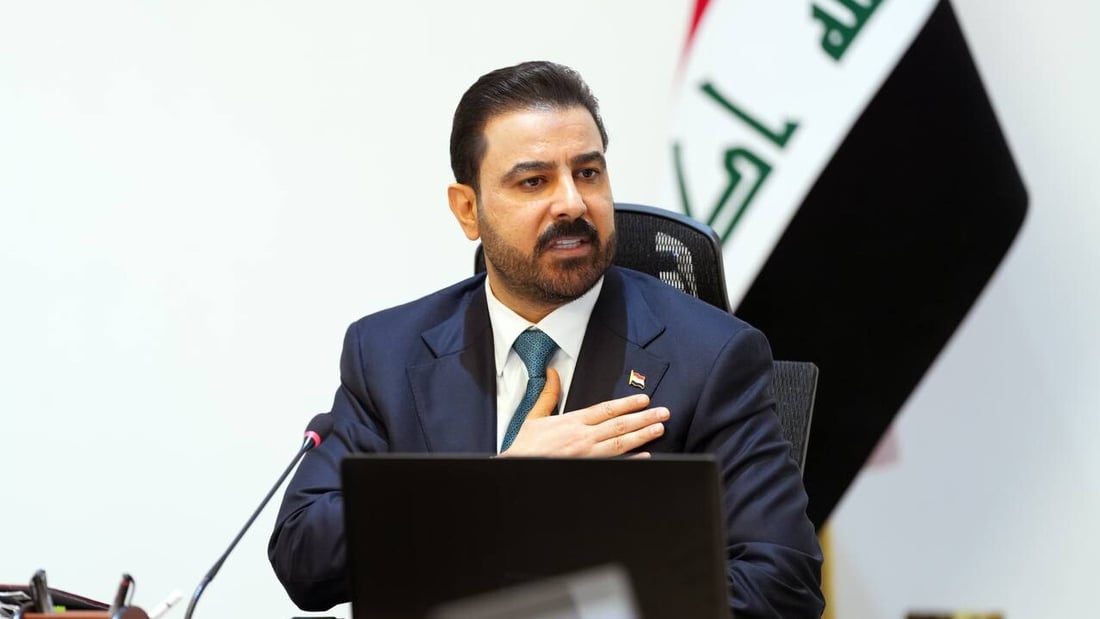
Prime Minister Ali al-Zaidi
Media Monitor
Zaidi ‘regrets’ taking office but will confront factions, lawmaker says he was told
BAGHDAD — Prime Minister Ali al-Zaidi told a parliamentary committee he regrets taking office and will confront armed factions that refuse to hand over their weapons after Sept. 30, according to a member of that committee, in an account the prime minister’s office has not confirmed.
“If I could go back three months, I would not have taken the premiership, but I will proceed with the confrontation after Sept. 30 if the weapons are not handed over, even if I am torn limb from limb,” Othman al-Shaibani quoted Zaidi as telling the Security and Defense Committee. Shaibani, a State of Law lawmaker, gave the account in a television interview.
He said Zaidi complained that some factions respect neither the prime minister nor state authority, and had found brigades listed on paper whose personnel could not be located, with reports later placing some of them at deer-breeding farms. Zaidi told the committee he came into politics as an economy man rather than a security figure, Shaibani said, and found that economic projects kept running into weapons outside state control. He cited the case of a woman and her daughter who came to him after an armed group seized their land, saying he could do nothing to protect them.
Shaibani said he advised the prime minister to establish who would be involved in any confrontation and what weapons they hold before acting, and to build political and social support through tribal sheikhs and the religious establishment first. Some of the weapons are held by groups operating inside state structures, he said, including from official offices and military convoys in Baghdad. He warned that leaving the issue unresolved could expose Iraq to international measures affecting oil revenues, financial transfers and salaries.
He named Kataib Hezbollah, Harakat al-Nujaba, Kataib Sayyid al-Shuhada and Ashab al-Kahf as the factions refusing to disarm, and said the government’s approach would offer them a choice between entering politics with their forces folded into state institutions, or facing possible U.S. and international intervention. American demands focus on handing over drones and on a process of disengagement under which field brigades would report directly to the commander-in-chief rather than to faction leaders, he said.
State of Law leader Nouri al-Maliki met Zaidi recently and argued for allowing time to negotiate, warning against measures that could leave the political system worse off and risk a regional confrontation, according to Shaibani.
Zaidi took office on May 16 and has set Sept. 30, when the U.S.-led coalition mission ends, as the date for bringing all weapons under state control. Saraya al-Salam, Asaib Ahl al-Haq and the Imam Ali Battalions have moved to comply. A parliamentary bloc affiliated with Kataib Hezbollah said this week it expects the disarmament law to fail, with its MP describing full American withdrawal — the condition it sets for handing over weapons — as impossible to achieve.